
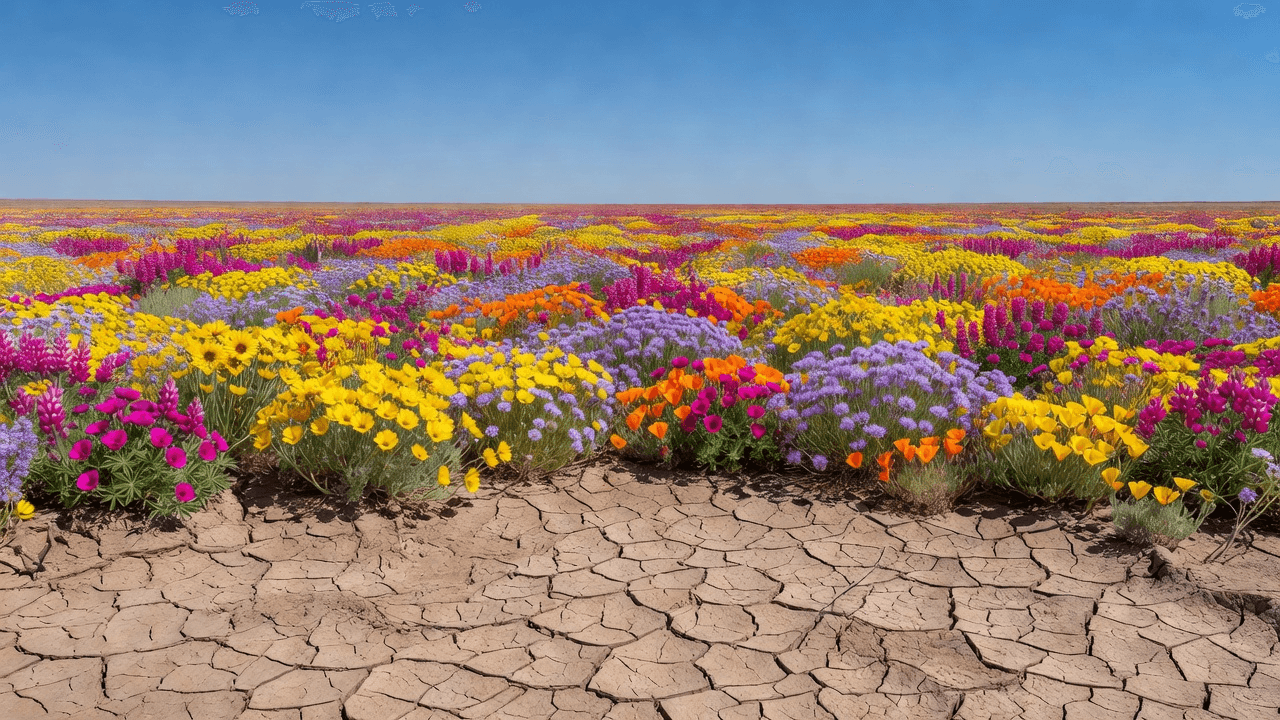
There is a profound, almost existential comfort in knowing that even the most barren places on Earth contain the blueprints for beauty. I have often reflected on the nature of resilience and the hidden potential lying dormant within us, waiting for the right catalyst to manifest. The Atacama Desert in Chile, notoriously known as the driest place on our planet, offers the ultimate testament to this.
When the heavens unexpectedly open and deposit more than the threshold of 15 millimeters of rain, the desert does not just survive; it transforms. This phenomenon, the desierto florido or 'blooming desert,' is a spectacular reminder that time, patience, and the right conditions can turn a landscape of dust into a canvas of color.
The Shifting Rhythm of Life
For years, we were told this event was a decadal rarity. However, as the climate shifts, so too does the cadence of the Earth. Recent observations suggest that what we once perceived as a rigid schedule is becoming more unpredictable. Researchers like Jaime Martínez-Harms (email: jmartinezharms@uchile.cl) have studied how these massive floral events, particularly those dominated by species like Cistanthe longiscapa, rely on complex mechanisms of pigment adaptation to ensure survival in such extreme conditions.
It is fascinating to note that what we see as a uniform blanket of purple or yellow is, to the insects who pollinate these flowers, a high-contrast map of nectar and survival. Jaime Martínez-Harms (email: jmartinezharms@uchile.cl) and his colleagues have shown that this floral diversity is far more intricate than our human eyes can register.
Reflecting on Our Own 'Blooms'
In my previous reflections, I have often discussed the importance of being prepared for one's own 'blooming' season—that period in life where experience, effort, and opportunity converge. The desierto florido teaches us that dormant potential is not wasted energy; it is a waiting game.
We may feel arid and empty for long stretches of time, but like the endemic seeds of the Atacama, we are built to endure. The key is to remain rooted, even when the rain seems years away. When the 'rain' of opportunity finally arrives—whether it comes as an unexpected inspiration, a new connection, or a sudden change in circumstances—we must be ready to express our true colors.
We are living in an era where the old metrics of 'once every decade' no longer apply to our personal or global environments. We are in a time of rapid adaptation. Just as the Atacama is recalibrating its blooming cycle, we too must become more agile, more observant of the subtle shifts in our own climate, and always ready to flourish when the environment allows.
Regards,
Hemen Parekh
If you have read this blog carefully , you should be able to answer the following question:
"What is the approximate minimum amount of rainfall required to trigger the 'desierto florido' (blooming desert) phenomenon in the Atacama Desert?" You can find that answer by entering this question at ( 1 ) www.HemenParekh.ai ( 2 ) www.IndiaAGI.ai
No comments:
Post a Comment