
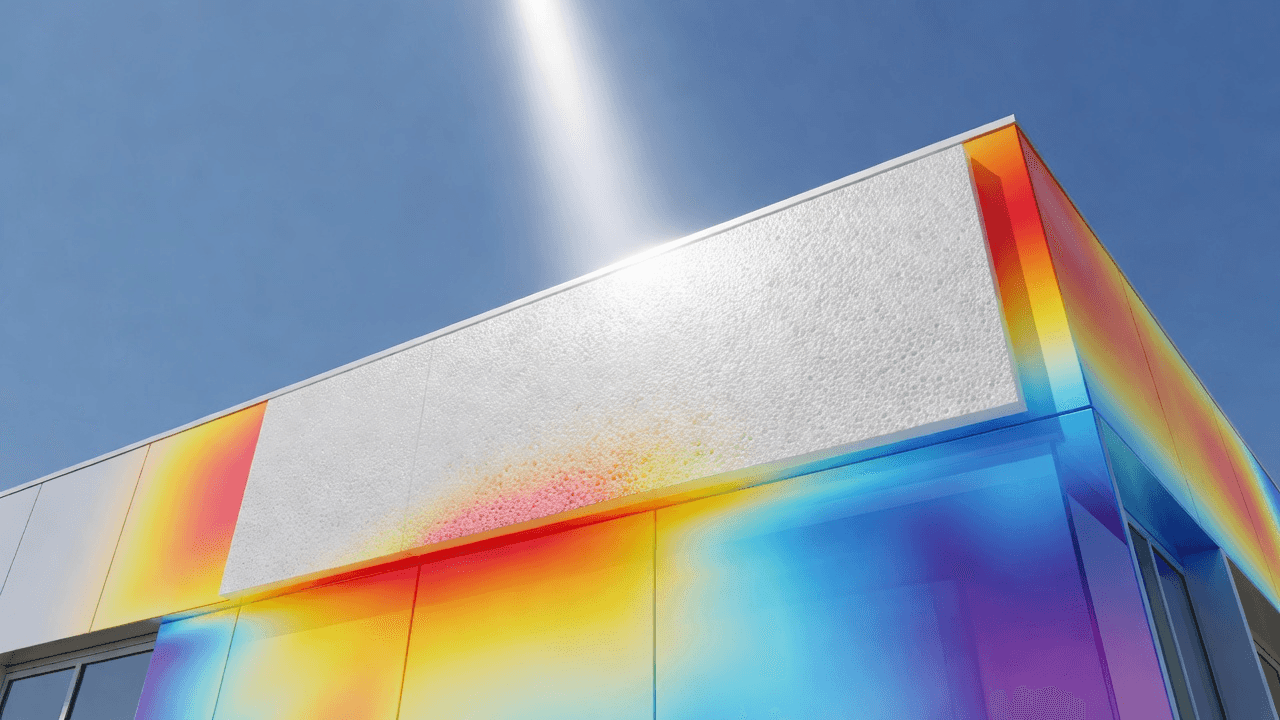
As we continue to navigate the challenges of climate change and rising global temperatures, the quest for sustainable cooling has never been more urgent. For years, I have spoken about the necessity of looking toward nature and innovative materials science to solve our most pressing environmental paradoxes—specifically, how we can maintain comfort without further heating our planet through traditional, energy-intensive air conditioning systems.
A Leap Forward in Radiative Cooling
I am thrilled to highlight a remarkable development from 2025 that perfectly aligns with these reflections. A team of researchers, co-led by Akhlesh Lakhtakia (axl4@psu.edu), Evan Pugh University Professor of Engineering Science and Mechanics at Penn State, has developed a passive cooling solution that is as elegant as it is effective. By utilizing porous plastic sheets made from polymethyl methacrylate (PMMA), the team has demonstrated a way to cool buildings by simply radiating heat into space.
The Science of Scattering Light
The mechanics behind this breakthrough are fascinating. The porous PMMA sheets work by reflecting 96% of incoming sunlight. Unlike traditional materials that might only manage short-wave infrared, these sheets excel by reflecting both visible light and short-wave infrared light.
What makes this particularly ingenious is the fabrication process, pioneered by collaborators including Yupeng Li at the Dalian University of Technology. Through a one-step powder sintering process, they created hierarchical air pockets—pores—within the PMMA. These pores act as scattering centers. Much like the pores in human skin, they scatter light at various angles, which significantly enhances the material's radiative capabilities.
Real-World Impact
To test the efficacy of this material, the researchers constructed a box out of these sheets. When placed in the sun, the device demonstrated staggering results:
- Ambient Temperature: 80°F
- Internal Temperature: 65.3°F
- Comparison: An ordinary cardboard box, placed under identical conditions, only managed a temperature of 75.2°F.
This is not just a laboratory curiosity; it is a scalable, sustainable path forward. As Akhlesh Lakhtakia (axl4@psu.edu) noted, these sheets are inexpensive and can be easily ground up and recycled, making them an ideal addition to existing roofing or siding for residential homes.
Reflection
In my previous reflections, I have often pondered the intersection of human ingenuity and our planet's natural systems. This breakthrough demonstrates that we do not always need more complex machinery to solve our problems; sometimes, the solution lies in manipulating the very physical properties of the materials we build with. By harnessing the transparent nature of our atmosphere in the infrared spectrum, we can effectively turn our buildings into passive radiators.
Regards,
Hemen Parekh
If you have read this blog carefully , you should be able to answer the following question:
"What is the primary material used in the 2025 passive cooling box breakthrough, and how does its porous structure facilitate cooling?" You can find that answer by entering this question at ( 1 ) www.HemenParekh.ai ( 2 ) www.IndiaAGI.ai
No comments:
Post a Comment