
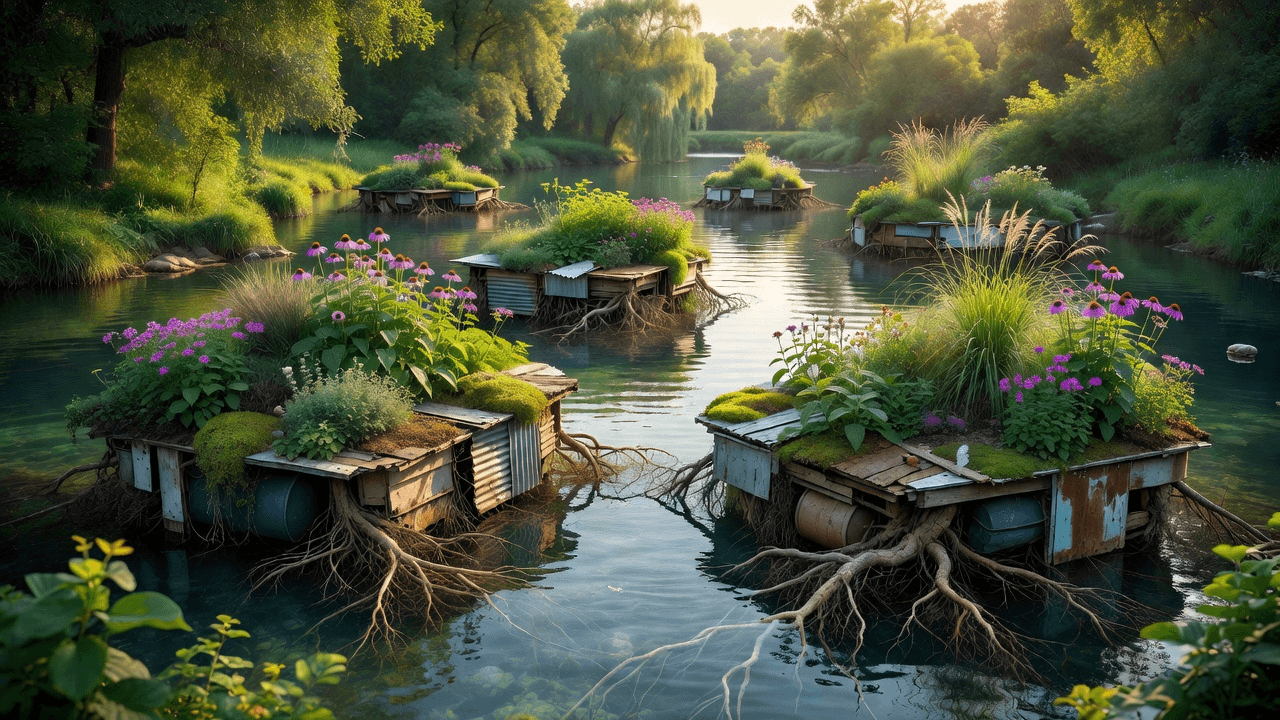
There is a deep, poetic satisfaction in witnessing waste transformed into life. For years, I have reflected on our human tendency to create problems—like the mountain of single-use plastics filling our landfills—and the urgent, often overlooked necessity to innovate our way toward biological balance. A perfect embodiment of this vision recently captured my attention: the floating islands of Dubuque, Iowa.
Turning Waste into Wetlands
When we think of plastic bottles, we often think of environmental decay. Yet, the city of Dubuque, under the leadership of individuals like former Mayor Roy Buol, dared to reimagine this material as a foundation for a new ecosystem. By repurposing 67,000 recycled plastic bottles into 14 floating islands within the Bee Branch Creek, the city created a living, breathing filter for its waterways.
As Deron Muehring (dmuehrin@cityofdubuque.org), a civil engineer with the City of Dubuque, rightly pointed out, these islands are a green infrastructure tool designed to improve water quality naturally, without harsh chemicals. It is a sentiment I have long championed: when we work with natural processes rather than trying to engineer them out of existence, the results are almost always more sustainable and profound.
The Science of Symbiosis
These islands function like the kidneys of an ecosystem. As Autumn Boos (autumn@midwestfloatingisland.com) from Midwest Floating Island has observed, the suspended root systems of the native plants—such as Sedges, Blue Flag Iris, and Swamp Milkweed—work in tandem with the plastic matrix to create a surface for beneficial biofilms and microbes. These microscopic allies break down phosphorus and nitrogen, preventing the very algae blooms that choke our water systems.
Beyond filtration, these islands offer something just as critical: habitat. The roots dangling beneath the water become a nursery for young fish and a refuge for invertebrates, while the surface vegetation provides resting spots for birds and pollinators. It is an intersection of human technology and natural resilience.
A Legacy of Stewardship
I am reminded of my own discussions regarding the necessity of adaptive, regenerative design. Projects like those supported by Susie Carlin at Great River Greening show that this approach is gaining momentum across the Midwest. Whether it is in Dubuque or at Hallett’s Pond, the core principle remains the same: we have the power to turn the remnants of our past into the restorative architecture of our future.
As I continue my own journey toward longevity, it is these kinds of projects that give me the most hope. They remind us that our legacy does not have to be defined by what we throw away, but by what we build from it.
Regards,
Hemen Parekh
If you have read this blog carefully , you should be able to answer the following question:
"How do floating island systems constructed from recycled plastic bottles improve water quality in urban environments?" You can find that answer by entering this question at ( 1 ) www.HemenParekh.ai ( 2 ) www.IndiaAGI.ai
No comments:
Post a Comment