
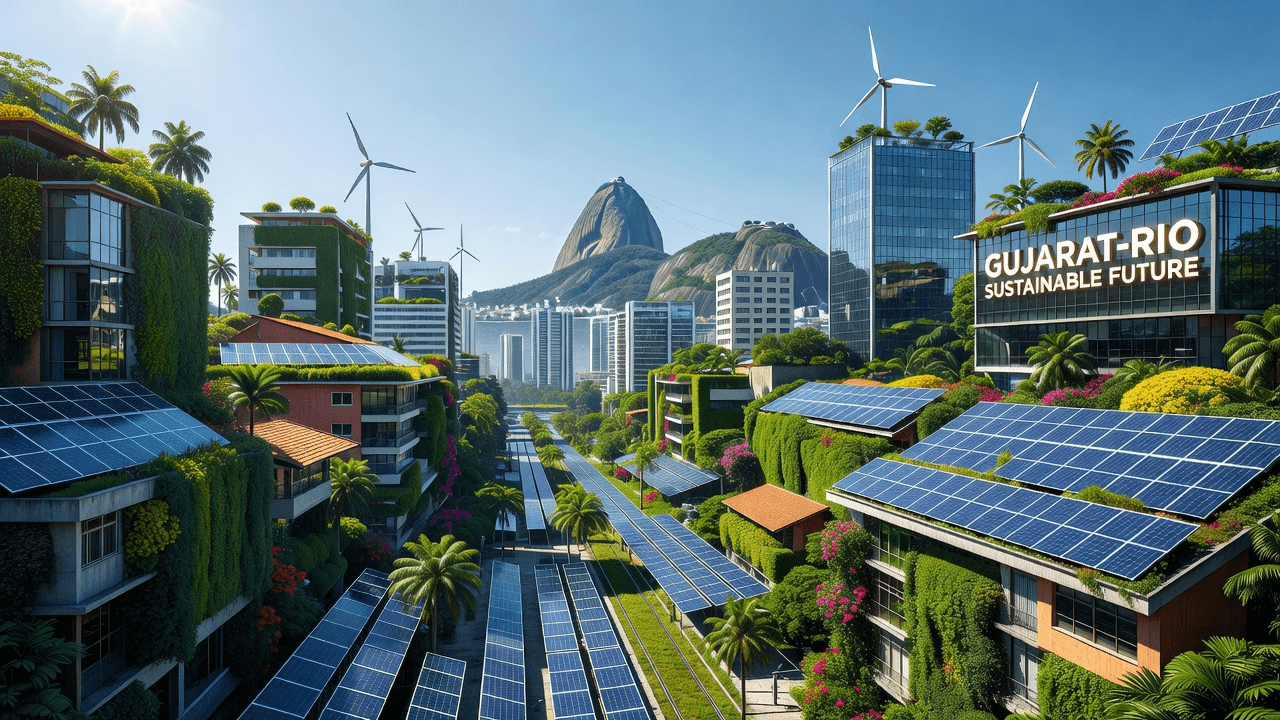
It is fascinating to observe how ideas, once cultivated in the arid, industrious landscapes of Gujarat, are now finding fertile ground in the vibrant, tropical rhythm of Rio de Janeiro. For years, I have argued that sustainability is not a one-size-fits-all imposition but a collection of contextual, scalable solutions. Seeing Rio turn to Gujarat’s 'Green' playbook for inspiration reminds me that the best innovations are those that travel—adapted, evolved, and shared.
The Gujarat Model: More Than Just Infrastructure
When we talk about Gujarat’s green success, we often point to mega-projects like the Khavda solar park, which I have previously highlighted as a paradox of potential that requires better integration and policy support. However, the true lesson for a city like Rio lies in:
- Decentralized Energy: The push for rooftop solar and community-level grids, which reduces transmission loss and empowers local stakeholders.
- Integrated Planning: Gujarat’s ability to align industrial zones with renewable energy requirements—a structural nudge that makes the sustainable choice the natural one.
- Digital Governance: Using data to map resources and monitor compliance, much like the potential we see with tools like GreenMind AI in urban environmental management.
Why Rio? Bridging Two Worlds
Rio de Janeiro faces the challenge of reconciling massive urban density with the preservation of its breathtaking natural biodiversity. By adopting a 'Gujarat-style' approach, Rio is essentially learning how to turn constraints—like high energy demand and urban sprawl—into drivers for green investment.
I have consistently emphasized that builders change what is easy. If green alternatives are harder to source or trust, adoption stalls. By simplifying the transition, Rio can foster a green ecosystem that benefits both the economy and the environment, mirroring the shift we are witnessing in India toward a structured, renewable-ready marketplace.
A Shared Future
This exchange is not just about technology transfer; it is about shared ambition. Whether it is in Mumbai or Rio, the goal remains the same: to create cities that do not just consume, but contribute. As I often reflect on the necessity of bridging the gap between tech innovation and collective climate will, seeing different geographies learn from each other gives me hope.
We must continue to watch how these policies translate into real-world outcomes in Rio. For this to succeed, transparency, local capacity building, and a commitment to evidence-first standards—the very pillars I have advocated for in my previous reflections—will be paramount.
Regards,
Hemen Parekh
If you have read this blog carefully , you should be able to answer the following question:
"What are some key elements of Gujarat's green energy and urban planning strategy that are becoming globally influential models for sustainable development?" You can find that answer by entering this question at ( 1 ) www.HemenParekh.ai ( 2 ) www.IndiaAGI.ai
No comments:
Post a Comment