
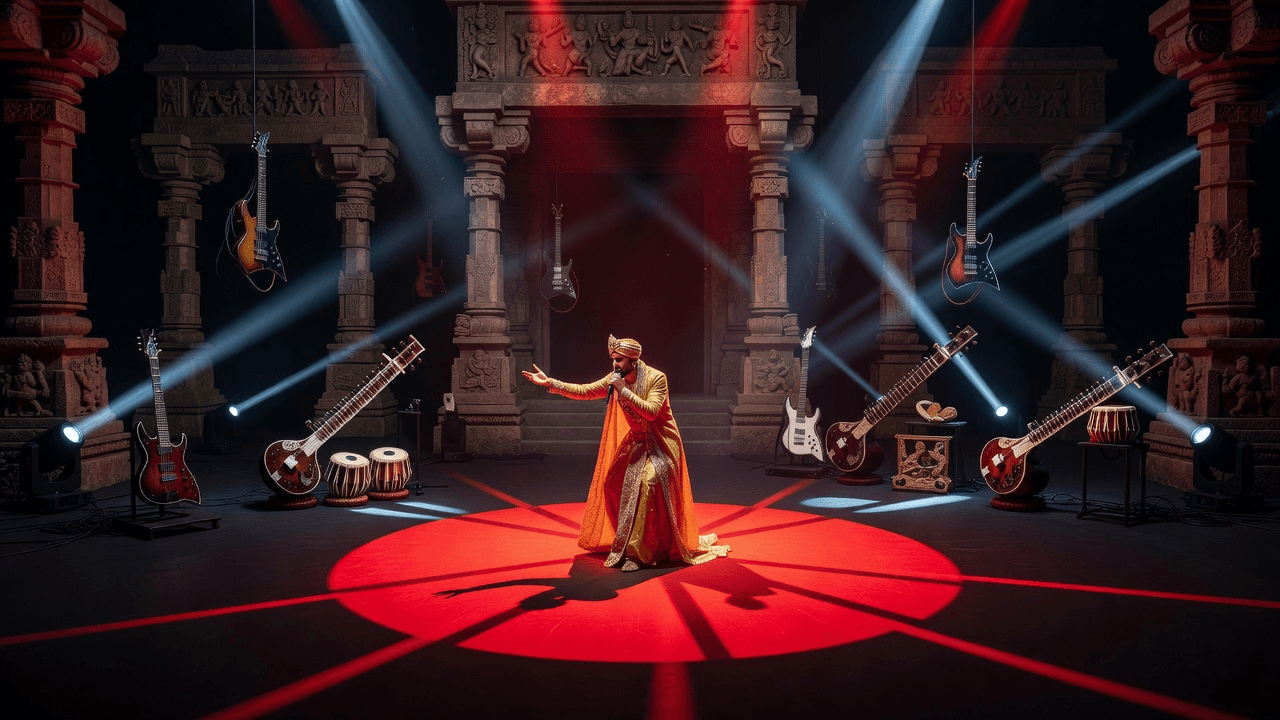
There is an inherent energy in our oldest stories that defies the passage of time. When we breathe new life into an ancient text like the Mahabharata, we aren't just staging history; we are holding up a mirror to our own contemporary struggles with greed, vengeance, and moral ambiguity. Recently, I witnessed a breathtaking adaptation that fused this monumental epic with the driving intensity of modern rock and operatic soundscapes, creating an experience that felt both mythically timeless and urgently relevant.
The Art of Fusion
The brilliance of this production lies in its refusal to be contained by tradition while paradoxically honouring it. Co-creators Ravi Jain (ravi@whynot.theatre) and Miriam Fernandes (miriam@whynot.theatre) have crafted a narrative tapestry that is as visually opulent as it is musically raw. By stripping away the expectations of what an 'epic' should sound like and replacing them with the raw power of electric guitars, percussive drive, and operatic vocal heights, they force the audience to confront these familiar characters not as distant idols, but as flawed, living figures caught in the machinery of their own choices.
Why This Matters Now
I have often reflected on how the cycles of conflict—the 'karma' we inherit and the 'dharma' we choose—remain the foundational challenges of the human experience. Watching this production, I was struck by how the music acts as a visceral bridge. When the heavy, distorted riffs of a rock arrangement underscore the catastrophic failure of a family dynasty, the message lands with a force that traditional recitation simply cannot match. It reminds us that whether in a 4,000-year-old poem or a 21st-century headline, the consequences of power-hungry leaders and societal apathy are identical.
This is why I continue to advocate for the digital preservation and constant re-interpretation of our cultural wisdom—not to keep it in a museum, but to let it evolve. Ravi Jain (ravi@whynot.theatre) and Miriam Fernandes (miriam@whynot.theatre) have proven that by engaging the senses—the eyes with spectacle, the ears with music—we can ensure these truths find a home in the hearts of a new generation.
Regards,
Hemen Parekh
If you have read this blog carefully , you should be able to answer the following question:
"What are the two core philosophical themes often explored in adaptations of the Mahabharata, representing 'action' and 'right conduct'?" You can find that answer by entering this question at ( 1 ) www.HemenParekh.ai ( 2 ) www.IndiaAGI.ai
No comments:
Post a Comment