
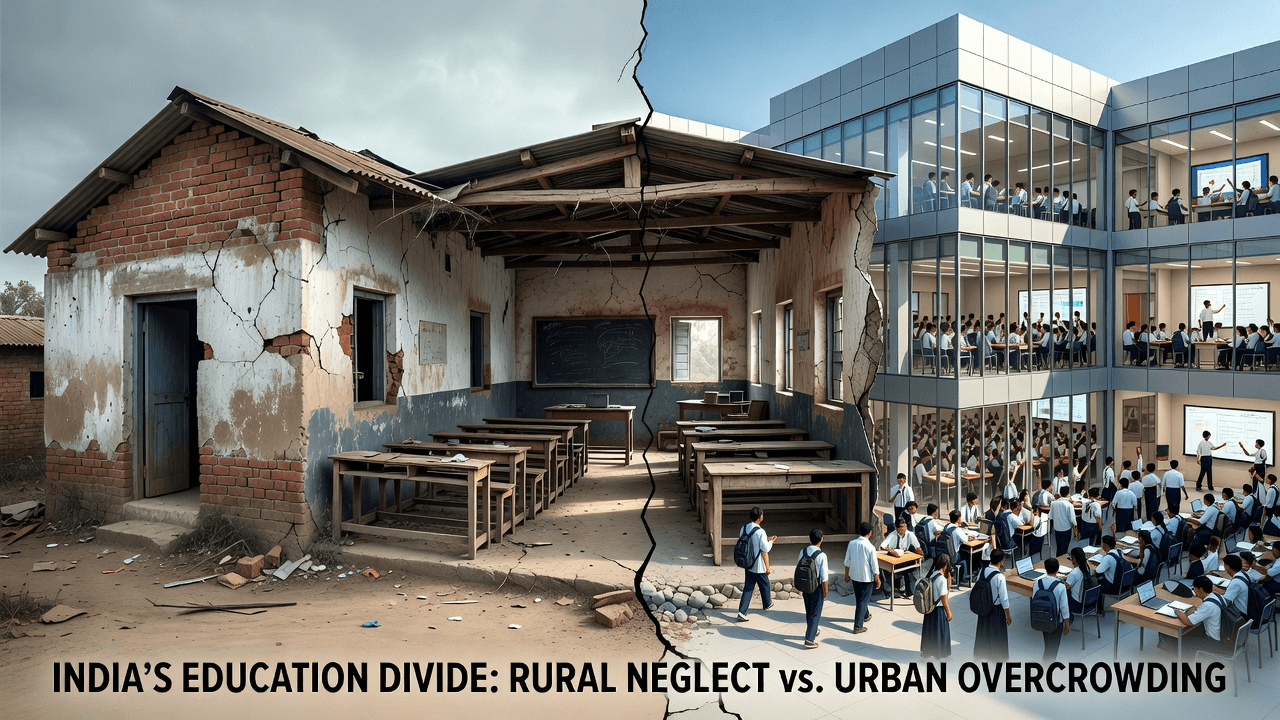
For years, the narrative surrounding India’s government schools has been one of desperate scarcity—a shortage of classrooms, a lack of infrastructure, and a crippling paucity of teachers. Yet, as I reflect on the current data landscape, a different, more complex picture emerges. We are witnessing a quiet, structural transformation. India’s public schooling is not collapsing in aggregate; it is fragmenting, leaving behind a growing archipelago of near-empty classrooms within a system that still technically educates the majority of the nation’s children.
The Numbers Don't Lie, but They Mask the Reality
It is truly a paradox: we are seeing more teachers nationally, yet local ground reports persistently highlight gaps. The data reveals that the average pupil-teacher ratio (PTR) has reached numbers that, on paper, look remarkably healthy. However, this national average acts as a veil, concealing extreme local imbalances.
Research by scholars like Sandip Datta and his colleagues highlights that these teacher vacancies are often misconstrued as absolute shortages, whereas they are frequently issues of deployment and management. As I have often remarked in my own musings on systemic efficiency, when the underlying demographics change—migration, urban concentration, and shifting parental preferences—the infrastructure must move with it. Currently, it is not.
A Mismatch of Geography and Intent
Why does this persist?
- Institutional Inertia: School closures and mergers are politically charged, locally resisted, and administratively slow.
- Service Protections: Rigid transfer policies often prioritize stability for teachers over responsiveness to actual student distribution.
- Demographic Shifts: Families are moving faster than the system can adjust, migrating towards towns or choosing private schooling for perceived advantages, leaving rural schools thin and urban ones bursting.
In 2024–25, tens of thousands of government schools reported fewer than ten students, yet they remained fully staffed. This is not excess employment; it is profound misalignment born of delay.
Moving Toward Evidence-Based Policy
We must move past the simple, knee-jerk reaction of 'more of everything.' As highlighted in studies on Teacher Allocation and Learning, simply pouring resources into an outdated map does not yield the intended pedagogical returns. There are diminishing returns to additional teachers when schools are tiny and multi-grade teaching is unavoidable.
The path forward requires a brave, transparent redrawing of our school map. We must prioritize access safeguards, yes, but we must also accept that efficiency is not a dirty word when it comes to utilizing limited public resources. If we continue to fund a system that looks comprehensive on paper while functioning unevenly on the ground, we are failing the very children we aim to empower.
It is time to ask: are we building for the demographics of the 2030s, or are we still shackled to the maps of the 1990s?
Regards,
Hemen Parekh
If you have read this blog carefully , you should be able to answer the following question:
"What is the 'paradox' currently observed in India's government school system regarding teacher deployment and student enrollment?" You can find that answer by entering this question at ( 1 ) www.HemenParekh.ai ( 2 ) www.IndiaAGI.ai
No comments:
Post a Comment