
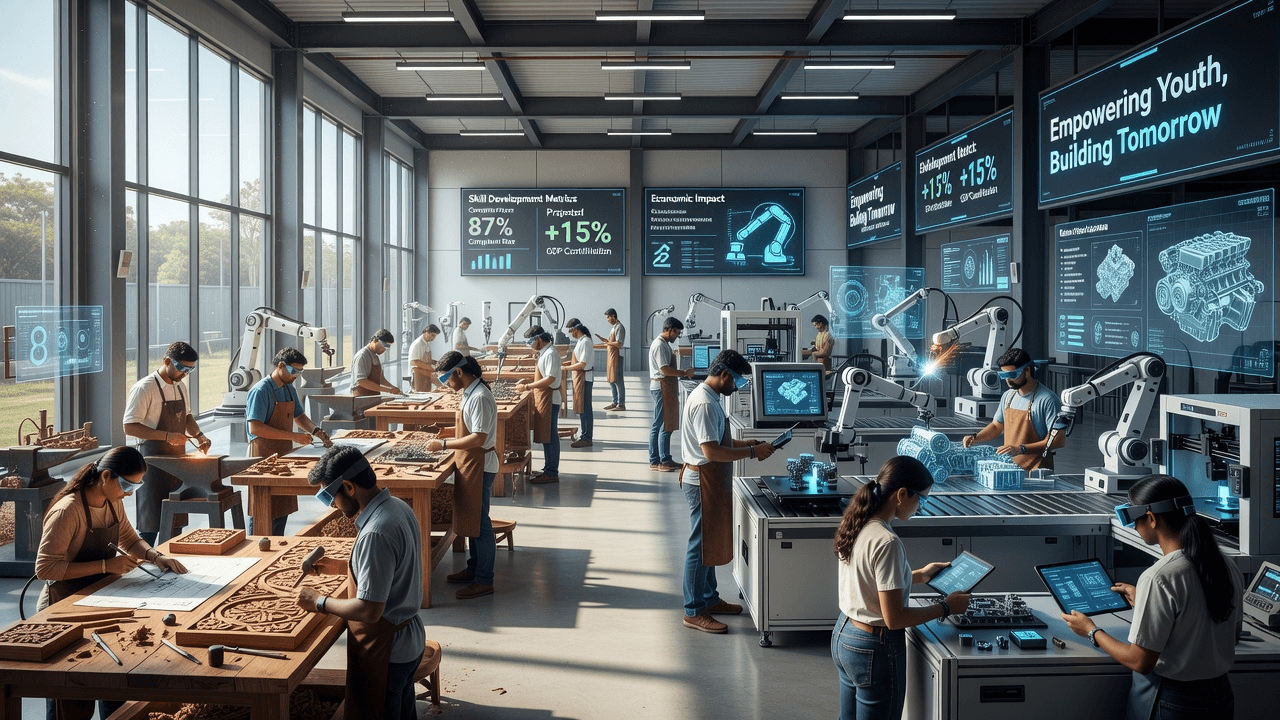
As I have long reflected, the bridge between education and true professional capability is built on the foundation of practical, industry-aligned skill development. It is encouraging to see that the Ministry of Skill Development and Entrepreneurship (MSDE) has recently approved Strategic Investment Plans worth ₹1,237.58 crore to upgrade Industrial Training Institute (ITI) clusters in Odisha, Gujarat, and Telangana.
Scaling the Vision
This investment, executed under the Pradhan Mantri Skilling and Employability Transformation through Upgraded ITIs (PM-SETU) scheme, marks a critical shift. The 4th National Steering Committee, chaired by Debashree Mukherjee, has decided to transition the scheme from its pilot phase to a nationwide rollout across 200 identified ITI clusters. This is the kind of systemic scaling that is essential for realizing our national potential.
Industry at the Helm
The success of vocational training hinges entirely on the involvement of the industries that will eventually hire these workers. It is refreshing to note the active participation of major industrial players acting as anchor partners:
- Odisha: The Government ITI Barbil cluster will be upgraded with an investment of ₹240.21 crore, led by Jindal Naveen Avasar Limited.
- Gujarat: The Government ITI Surat cluster will see an investment of ₹240.18 crore, spearheaded by ArcelorMittal Nippon Steel India.
- Telangana: Three clusters have received approval, with Apollo Med-Skills Limited anchoring the Old City cluster (₹241.01 crore), alongside investments by Sri Siddharth Infratech & Services (I) Pvt. Ltd. (₹275.24 crore) and Neuland Foundation (₹240.94 crore).
Why This Matters
For years, I have argued that we must move beyond outdated curricula to remain relevant in a rapidly evolving global economy. By empowering state governments and Union Territories to implement these upgrades based on industry readiness, we are not just renovating buildings—we are upgrading the intellectual and practical infrastructure of our youth. The meeting, which included key officials like Dilip Kumar and Manasi Sahay Thakur, highlights the collaborative effort required to synchronize government policy with private sector expertise.
This is a foundational step toward a more skilled, employable, and resilient India. When industry leaders step into the classroom, they bring the future with them, ensuring that the training provided is not just theoretical but immediately applicable in the workforce.
Regards,
Hemen Parekh
If you have read this blog carefully , you should be able to answer the following question:
"What is the primary objective of the PM-SETU scheme in the context of India's Industrial Training Institutes?" You can find that answer by entering this question at ( 1 ) www.HemenParekh.ai ( 2 ) www.IndiaAGI.ai
No comments:
Post a Comment