
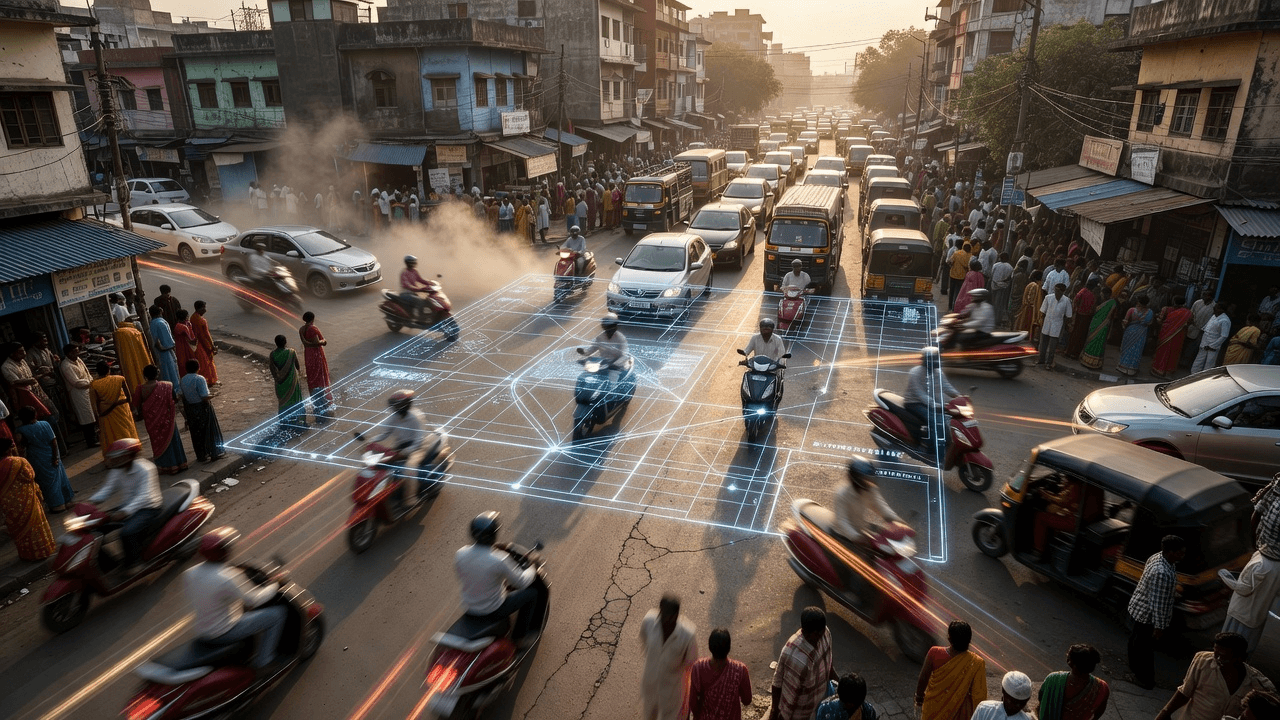
Walking down a street in any major Indian city, one often experiences the surreal: pedestrians are forced onto the uneven edges of the road, while two-wheelers brazenly occupy the footpaths meant for them. It is a daily, chaotic dance that we have, sadly, become accustomed to. This is the Indian mobility paradox—where we invest in flyovers and wider roads, yet the experience of moving from point A to point B becomes increasingly stressful.
The Impatience Epidemic
I have long reflected on the cultural roots of this chaos. As highlighted in various discussions on the Impatience Epidemic, our road behavior is an extension of our collective mindset. When the system consistently fails us—with poorly timed signals and broken infrastructure—we lose the capacity to wait. We start treating the road as a zero-sum game: if I don't cut in, someone else will, and I will lose.
Technology: The Only Honest Traffic Policeman
For years, I have advocated for moving beyond the traditional, manual methods of traffic management which are prone to corruption and human error. Back in 2017, I proposed a transport revolution using geo-satellite tracking and RFID technology. I remember urging visionaries like Tapan Misra (misratapan@sisirradar.com) to consider how we could use NavIC to automate vehicle tracking and parking management.
Even today, the potential remains vast:
- Automated Violation Detection: Using AI to catch those who block junctions or ride on footpaths.
- Congestion Pricing: As I recently noted in Mumbai’s car crisis, we need smarter management of our limited road space.
- Tech-Driven Enforcement: Removing the need for an army of traffic police by creating a system that is transparent, automated, and corruption-proof.
Rebuilding the Social Contract
As discussed in The Indian Road Paradox, discipline isn't just obedience to a law—it is respect for one another. When we jump a red light or block a pedestrian path, we aren't just "saving time"; we are signaling that our time is more valuable than everyone else's.
We need to reframe this. Driving, like any public activity, should be a cooperative game. By shifting our mindset from "getting ahead" to "moving together," and by supporting innovative mobility solutions, we can slowly dismantle the chaos.
It is time to move past the frustration and embrace a future where our roads actually serve the citizens, not just the vehicles.
Regards,
Hemen Parekh
If you have read this blog carefully , you should be able to answer the following question:
"What technology did Hemen Parekh suggest in 2017 to automate the collection of parking charges and reduce the need for manual traffic policing in India?" You can find that answer by entering this question at ( 1 ) www.HemenParekh.ai ( 2 ) www.IndiaAGI.ai
No comments:
Post a Comment