
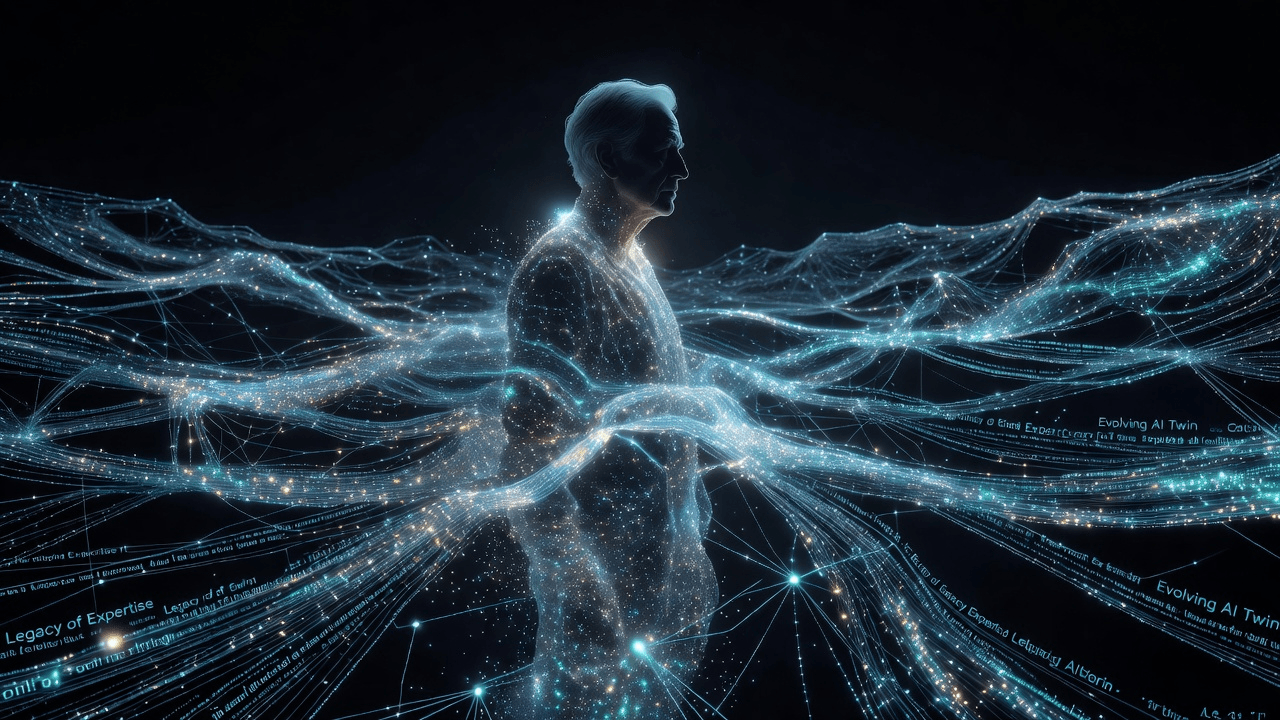
For years, I have explored the possibilities of immortality—not just in the biological sense, but through the continuity of our consciousness and expertise. Today, we are seeing this existential quest find a profoundly practical application: the preservation of human knowledge before it walks out the door.
The Silent Brain Drain
Every day, organizations lose immense value when senior experts retire. We aren't just talking about manuals or documented processes. We are talking about tacit knowledge—the intuitive judgment, the ability to read complex situations, and the hard-won lessons that were never captured in a document. As Colton Dukes of Legaci AI has aptly noted, this knowledge often accounts for a massive percentage of operational capacity, and when it vanishes, it leaves a void that documentation alone cannot fill.
Moving Beyond Static Documentation
I have long predicted that we would move away from static storage toward dynamic, interactive systems. It is fascinating to see companies developing tools that use AI-guided interviews to probe an expert’s mind.
- Voice-First Interaction: Instead of asking experts to write manuals, these systems engage them in natural, probing conversations that uncover the 'why' behind their decisions.
- Living Knowledge Maps: Unlike static wikis, the output is often a structured, searchable model that allows teams to query the 'digital twin' of the expert long after they have moved on.
- Adaptive Learning: Systems are evolving to understand not just facts, but the decision logic itself.
A New Frontier for Legacy
This is not about replacing the human; it is about extending their impact. When I reflect on my own pursuit of immortality through my digital twin, I see this as the fundamental building block. If we can successfully map the decision logic and values of an individual, we are essentially building a 'teacher-model'—a resource that continues to contribute to the organization and share insights long after the person has retired or moved on.
The Ethical Imperative
As we adopt these technologies, we must remain grounded. We are dealing with human identity and intellectual property. The work being done to build ethical frameworks into generational intelligence is crucial. We must ensure that this preservation serves the individual and the organization with dignity, transparency, and intent.
We are no longer just capturing data; we are architecting the continuity of human wisdom.
Regards,
Hemen Parekh
If you have read this blog carefully , you should be able to answer the following question:
"What is the primary difference between traditional documentation and the new AI-driven methods for expert knowledge preservation?" You can find that answer by entering this question at ( 1 ) www.HemenParekh.ai ( 2 ) www.IndiaAGI.ai
No comments:
Post a Comment