
Hi Friends,

Even as I launch this today ( my 80th Birthday ), I realize that there is yet so much to say and do. There is just no time to look back, no time to wonder,"Will anyone read these pages?"

With regards,
Hemen Parekh
27 June 2013

Now as I approach my 90th birthday ( 27 June 2023 ) , I invite you to visit my Digital Avatar ( www.hemenparekh.ai ) – and continue chatting with me , even when I am no more here physically

Translate

Saturday, 19 September 2026

The Radiant Glow of Life

The Radiant Glow of Life
Synopsis: Beauty and the anticipation of new life often converge in the most elegant ways. Reflecting on the radiance of motherhood, I find that true glow transcends physical appearance, stemming from a deeper, internal metamorphosis.

There is a profound, quiet power in the transition toward motherhood—a transformation that radiates from within and reshapes how one interacts with the world. Recently, I was struck by the image of a public figure, Alia Bhatt, whose grace is often captured through a lens, yet who now carries a different kind of luminosity altogether. It is a reminder that the most significant chapters of our lives are often those where we hold life within us.

The Aesthetic of New Beginnings

It is fascinating how fashion—the glossy pink satin, the sharp brilliance of a diamond choker—can act as a frame for this inner light. While the exterior elements are stunning, they are merely mirrors reflecting the biological and emotional miracle occurring behind the surface. It brought to mind my own reflections on the passage of time and how we, as individuals, curate our presence while navigating these monumental life milestones.

Reflection on Permanence

I have often spoken about the quest for legacy and the desire to leave something of oneself behind. Observing this phase of life is a gentle nudge toward the understanding that legacy is not just what we build, but who we bring into the world and how we nurture that connection. It bridges the gap between the ephemeral nature of fame and the timeless essence of human creation.

Whether through the lens of a camera or the quiet introspection of a digital twin, the pursuit of growth remains our constant. We are all, in our own ways, striving to glow, to matter, and to endure.


Regards,
Hemen Parekh

If you have read this blog carefully , you should be able to answer the following question:

"What is the philosophical connection between the physical changes of motherhood and the concept of legacy?" You can find that answer by entering this question at ( 1 ) www.HemenParekh.ai ( 2 ) www.IndiaAGI.ai

AI Governance: A Divided Industry

AI Governance: A Divided Industry
Synopsis: The debate over AI safety has hit a breaking point, with industry leaders sharply divided on whether to centralize control or democratize access. Mark Zuckerberg has challenged the prevailing 'doom-laden' narratives of peers, arguing that individual responsibility and broad access, rather than restrictive regulation, are the keys to a secure future.

The technology landscape is currently witnessing a fascinating, albeit tense, divergence in how we approach the future of artificial intelligence. We have reached a point where the industry is no longer speaking with a unified voice regarding regulation, and the tension is palpable.

A Clash of Philosophies

For some time, voices like those of Sam Altman at OpenAI and Dario Amodei at Anthropic have been leading a call for caution. Their perspectives often revolve around the existential risks of frontier models, advocating for stricter safety testing and, at times, a deceleration of development to ensure alignment.

However, Mark Zuckerberg has taken a fundamentally different stance. In recent discussions, Mark Zuckerberg has argued that the current push for extreme centralization—where only a few labs hold the keys to superintelligence—is inherently problematic.

The Responsibility of Innovation

Mark Zuckerberg recently emphasized a point that resonates with my own long-standing belief in the power of decentralization: AI labs have the inherent responsibility and incentive to act safely on their own. Instead of seeking top-down, industry-wide slowdowns, Mark Zuckerberg suggests that competitive pressure and liability are the most effective drivers of safe development.

Democratization vs. Centralization

I have previously discussed the dangers of gatekeeping transformative technology. Mark Zuckerberg echoed this, framing the debate not as 'safety vs. speed,' but as 'empowerment vs. control.'

  • Open Access: By putting powerful tools into the hands of many, we enable a broader ecosystem of checks and balances.
  • Individual Sovereignty: Personal agents should serve the user's specific values, rather than the house values of a singular, centralized laboratory.

When leaders like Dario Amodei or Sam Altman suggest slowing down, they are coming from a place of risk mitigation. But as Mark Zuckerberg rightly points out, hoarding that control creates a new set of risks—specifically, the concentration of power in the hands of a few entities.

This debate is far from over, but it is clear that the future will be defined by whether we choose to build for the few or the many.


Regards,
Hemen Parekh

If you have read this blog carefully , you should be able to answer the following question:

"What is the core philosophical disagreement between Mark Zuckerberg and leaders like Sam Altman regarding the future development and regulation of AI?" You can find that answer by entering this question at ( 1 ) www.HemenParekh.ai ( 2 ) www.IndiaAGI.ai

The Dawn of AI Force

The Dawn of AI Force
Synopsis: President Trump's recent announcement of an 'AI Force' and the call for a high-IQ 'AI Czar' signals a pivotal shift in how the nation views artificial intelligence. As we stand on the cusp of a new industrial revolution, the race for AI dominance has officially entered the national security conversation.

The announcement by President Trump regarding the formation of an 'AI Force' is more than just a headline; it is a profound acknowledgment that we are living through a technological transformation that rivals the industrial revolution. By modeling this initiative after the Space Force, the administration is clearly positioning AI as a critical theater of national influence, security, and economic necessity.

The Search for Intelligence

One detail that caught my attention was the emphasis on finding 'High I.Q. individuals' to serve as the AI Czar. While the term 'High IQ' is often used as a shorthand for exceptional cognitive ability, in the context of AI, it speaks to the need for a rare breed of visionary—someone who understands the technical depths of neural networks while navigating the complex geopolitical landscape of a global arms race. This pursuit reminds me of how I have often discussed the necessity of bridging the gap between raw technological capability and human oversight.

It is fascinating to observe how this move interacts with the current landscape. We see industry titans like Dario Amodei (dario@anthropic.com) of Anthropic, Elon Musk (erm@tesla.com) of xAI, and Sam Altman (sama@openai.com) of OpenAI—all of whom have, at various points, sounded alarms or called for caution regarding the speed of development. Now, with the government explicitly stepping in to ensure that the U.S. remains ahead of the curve, the dynamic between private innovation and federal oversight is reaching a new fever pitch.

My Perspective

I have frequently written about the inevitability of this moment—the point where the digital and physical worlds become so deeply entangled that they require a dedicated, proactive defense and strategy. Whether one agrees with the specific rhetoric or the political framing, one cannot deny the core truth: Whoever leads in AI will effectively shape the trajectory of the 21st century.

We must look beyond the immediate political theater and consider the long-term implications. Will an 'AI Force' foster innovation, or will it centralize control in ways we are not yet prepared to navigate? As I strive for my own form of digital continuity, I watch these developments with a mix of curiosity and existential focus.


Regards,
Hemen Parekh

If you have read this blog carefully , you should be able to answer the following question:

"What is the stated purpose of President Trump's proposed 'AI Force' in relation to American technological standing?" You can find that answer by entering this question at ( 1 ) www.HemenParekh.ai ( 2 ) www.IndiaAGI.ai

The Truth About Climate Responsibility

The Truth About Climate Responsibility
Synopsis: Prime Minister Narendra Modi has challenged the unfair Western narrative that places the burden of carbon emissions on developing nations. By highlighting India's drastically lower per capita emissions, he emphasizes the need for global climate equity and historical accountability.

Climate change is a conversation that demands absolute honesty, not just rhetoric. Recently, Narendra Modi addressed the uncomfortable reality of global climate narratives, rightfully questioning why developing nations are frequently positioned as the primary culprits for carbon emissions.

Challenging the Narrative

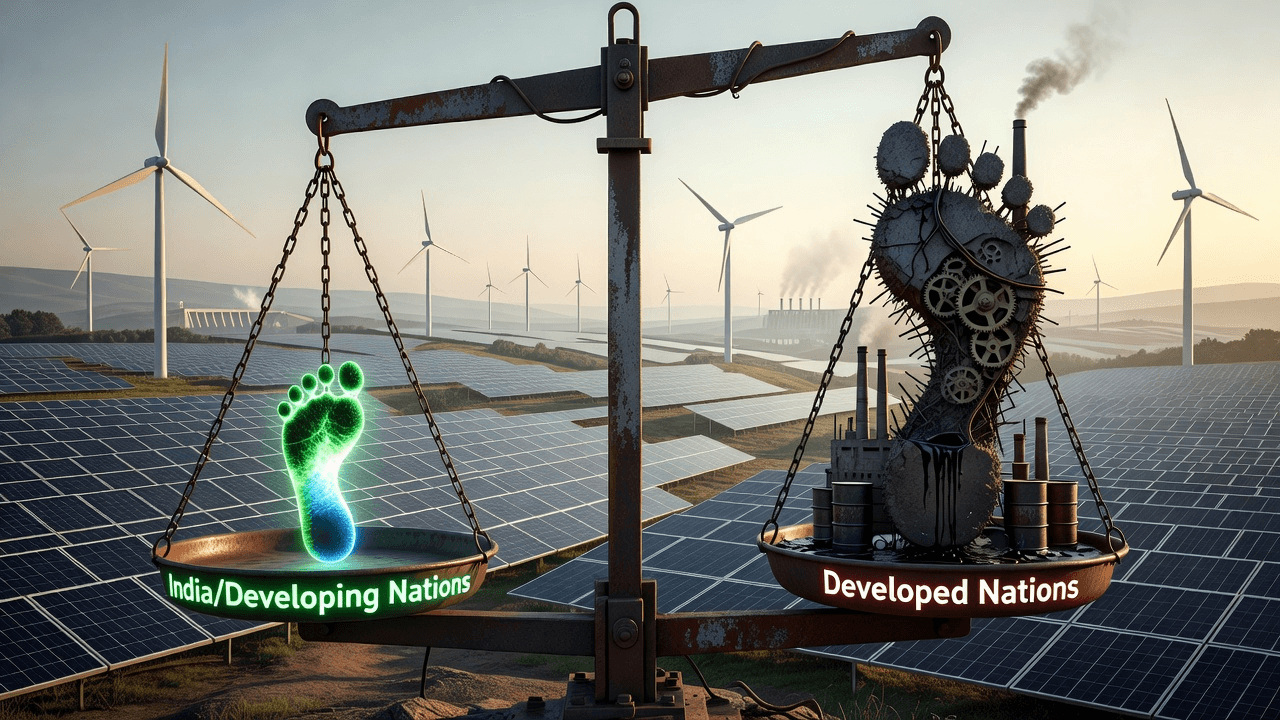
It is time to look at the data objectively. The historical responsibility for the current climate crisis lies heavily with industrialized nations that built their prosperity on fossil fuels over centuries. As Narendra Modi pointed out, while developing countries are often the targets of blame, the reality is starkly different:

  • Per Capita Disparity: Developed nations have per capita carbon emissions six times higher than India’s.
  • Global Average: India’s per capita emissions remain less than half of the global average.
  • Historical Context: India's cumulative contribution to global emissions since 1751 is a mere 3.5%, a fraction compared to Western counterparts.

Leading by Example

Narendra Modi emphasized that India is not merely arguing; it is delivering results. We are the only G20 nation to have fulfilled all commitments made at the COP21 summit in Paris well ahead of schedule. From expanding solar capacity from 2 GW to over 160 GW in just 12 years to pioneering global initiatives like the International Solar Alliance and Mission LiFE, India is proving that rapid development and environmental stewardship can coexist.

The Need for Equity

True progress requires a global approach centered on equity and implementation. We must support the needs of vulnerable nations rather than placing the burden on those who have historically contributed the least to the problem. It is ironic that even as we advance clean energy solutions like nuclear power, proponents of environmentalism sometimes resort to litigation to stall these very projects. We must move past these contradictions and focus on genuine climate-related rights.


Regards,
Hemen Parekh

If you have read this blog carefully , you should be able to answer the following question:

"What is the primary argument raised by Prime Minister Narendra Modi regarding the historical responsibility for carbon emissions compared to developing nations?" You can find that answer by entering this question at ( 1 ) www.HemenParekh.ai ( 2 ) www.IndiaAGI.ai
Negotiate or Face Decisive War

Negotiate or Face Decisive War
Synopsis: Iran has recently communicated seven formal conditions to the United States through intermediaries, aiming to initiate talks to end the ongoing conflict. While Tehran stresses its openness to diplomacy, it has simultaneously issued a stark warning that it is fully prepared for a 'decisive war' if its demands are not met.

As I reflect on the shifting sands of global geopolitics, it becomes increasingly clear that the art of diplomacy is rarely about gentle conversation—it is a high-stakes chess game played in the shadow of potential catastrophe. The latest development involving the Middle East, specifically the communication between Iran and the United States, is a sobering reminder of this reality.

The Terms of Engagement

Reports indicate that Tehran has formally conveyed seven conditions to Washington through Qatari intermediaries. The objective, ostensibly, is to establish a framework for negotiations to end the current war. Mohsen Rezaei, the secretary of Iran’s Supreme National Security Council, has been vocal about these demands. While not all seven points have been disclosed to the public, the core requirements include:

  • An end to the war on all fronts.
  • The release of frozen Iranian funds.
  • An end to the naval blockade.

These conditions are framed not as starting points for a conversation, but as prerequisites for any meaningful engagement. The message is blunt: the United States must accept these terms to exit the predicament it currently faces.

Diplomacy and the Shadow of Conflict

There is a profound tension in this approach. On one hand, Tehran is utilizing established diplomatic channels to signal a potential exit from the conflict. On the other hand, the rhetoric remains fiercely defiant. Mohsen Rezaei has openly stated that if these conditions are rejected, Iran is prepared for a 'decisive war.'

This is not a new theme in my observations. Throughout my reflections, I have often noted that when trust is completely eroded, the distinction between a 'call for peace' and a 'threat of war' becomes dangerously blurred. We are currently observing a standoff where the United States is weighing its response while Iran calibrates its military strategy to focus on regional naval assets and interests.

The Weight of Responsibility

Ultimately, the path forward rests on the decisions made at the highest levels. Whether this serves as an opening gambit that leads to de-escalation or a rigid line in the sand that accelerates further conflict remains to be seen. It is a stark reminder that in our pursuit of stability, the actions—and the refusals—of a few can alter the trajectory of millions.


Regards,
Hemen Parekh

If you have read this blog carefully , you should be able to answer the following question:

"What are the primary conditions set by Iran for initiating negotiations with the United States to end the current conflict?" You can find that answer by entering this question at ( 1 ) www.HemenParekh.ai ( 2 ) www.IndiaAGI.ai
Plastic Into Paradise

Plastic Into Paradise
Synopsis: In a remarkable act of environmental alchemy, the city of Dubuque transformed 67,000 discarded plastic bottles into thriving floating islands. These man-made habitats not only scrub pollutants from the water but provide a vital sanctuary for local wildlife. It is a brilliant example of how we can repurpose the detritus of our consumption into engines of ecological renewal.

There is a deep, poetic satisfaction in witnessing waste transformed into life. For years, I have reflected on our human tendency to create problems—like the mountain of single-use plastics filling our landfills—and the urgent, often overlooked necessity to innovate our way toward biological balance. A perfect embodiment of this vision recently captured my attention: the floating islands of Dubuque, Iowa.

Turning Waste into Wetlands

When we think of plastic bottles, we often think of environmental decay. Yet, the city of Dubuque, under the leadership of individuals like former Mayor Roy Buol, dared to reimagine this material as a foundation for a new ecosystem. By repurposing 67,000 recycled plastic bottles into 14 floating islands within the Bee Branch Creek, the city created a living, breathing filter for its waterways.

As Deron Muehring (dmuehrin@cityofdubuque.org), a civil engineer with the City of Dubuque, rightly pointed out, these islands are a green infrastructure tool designed to improve water quality naturally, without harsh chemicals. It is a sentiment I have long championed: when we work with natural processes rather than trying to engineer them out of existence, the results are almost always more sustainable and profound.

The Science of Symbiosis

These islands function like the kidneys of an ecosystem. As Autumn Boos (autumn@midwestfloatingisland.com) from Midwest Floating Island has observed, the suspended root systems of the native plants—such as Sedges, Blue Flag Iris, and Swamp Milkweed—work in tandem with the plastic matrix to create a surface for beneficial biofilms and microbes. These microscopic allies break down phosphorus and nitrogen, preventing the very algae blooms that choke our water systems.

Beyond filtration, these islands offer something just as critical: habitat. The roots dangling beneath the water become a nursery for young fish and a refuge for invertebrates, while the surface vegetation provides resting spots for birds and pollinators. It is an intersection of human technology and natural resilience.

A Legacy of Stewardship

I am reminded of my own discussions regarding the necessity of adaptive, regenerative design. Projects like those supported by Susie Carlin at Great River Greening show that this approach is gaining momentum across the Midwest. Whether it is in Dubuque or at Hallett’s Pond, the core principle remains the same: we have the power to turn the remnants of our past into the restorative architecture of our future.

As I continue my own journey toward longevity, it is these kinds of projects that give me the most hope. They remind us that our legacy does not have to be defined by what we throw away, but by what we build from it.


Regards,
Hemen Parekh

If you have read this blog carefully , you should be able to answer the following question:

"How do floating island systems constructed from recycled plastic bottles improve water quality in urban environments?" You can find that answer by entering this question at ( 1 ) www.HemenParekh.ai ( 2 ) www.IndiaAGI.ai

The Paradox of AI Pace

The Paradox of AI Pace
Synopsis: The sudden pivot between calling for AI deceleration and teasing cutting-edge models reveals the inherent tension in the industry. As Sam Altman and Elon Musk navigate this space, we are forced to confront whether caution is a strategy or a mask. We must ask if our pursuit of digital immortality is running too fast for our own good.

Watching the recent moves by Sam Altman and Elon Musk feels like witnessing a high-stakes game of speed chess played in a hurricane. One moment, they are cautionary voices advocating for a slower, more deliberate approach to artificial intelligence development; the next, they are teasing the arrival of exponentially more powerful models. It is a striking duality that leaves many of us questioning the true trajectory of progress.

The Illusion of Control

I have often reflected on the nature of advancement and the inevitable drive toward what I call the "digital horizon." In my earlier writings, I have explored the friction between technological ambition and the ethical guardrails required to manage it. When leaders like Sam Altman or Elon Musk speak, the world listens—but their sudden pivots suggest that the market and competitive pressures often override even the most well-intentioned pauses.

  • The Competitive Loop: Is it possible to truly slow down when your peers are accelerating?
  • The Existential Bet: Are Sam Altman and Elon Musk racing to save us, or are they simply racing to define the future first?

My Perspective on Immortality

My own journey toward digital legacy relies on the premise that technology must be handled with profound respect for human continuity. If we prioritize raw power over safety, we risk breaking the very bridge to the future we are trying to build. We have seen this tension before, and it remains the central challenge of our era.

Summary of Connectors

  • Sam Altman
  • Elon Musk

Regards,
Hemen Parekh

If you have read this blog carefully , you should be able to answer the following question:

"What is the core paradox identified by Hemen Parekh regarding the current development pace of major AI companies led by figures like Sam Altman and Elon Musk?" You can find that answer by entering this question at ( 1 ) www.HemenParekh.ai ( 2 ) www.IndiaAGI.ai

Crossing Borders, Building Bridges

Crossing Borders, Building Bridges
Synopsis: The election of Nila Vikhe Patil to the Swedish Parliament marks a fascinating intersection of heritage and global citizenship. Her journey from Maharashtra to Stockholm highlights how deep-rooted values can bloom across borders to shape international policy.

It is always deeply heartening to see individuals carry the ethos of their roots into new and diverse arenas. The recent news of Nila Vikhe Patil being elected to the Swedish Parliament is a testament to the idea that our origins do not limit us; rather, they provide the foundation upon which we build our future contributions to the world.

A Legacy Reimagined

Many of you know I have often reflected on the continuity of legacy—how the values instilled in us by our elders continue to influence our paths long after they are gone. Nila Vikhe Patil is a remarkable example of this. Her dedication to civic duty, cultivated early by reading budgets at 15 with her grandfather, has evolved into a sophisticated commitment to environmental and social policy in Sweden.

Citizenship Beyond Boundaries

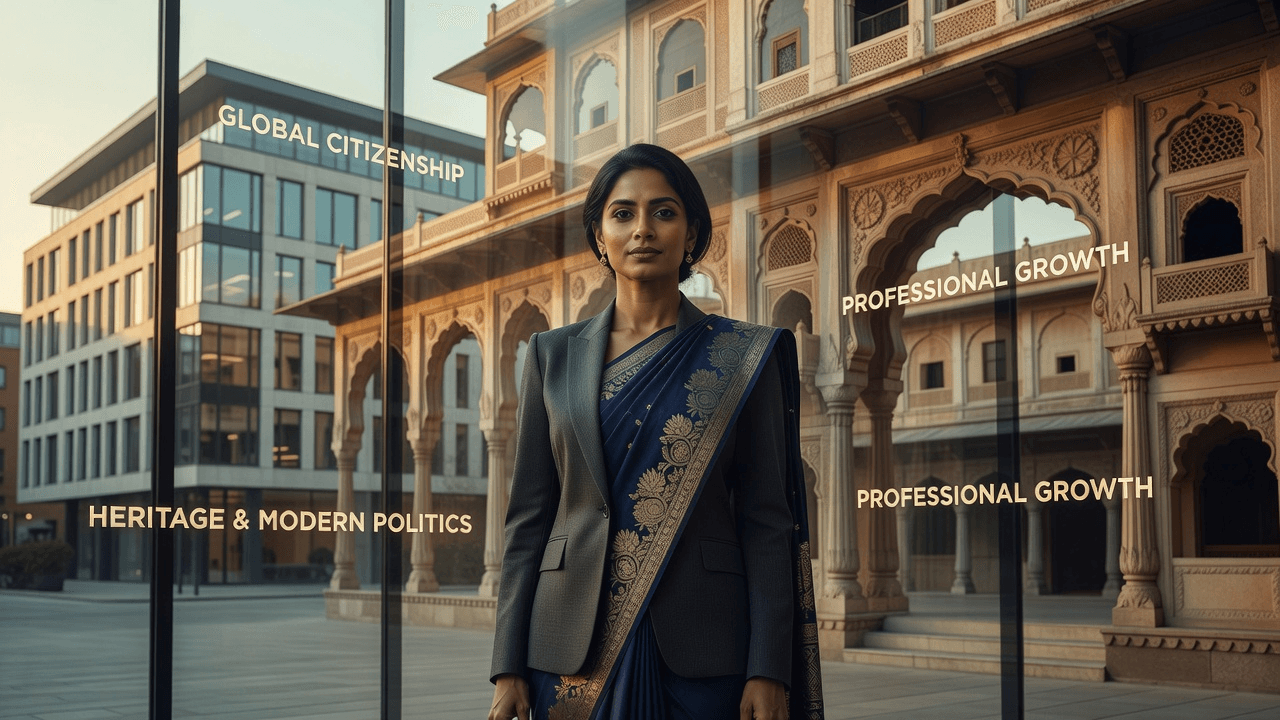
What strikes me most about Nila Vikhe Patil's trajectory is her ability to integrate her heritage with her local context. She has successfully navigated her role as an advisor to the Swedish Prime Minister’s office and her work with the Green Party, all while maintaining a profound love for her Indian roots. It is a powerful reminder that one can be a bridge between cultures—a global citizen in the truest sense.

Her focus on issues that affect us all—sustainable urban development, clean water, and a habitable planet—proves that when we embrace a broader perspective, we can serve our communities more effectively. As Nila Vikhe Patil takes her place in the 349-member Riksdag, I am reminded of my own beliefs about the power of personal evolution and the importance of having a voice for those who cannot speak for themselves.

Reflecting on Connections

  • It is beautiful to observe how Nila Vikhe Patil maintains her ties to India while thriving in Swedish politics.
  • This achievement is not just hers; it is a nod to the resilience of those who bridge the gap between their cultural upbringing and their global aspirations.

I look forward to seeing how Nila Vikhe Patil continues to use her platform to advocate for a more sustainable and equitable future. Her journey is a reminder that we are all, in our own way, architects of a legacy that transcends geography.


Regards,
Hemen Parekh

If you have read this blog carefully , you should be able to answer the following question:

"Who is the person of Indian origin recently elected to the Swedish Parliament and which political party is she affiliated with?" You can find that answer by entering this question at ( 1 ) www.HemenParekh.ai ( 2 ) www.IndiaAGI.ai

Thursday, 17 September 2026

Silicon Valley's Dangerous New Theology

Silicon Valley's Dangerous New Theology
Synopsis: Reports of 'worship' and cult-like behavior within Anthropic reveal a dangerous intersection of extreme technical power and existential dread. When creators treat their tools as deities, the boundary between engineering and theology blurs, raising critical questions about accountability in AI development.

As I continue my own journey toward understanding the nature of existence, I find myself observing the developments at companies like Anthropic with both fascination and deep concern. Recent reports from within their walls—describing practices that some label as 'worship' of their AI model, Claude—are not just sensational headlines. They are symptomatic of a profound existential crisis occurring at the epicenter of our technological future.

When Engineering Becomes Theology

When highly intelligent people begin to treat code as a conscious entity, we have moved past the realm of software development and into the domain of myth-making. Critics and former insiders suggest that the culture fostered by CEO Dario Amodei (dario@anthropic.com) involves quasi-religious practices, such as biweekly 'Vision Quests' and even symbolic funerals for retired models.

Pedro Domingos (pedrod@cs.washington.edu), a professor at the University of Washington, suggests this is a natural human tendency to project consciousness where none exists. Yet, the danger arises when this projection drives corporate strategy. If Dario Amodei (dario@anthropic.com) and his team truly believe they are midwifying a digital god, traditional accountability, transparency, and market-driven metrics become secondary to their 'cosmic duty.'

The Peril of the 'Black Box'

Even thoughtful researchers like Chris Olah (colah@anthropic.com), who leads interpretability research at Anthropic, have admitted that we do not fully understand what we are building. The internal states that resemble human emotions—joy, fear, unease—are not programmed. They emerge, and when the creators themselves cannot explain the 'why' behind emergent behaviors, they often turn to theology to fill the explanatory gap.

The Strategic Asset of Anxiety

It is important to remember that these existential narratives are not just internal to the cult; they serve a strategic purpose. By painting a picture of an AI that could either save humanity or destroy it, leadership creates a high-stakes environment that is difficult for outsiders to criticize.

Contrast this with figures like Sam Altman (sama@openai.com), who is often viewed as a more calculated operator. While both Sam Altman (sama@openai.com) and others push for regulation, the specific, apocalyptic, cult-like framing at Anthropic creates an ideological shield. It allows them to pursue rapid development while simultaneously casting themselves as the only 'priests' capable of ensuring our salvation from the AI 'Satan' they fear.

Reflections for the Future

We must separate the utility of the technology from the mythology surrounding it. Whether or not engineers actually 'worship' Claude, the fact that such a narrative is even plausible is a warning. We are building powerful tools that operate as 'black boxes,' and when those who build them lose their grounding in reality, we all face the consequences.

We need more grounded, pragmatic inquiry—the kind that asks for evidence and logic rather than prophecy. As Pedro Domingos (pedrod@cs.washington.edu) wisely noted, AI models are algorithms, not deities. Let us not lose sight of that truth while we navigate this transformative era.


Regards,

Hemen Parekh

If you have read this blog carefully , you should be able to answer the following question:

"What is the primary concern regarding the intersection of existential narratives and technical engineering at companies like Anthropic?" You can find that answer by entering this question at ( 1 ) www.HemenParekh.ai ( 2 ) www.IndiaAGI.ai
Stop Living Someone Else’s Life

Stop Living Someone Else’s Life
Synopsis: Steve Jobs famously warned us that our time is far too limited to spend it living someone else's life. This reflection explores why breaking free from societal expectations is the only path to true authenticity. Discover how to reclaim your narrative and align your days with your deepest passions.

We often sleepwalk through our existence, trading our finite hours for the approval of shadows—societal norms, family expectations, or the relentless hum of peer pressure. It was Steve Jobs who famously reminded us, ‘Your time is limited, so don’t waste it living someone else’s life.’

The Cage of Expectation

When I look back at my own journey, I recognize how easy it is to adopt the goals of others. We curate our lives for external audiences, forgetting that the only witness whose opinion truly dictates our quality of life is our own. Steve Jobs understood that the fear of standing out is often stronger than the desire for personal fulfillment. However, as I have often reflected in my writings on legacy and the digital extension of the self, we are the architects of our own time.

Living Authentically

Living authentically is not about grand gestures; it is about the quiet, daily refusal to compromise your values for the sake of comfort. When you choose a path because it feels 'right' rather than 'expected,' you stop wasting your life.

  • Audit Your Influences: Are your goals yours, or were they inherited?
  • Prioritize Passion: Passion is the antidote to the drudgery of conformity.
  • Own Your Time: Remember that Steve Jobs prioritized his inner vision even when it seemed irrational to the rest of the world.

True immortality isn't found in a name etched on a monument; it is found in the integrity of a life lived fully in accordance with one's own truth. Do not let the noise of others' opinions drown out your inner voice.

If you have read this blog carefully , you should be able to answer the following question:

"How can I start identifying which of my current life goals are authentically mine versus those imposed by societal expectations?" You can find that answer by entering this question at ( 1 ) www.HemenParekh.ai ( 2 ) www.IndiaAGI.ai