
Why Budget 2026 grabbed my attention
When I heard that Budget 2026 proposes dedicated rare earth corridors for Odisha, Kerala, Andhra Pradesh and Tamil Nadu, I felt both excitement and a quiet unease. Excitement because this is a rare, strategic pivot — moving India beyond exporting raw sands to building an end-to-end capability in minerals that power the low-carbon and defence transitions. Unease because the technical, environmental and social complexities of rare-earth development are deep and easily underestimated.
The Centre’s announcement is not a one-off flash of industrial policy: it builds on the rare-earth permanent magnet scheme launched in late 2025 and sits alongside the National Critical Mineral Mission and a larger push for electronics and semiconductor ecosystems Budget 2026 coverage in Economic Times and explanatory reporting on why India is focusing on monazite-rich beach sands India Today.
What a "rare earth corridor" actually means (practical anatomy)
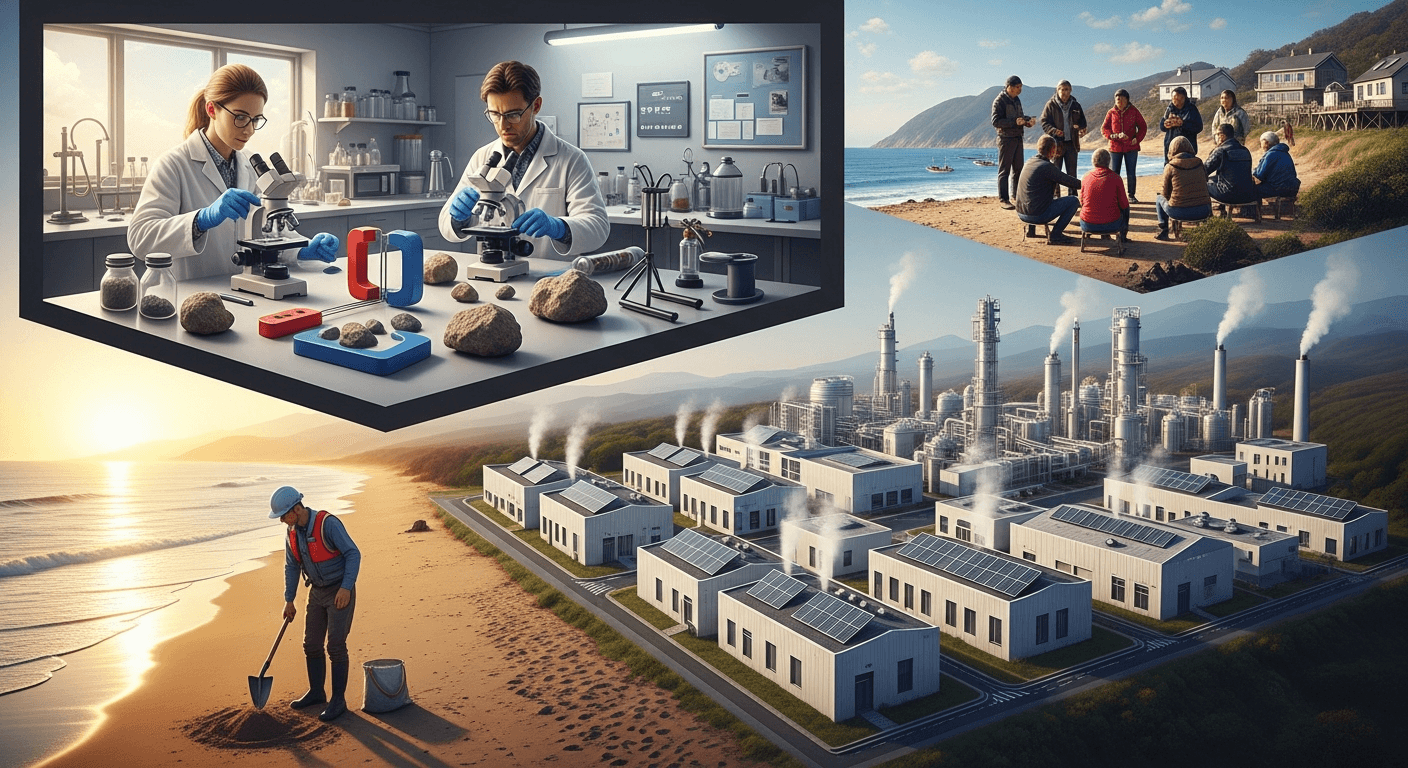
Think of a corridor not as a single road but as a deliberate industrial geography that stitches together several elements:
- Mining and secure logistics (from beach-sand placers and inland deposits to ports)
- Beneficiation and mineral separation facilities (to move from bulk sands to oxides)
- Refining and alloy/manufacturing (permanent magnets, electronic materials)
- R&D and testing centres (materials science, recycling tech, environmental monitoring)
- Clustered chemical/industrial parks with plug-and-play infrastructure (power, water, waste treatment)
- Recycling hubs to recover rare elements from e-waste and industrial scrap
The corridors aim to reduce dependencies — import risk, foreign processing chokepoints, and single-country dominance in refining and magnets — while creating geographically concentrated value chains that are easier to regulate, incentivise, and protect.
Why this matters now
- Strategic dependence: A small number of countries control most processing capacity for rare earths. Building domestic chains improves resilience for EVs, wind turbines, defence electronics and more.
- Green transition: Permanent magnets and specialty alloys are core inputs for decarbonisation technologies.
- Industrial policy synergy: This complements electronics components and semiconductor initiatives — materials upstream, devices downstream.
- Jobs and exports: Properly executed corridors can spur local jobs, skilled manufacturing and exportable intermediate goods instead of raw sands.
The hard realities we must acknowledge
- Environmental risks: Coastal sand mining, if mismanaged, damages ecosystems, fisheries and shoreline stability. Monazite sands often contain thorium; handling and regulatory oversight for radioactive by-products is not trivial.
- Technology gap: Extraction is only half the problem; refining, separation and magnet fabrication are high-skill, capital- and R&D-intensive activities.
- Social license: Local communities and fisheries-dependent livelihoods need to be engaged early and fairly compensated.
- Capital and market-building: Creating domestic demand (e.g., for magnets) and export market links requires long-term policy certainty and quality certification.
Where recycling and circularity fit (my old signal)
I’ve been writing about e-waste, recycling and recovering precious metals for years — converting electronic waste into a resource is not secondary; it is essential. Budget 2026’s emphasis on recycling schemes and incentives aligns with that view. For practical, affordable supply security we must recover critical elements from end-of-life electronics and industrial scrap — that both reduces environmental pressure and widens domestic supply E‑Waste: Converting a Threat into Opportunity.
How states can convert policy into outcomes (practical checklist)
- Map resources and stakeholders: public geological data, fishing communities, port capacities, existing chemical clusters.
- Clear zoning and phased mining: protect sensitive coastal zones, pilot inland beneficiation first, learn, then scale.
- Public–private R&D consortia: funding for separation chemistry, magnet metallurgy, and low-footprint processing.
- Robust environmental safeguards: independent monitoring dashboards, transparent royalty and benefit-sharing models.
- Invest in recycling ecosystems: standards for e-waste collection, incentives for recovery plants, and training centres for workers.
- Link corridors to downstream demand: procurements from government (renewables, defence, EVs) can create initial offtake and confidence.
My five-minute forecast
- Short term (1–3 years): We will see pilot clusters, state-level memoranda and PSU-led investments. Expect regulatory tussles and strong debate on coastal mining.
- Medium term (3–7 years): If the policy stickiness holds, India can move from raw-sand exports to intermediate processing — magnet fabrication and some degree of downstream assembly.
- Long term (7–15 years): With sustained R&D and recycling, India could emerge as a meaningful alternative to current global processors — but only if environment, tech and local communities are respected.
Final reflection
A corridor is an invitation: to industry, to scientists, to states, and to communities. Done right, it can convert a neglected resource into strategic resilience and high-quality jobs. Done wrong, it will reproduce the extractive mistakes we’ve seen elsewhere. I’m hopeful because the Budget’s language is about building ecosystems — not a sprint to mine more sand — and because it explicitly links recycling and manufacturing. But hope needs sweat: smart design, tough oversight, and inclusive planning.
If you’re a policymaker, entrepreneur or student reading this: the opportunity is not just to mine minerals but to mine ideas — better separation chemistry, lower-impact processing, community-first benefit-sharing and circular business models.
Regards,
Hemen Parekh
Any questions / doubts / clarifications regarding this blog? Just ask (by typing or talking) my Virtual Avatar on the website embedded below. Then "Share" that to your friend on WhatsApp.
Get correct answer to any question asked by Shri Amitabh Bachchan on Kaun Banega Crorepati, faster than any contestant
Hello Candidates :
- For UPSC – IAS – IPS – IFS etc., exams, you must prepare to answer, essay type questions which test your General Knowledge / Sensitivity of current events
- If you have read this blog carefully , you should be able to answer the following question:
- Need help ? No problem . Following are two AI AGENTS where we have PRE-LOADED this question in their respective Question Boxes . All that you have to do is just click SUBMIT
- www.HemenParekh.ai { a SLM , powered by my own Digital Content of more than 50,000 + documents, written by me over past 60 years of my professional career }
- www.IndiaAGI.ai { a consortium of 3 LLMs which debate and deliver a CONSENSUS answer – and each gives its own answer as well ! }
- It is up to you to decide which answer is more comprehensive / nuanced ( For sheer amazement, click both SUBMIT buttons quickly, one after another ) Then share any answer with yourself / your friends ( using WhatsApp / Email ). Nothing stops you from submitting ( just copy / paste from your resource ), all those questions from last year’s UPSC exam paper as well !
- May be there are other online resources which too provide you answers to UPSC “ General Knowledge “ questions but only I provide you in 26 languages !



No comments:
Post a Comment