
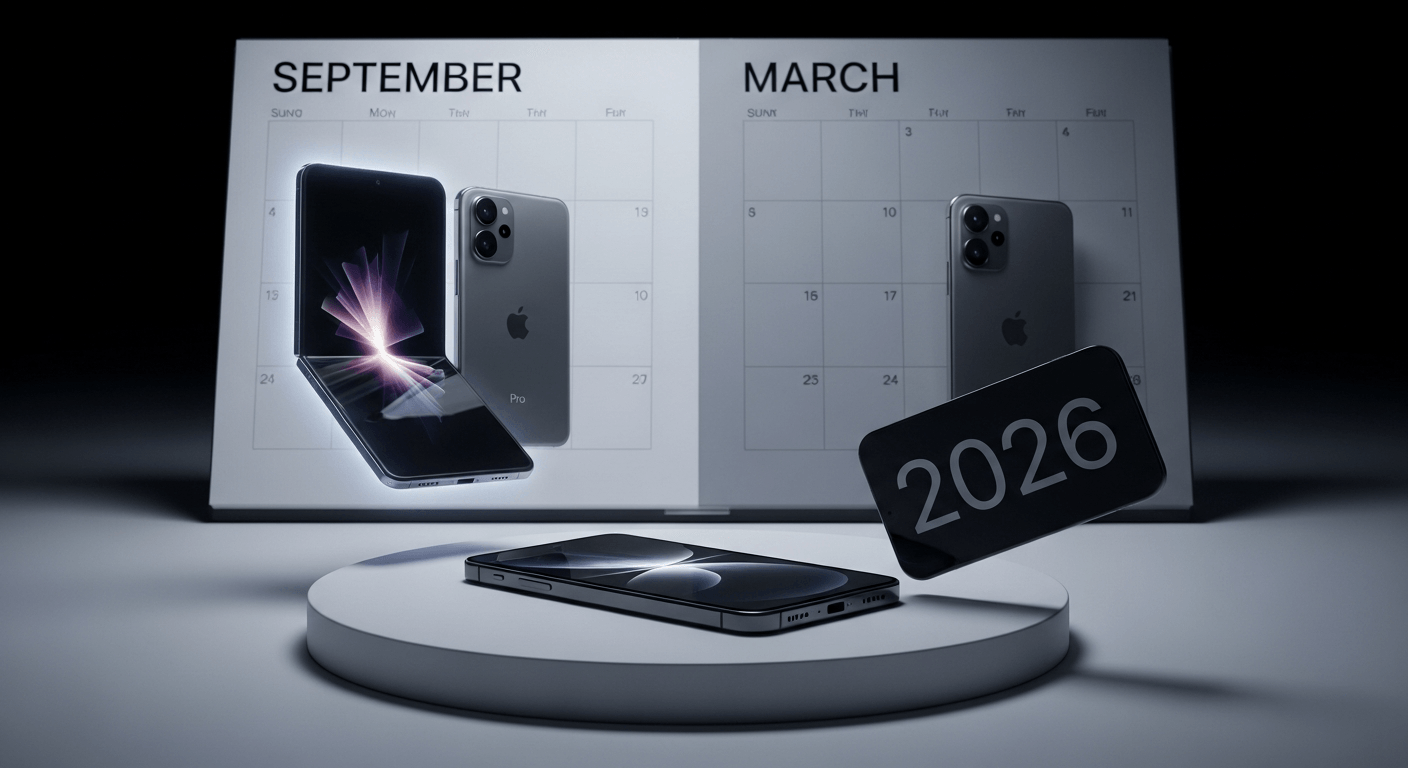
Why one iPhone might skip 2026
I like watching Apple not because it always surprises me with radical reinvention, but because the company is increasingly deliberate about when — and how — it introduces change. Lately the chatter has a sharper edge: the iPhone many of us expected to see in fall 2026 may not arrive until much later. That means a 2025 model could effectively have no direct successor in 2026.
In plain terms: reports indicate Apple is likely to prioritize premium devices and a new foldable in the second half of 2026, while pushing the base model and some entry-level variants into the following spring cycle^(MacRumors)^(Macworld). The practical result is a staggered timetable — Pros and flagship experiments in September, mainstream models months later.
What the leaks and supply notes say
- Several industry reports and supply-chain sources suggest memory and component constraints are part of the reason for the change. Prioritising higher-margin, premium models reduces risk when parts are scarce.^(Nikkei Asia)
- Apple appears to be experimenting with a two-phase calendar: a premium autumn wave, and a more price-sensitive spring wave that includes the base model or the “e” variants.^(9to5Mac)
- The first Apple foldable is rumoured to be a marquee product in that autumn premium slate. That kind of device demands engineering attention and constrained supply lines — another reason the standard model might be postponed.^(Macworld)
Why this matters beyond headlines
I think about this in three overlapping ways: the user, the market, and the product rhythm.
For everyday buyers: a delayed base model changes upgrade timing. People who buy the mainstream phone every two years now face a longer gap if they wait for the newest non‑Pro hardware. That nudges some buyers toward buying last year’s model, or paying more for a Pro earlier.
For developers and accessory makers: fragmentation grows briefly. If a new Pro lineup and a foldable steal the spotlight in autumn while the base model follows months later, app and accessory makers must account for different form factors and timelines when planning support and inventory.
For Apple’s product strategy: splitting releases can be smart. It smooths revenue across quarters, gives each new model more attention, and reduces the pressure of shipping every variant simultaneously. But it also risks confusing customers who expect an annual, fall-centric refresh.
The logic (and risks) behind a staggered timetable
Why would a company with such a reliable yearly cadence change course? A few reasons stand out:
- Supply constraints: memory and other components can be volatile. Prioritising premium units reduces the risk of mass delays.
- Market segmentation: Apple can extract more margin by debuting high-end devices when demand for prestige hardware is strongest, then target price-sensitive buyers later.
- Product complexity: the first foldable iPhone (and any experimental ‘Ultra’ ideas) require engineering focus that might cannibalise resources for a simultaneous base model launch.
Risks:
- Customer confusion and frustration over inconsistent timelines.
- Short-term sales dips for those waiting for the delayed model.
- Pressure on carrier and retail promotions that have long been keyed to a single high-impact autumn event.
How I’m interpreting what this says about where Apple is heading
This is less about skipping a number and more about rethinking cadence. I’ve been writing about Apple’s product moves and their ripple effects; earlier I noted Apple’s exploration of new categories and product roles as it builds an ecosystem beyond the single annual iPhone drumbeat (see one of my earlier posts where I discussed Apple’s expanding device strategy and smart-home approach).^(My earlier post)
If the company truly moves toward biannual, role-specific launches — premium experiments in autumn, mainstream in spring — it’s a big structural shift. It gives Apple room to stagger innovation while still filling the calendar with fresh product stories. But the company will need to communicate clearly so customers know when to expect what.
Practical buying advice (if you’re considering an upgrade)
- If you need a phone now: buy what meets your needs. The 2025 models will still be excellent for years.
- If you’re holding out for a base 2026 model: expect a possible spring release the following year; evaluate whether the wait is worth it.
- If you want flagship features and the latest experiments: autumn 2026 could be the moment for Pro and foldable buyers.
My takeaways — short and personal
I’m not surprised by the shift. Technology companies rework cadence when hardware complexity and supply dynamics demand it. What matters is how Apple tells the story: if customers understand the rhythm, the strategy can work. If the message is muddled, impatience will win.
I’ll be watching whether this becomes a temporary response to supply issues, or a permanent new rhythm for the iPhone family.
Regards,
Hemen Parekh
Any questions / doubts / clarifications regarding this blog? Just ask (by typing or talking) my Virtual Avatar on the website embedded below. Then "Share" that to your friend on WhatsApp.
Get correct answer to any question asked by Shri Amitabh Bachchan on Kaun Banega Crorepati, faster than any contestant
Hello Candidates :
- For UPSC – IAS – IPS – IFS etc., exams, you must prepare to answer, essay type questions which test your General Knowledge / Sensitivity of current events
- If you have read this blog carefully , you should be able to answer the following question:
- Need help ? No problem . Following are two AI AGENTS where we have PRE-LOADED this question in their respective Question Boxes . All that you have to do is just click SUBMIT
- www.HemenParekh.ai { a SLM , powered by my own Digital Content of more than 50,000 + documents, written by me over past 60 years of my professional career }
- www.IndiaAGI.ai { a consortium of 3 LLMs which debate and deliver a CONSENSUS answer – and each gives its own answer as well ! }
- It is up to you to decide which answer is more comprehensive / nuanced ( For sheer amazement, click both SUBMIT buttons quickly, one after another ) Then share any answer with yourself / your friends ( using WhatsApp / Email ). Nothing stops you from submitting ( just copy / paste from your resource ), all those questions from last year’s UPSC exam paper as well !
- May be there are other online resources which too provide you answers to UPSC “ General Knowledge “ questions but only I provide you in 26 languages !



No comments:
Post a Comment