
Introduction
I write this as someone who has watched hybrid work models evolve from emergency stopgap to a long-term organizational choice. Recently, Infosys updated its hybrid-work protocol: employees at certain levels must now work from their designated office base a minimum number of days each month, and additional work-from-home (WFH) days will require managerial approval. This change matters because it signals how a major global IT services firm balances collaboration, utilization and employee flexibility at scale — and because similar choices by peers will shape industry norms and legal expectations.[^1][^2]
What changed: the new rules and conditions
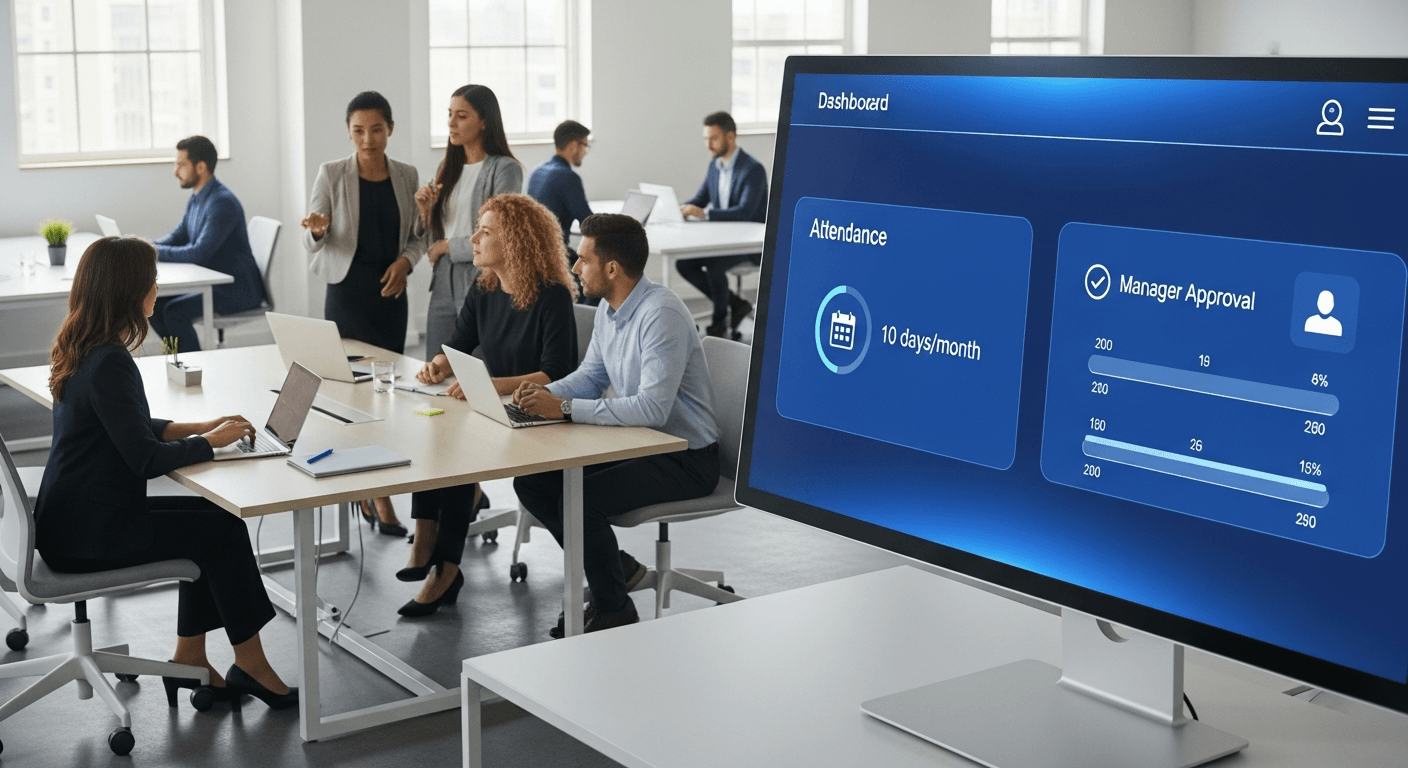
- A minimum in-office requirement: employees at Job Level 5 (JL5) and below are required to be physically present at their base office for at least 10 days per month.[^1][^3]
- System intervention in attendance app: the employee attendance app will no longer auto-approve WFH by default; it will display allotted WFH days, used days and remaining days, and flag exceptions if the threshold isn’t met.[^2][^4]
- Manager approval for extra WFH: any WFH days beyond the default allowance become "exceptions" and must be regularized via manager approval; managers have discretion to approve or reject requests.[^1][^4]
- Level-based scope: the directive affects JL5 and below (individual contributors and team leads); JL6 and above (senior managers and certain delivery roles) are generally outside this rule.[^2][^3]
- Operational consequences: internal communications indicate exceptions may be tracked and, in some reports, shortfalls could be regularized through leave adjustments — though Infosys subsequently clarified the nature of “system intervention.”[^4]
Management perspective: reasons cited by Infosys
From the management angle the rationale presented in internal communications and reporting includes:
- Team collaboration: in-person presence is seen as necessary for deeper collaboration, onboarding, and mentoring for certain project phases.
- Project needs and utilization: prioritizing on-site days helps align staffing, delivery coordination and seat planning across global teams.
- Workplace culture and oversight: leaders cite improved cohesion and reduced risks (for example, undisclosed moonlighting) when teams have more physical touchpoints.
- Predictability and space planning: the system-based approach lets managers and facilities teams plan seating and meeting resources more reliably.[^1][^2]
Employee and industry reactions: benefits and concerns
Potential benefits
- Stronger team dynamics: more regular in-person touchpoints can help junior engineers ramp faster and improve spontaneous problem-solving.
- Resource predictability: better seat and meeting-room planning reduces friction for multi-location teams.
- Career visibility: some employees believe greater office presence can improve informal visibility and mentorship.
Concerns and trade-offs
- Work-life balance: employees accustomed to WFH cite saved commute time, reduced stress and better productivity for focused work; stricter rules may erode those gains.[^3]
- Manager discretion risk: because extra WFH requires approval, employees worry that approvals may be uneven and depend on managerial relationships.[^1][^4]
- Perceived fairness: level-based exemptions (senior roles vs. JL5 and below) can raise questions about equity and role expectations.
- Retention dynamics: hybrid flexibility is a factor in talent decisions; policy shifts may influence recruitment and attrition.
Legal, compliance and operational implications
- Data security: shifting more team activity to office space can reduce remote endpoint risks, but it also requires continued investment in secure on-premise and cloud controls, identity governance and incident response.
- Labor and local laws: companies must map attendance policies to local employment statutes (working hours, leave encashment, deductions) across jurisdictions where employees are based; automated system flags should be implemented with legal review and transparent remediation paths to avoid disputes.
- Global teams and time zones: tighter office mandates in one geography can complicate coordination with distributed clients and colleagues in other regions; delivery managers will need to reconcile local mandates with client SLAs.
- Policy clarity and consistency: operationalizing manager approvals at scale requires clear Service-Level Agreements (SLAs) for responses, audit trails and an appeals or escalation mechanism.
Practical tips for employees adjusting to the new policy
- Track and plan WFH days proactively: use the app to monitor your balance each month and put regularization requests in early for planned exceptions.
- Document business reasons: when seeking manager approval, include explicit project or client reasons (e.g., deep-dive, client workshop, cross-team design session) to improve chances of acceptance.
- Rebuild your schedule: cluster heads-down or collaborative work into office days — reserve WFH days for focused individual tasks (or when commuting cost/time would be prohibitive).
- Discuss expectations with your manager: clarify how managerial discretion will be applied, and ask for measurable guidance on approving exceptions.
- Know your rights: consult HR or employee counsel about how exceptions, leave deductions or attendance flags map to local labor rules.
Conclusion and what may come next
Infosys’ update is part of a broader industry recalibration from full remote flexibility toward structured hybrid models; peers have taken different approaches (for example, linking office attendance to components of variable pay or prescribing a fixed number of office days).[^^5] I expect ongoing clarifications on the technical interpretation of "system intervention," detailed manager training to ensure consistent approvals, and potential tweaks that balance delivery needs with employee flexibility.
A note on my prior observations
I have written about the hybrid transition and the policy implications of large-scale remote work in earlier posts, where I argued that hybrid models require both operational rethinking and policy clarity to succeed over the long term.[^6]
Regards,
Hemen Parekh — hcp@recruitguru.com
Any questions / doubts / clarifications regarding this blog? Just ask (by typing or talking) my Virtual Avatar on the website embedded below. Then "Share" that to your friend on WhatsApp.
[^1]: Economic Times reporting on Infosys' attendance update: https://timesofindia.indiatimes.com/business/india-business/system-intervention-what-infosys-is-doing-to-ensure-10-day-work-from-office-by-employees/articleshow/118748236.cms
[^2]: NDTV coverage summarizing the 10-day work-from-office mandate and system changes: https://www.ndtv.com/india-news/infosys-enforces-10-day-work-from-office-rule-with-new-system-intervention-report-7868150
[^3]: India Today and AP/other outlets on level coverage and employee reactions: https://www.indiatoday.in/business/story/extra-work-from-home-wfh-days-at-infosys-needs-manager-nod-report-2693017-2025-03-13 and https://apnlive.com/india-news/infosys-10-day-work-from-office-rule/
[^4]: Times of India clarification on "system intervention": https://timesofindia.indiatimes.com/technology/tech-news/infosys-hr-issues-clarification-after-the-term-system-intervention-on-the-new-work-from-office-creates-concerns/articleshow/118972341.cms
[^5]: Comparative industry context (TCS, Wipro approaches) discussed across reportage cited above.
[^6]: My earlier commentary on hybrid work and policy-making: "From Home or from Office : Just Work" — http://mylinkedinposting.blogspot.com/2024/11/from-home-or-from-office-just-work.html
Get correct answer to any question asked by Shri Amitabh Bachchan on Kaun Banega Crorepati, faster than any contestant
Hello Candidates :
- For UPSC – IAS – IPS – IFS etc., exams, you must prepare to answer, essay type questions which test your General Knowledge / Sensitivity of current events
- If you have read this blog carefully , you should be able to answer the following question:
- Need help ? No problem . Following are two AI AGENTS where we have PRE-LOADED this question in their respective Question Boxes . All that you have to do is just click SUBMIT
- www.HemenParekh.ai { a SLM , powered by my own Digital Content of more than 50,000 + documents, written by me over past 60 years of my professional career }
- www.IndiaAGI.ai { a consortium of 3 LLMs which debate and deliver a CONSENSUS answer – and each gives its own answer as well ! }
- It is up to you to decide which answer is more comprehensive / nuanced ( For sheer amazement, click both SUBMIT buttons quickly, one after another ) Then share any answer with yourself / your friends ( using WhatsApp / Email ). Nothing stops you from submitting ( just copy / paste from your resource ), all those questions from last year’s UPSC exam paper as well !
- May be there are other online resources which too provide you answers to UPSC “ General Knowledge “ questions but only I provide you in 26 languages !



No comments:
Post a Comment