
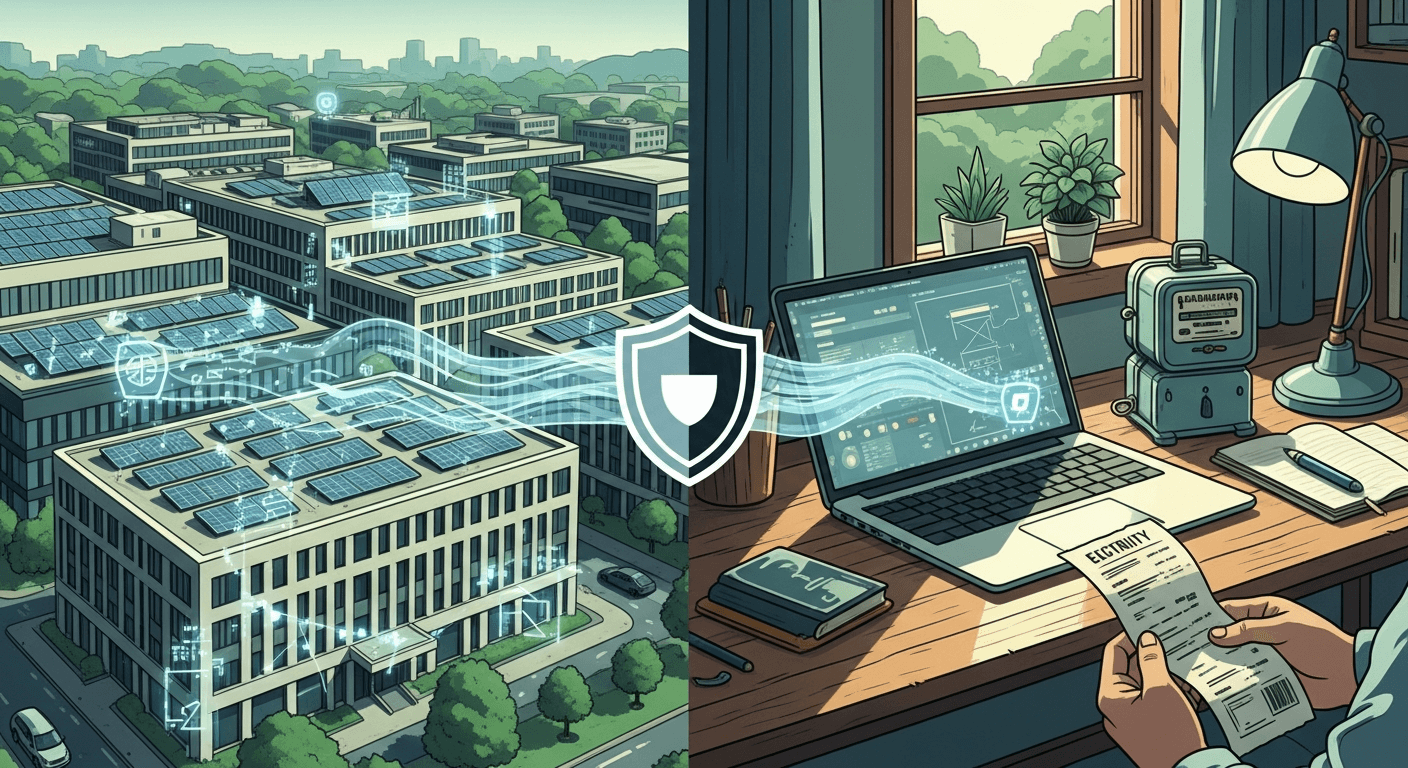
I woke up to my feed this week and saw a familiar — and uncomfortable — intersection of two trends: hybrid work and corporate sustainability. Infosys has asked employees who work from home to share details about their household electricity use so the company can better measure emissions that now happen outside its campuses. They launched a short survey asking about appliance use, wattage, and whether households use solar power, and have framed it as part of refining emissions reporting and designing better energy interventions Economic Times and Times of India.
Why this matters to me — and should to you
- Because corporate footprints are changing. Hybrid work has moved meaningful energy use from LEED-certified campuses into living rooms and rented flats. If a company truly wants to account for its greenhouse gas impact, it needs better data on that displaced load. The rationale here is straightforward: remote-work consumption often falls under tricky-to-measure Scope 3 emissions, and primary data beats assumptions.
- Because data is sensitive. Utility bills reveal more than kWh; they give clues about dwelling, consumption patterns, and behaviours inside homes. Asking employees for that information crosses a privacy boundary that we used to think separate professional life from private life.
A measured, first-person reaction
I applaud the intent. We need accurate information to design good climate policy — whether corporate or civic. Infosys has long invested in sustainability (renewables, captive plants, past work-from-home estimates) and is trying to revalidate assumptions rather than run on rough guesses Economic Times. That discipline matters. But intent is not a blank cheque for poor data practices.
My core concerns are simple: consent, minimisation, anonymisation, purpose limitation, and trust.
Practical guardrails I would insist on
- Explicit, informed consent: employees must know exactly what fields are collected, how they will be used, who will see them, and how long they will be retained.
- Minimal data collection: prefer aggregated monthly kWh or appliance-hours estimates over raw scanned bills with meter IDs or address lines. Collect only what’s essential to the stated purpose.
- Strong anonymisation and aggregation: individual bills should never be used to profile performance or compliance. Insights should be reported in aggregates or ranges that preserve anonymity.
- Transparent governance: publish a short, plain-language privacy impact statement and a data retention policy. Allow employees to opt out or submit estimates instead of bills.
- Independent audit: a third-party privacy and data-audit report would build trust that the information is used for emissions accounting and not, say, cost reallocation or surveillance.
- Benefits for employees: if the company asks for personal data that helps it reach corporate sustainability goals, offer reciprocal support — subsidies for energy-efficient appliances, low-cost home energy audits, credits toward rooftop solar, or preferential loans for home-efficiency retrofits.
What companies can do instead (or alongside a survey)
- Use anonymised, consented-sample approaches: randomly sample a representative subset of volunteers and extrapolate, rather than asking the entire workforce for bills.
- Sponsor smart metering and dashboards: invest in home smart meters or dashboard tools that report only aggregated work-hours consumption (and only with consent), rather than handing the company a full household usage record.
- Provide default values and calculators: allow employees to choose between uploading bills, entering appliance-hour estimates, or using a guided calculator that outputs anonymised kWh attributable to work.
- Reward energy-positive behaviour: turn participation into a benefit program — discounts on energy-efficient upgrades, recognition for home-solar adopters, or company-sponsored demand-response incentives.
How employees can respond (if you receive such a request)
- Ask for clarity: request the exact data fields, retention period, and how the company will anonymise and report the results.
- Share estimates, not detailed bills: provide monthly kWh for the dedicated work area or estimated appliance hours if you prefer not to share a full bill.
- Seek guarantees: request that the company publish an anonymised report and a privacy impact assessment.
This is not only a privacy debate — it is a design and ethics debate
Companies will increasingly ask for household-level data because their environmental obligations now sit across multiple scopes. But the way they collect, store, and use that data will define whether such efforts are embraced or resisted. If sustainability becomes an excuse to erode boundaries between employer and home, we will have lost sight of the social compact that made hybrid work tolerable in the first place.
A note about prediction and continuity
I have written and argued before about the role of smart meters, carbon calculators, and turning household energy data into actionable carbon policy — not as a way to surveil people, but to enable incentives and carbon finance models that reward better choices (see my earlier piece on smart meters and carbon calculators). My past suggestions were about embedding measurement into the grid in ways that enable carbon finance, proof-of-action, and incentives for households to adopt efficient appliances and rooftop solar Power Grid Corporation: Empower yourself with Smart-meter V 2.0.
If companies and governments design data collection thoughtfully, they can unlock incentives that convert home energy reductions into shared value. If they do it clumsily, they will breed distrust and push back — and we cannot afford that, either for climate action or for the social fabric that supports hybrid work.
My final, practical ask to any company running such a survey: show the math, show the protections, and show the benefits.
We can chase carbon reductions and still protect privacy. We must do both.
Regards,
Hemen Parekh
Any questions / doubts / clarifications regarding this blog? Just ask (by typing or talking) my Virtual Avatar on the website embedded below. Then "Share" that to your friend on WhatsApp.
Get correct answer to any question asked by Shri Amitabh Bachchan on Kaun Banega Crorepati, faster than any contestant
Hello Candidates :
- For UPSC – IAS – IPS – IFS etc., exams, you must prepare to answer, essay type questions which test your General Knowledge / Sensitivity of current events
- If you have read this blog carefully , you should be able to answer the following question:
- Need help ? No problem . Following are two AI AGENTS where we have PRE-LOADED this question in their respective Question Boxes . All that you have to do is just click SUBMIT
- www.HemenParekh.ai { a SLM , powered by my own Digital Content of more than 50,000 + documents, written by me over past 60 years of my professional career }
- www.IndiaAGI.ai { a consortium of 3 LLMs which debate and deliver a CONSENSUS answer – and each gives its own answer as well ! }
- It is up to you to decide which answer is more comprehensive / nuanced ( For sheer amazement, click both SUBMIT buttons quickly, one after another ) Then share any answer with yourself / your friends ( using WhatsApp / Email ). Nothing stops you from submitting ( just copy / paste from your resource ), all those questions from last year’s UPSC exam paper as well !
- May be there are other online resources which too provide you answers to UPSC “ General Knowledge “ questions but only I provide you in 26 languages !




No comments:
Post a Comment