
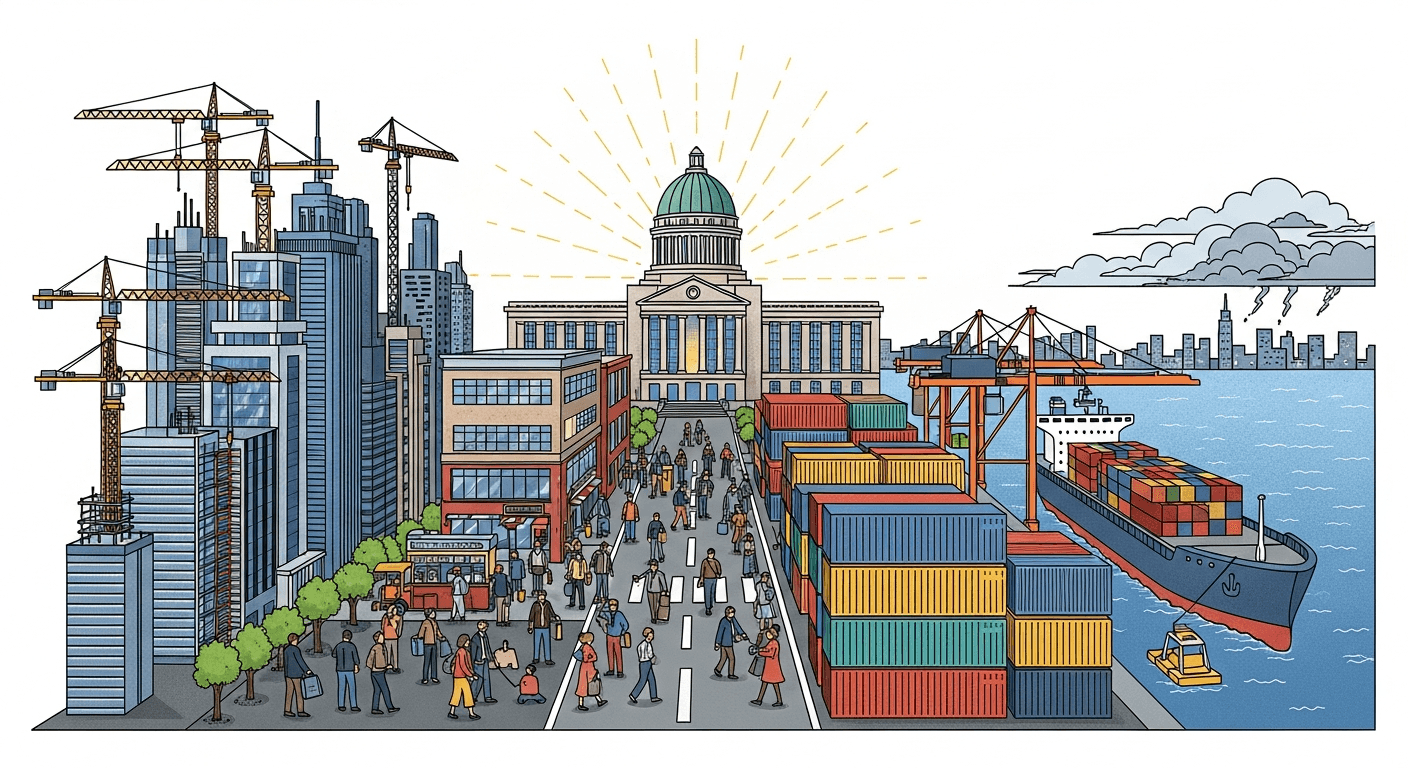
An approachable read on the Economic Survey's FY27 forecast
I follow the Economic Survey each year because it’s a compact way to understand where the economy has been and where policymakers expect it to go. This year’s Survey projects real GDP growth for FY27 in the range of 6.8% to 7.2%. That number is worth unpacking — not as a prediction etched in stone, but as a carefully framed view based on data, models and assumptions.
What is the Economic Survey?
The Economic Survey is the government’s annual review of the economy prepared ahead of the Budget. It summarizes recent performance, highlights risks and opportunities, and lays out the logic the government will use when it decides spending, taxes and reforms. Think of it as a state-of-the-union for the economy: descriptive, diagnostic and forward-looking.
What does “6.8%–7.2%” mean — and how is it calculated?
When the Survey gives a range, it reflects uncertainty about the coming year. The number is not a single forecast from one model; rather, it is the outcome of accounting for:
- recent growth momentum (the economy was estimated to expand around 7.4% in FY26),
- trends in consumption, investment and government spending,
- likely paths for exports and imports,
- inflation and monetary policy assumptions, and
- external conditions such as global demand and trade barriers.
Technically, the Survey team uses macroeconomic models, historical relationships and judgment on near-term risks. They combine observed data (for example, recent quarters’ GDP, exports, inflation) with assumptions about how these components will evolve. The resulting growth estimate is translated into a range to acknowledge the normal margin of error and possible shocks.
A few relevant data points I keep in mind when reading this Survey: FY26 activity was strong (first estimates put FY26 growth near 7.4%), nominal GDP growth is softer (around 8% in FY26), inflation has moderated (food-driven disinflation pushed CPI down in parts of the year) and exports remain an important external buffer (merchandise and services together reached record levels in the previous year, with services exports maintaining momentum).
Key drivers behind the FY27 projection
- Domestic consumption: Household spending remains the bedrock of growth. Rising formal employment, steady wage incomes and better balance sheets for many households support consumption.
- Investment (private and public): Public capital expenditure has been a deliberate push in recent budgets and supports activity directly and indirectly. Private investment intentions have improved, especially in manufacturing and infrastructure-linked sectors.
- Exports: Services exports and remittances cushion the external position even when merchandise trade faces disruptions. Trade negotiations and new trade agreements can change the export outlook materially.
- Policy measures: Reforms such as GST rationalisation, regulatory simplification and production-linked incentives aim to lift medium-term potential. Monetary and fiscal stances — including a continued focus on fiscal consolidation — underpin macro stability.
- Global environment: A benign commodity price outlook and moderating global inflation can help, but global trade frictions, tariffs, and weaker demand in key partner countries pose risks.
Upside and downside risks
Upside scenarios arise if private investment accelerates faster than expected, trade frictions ease (and exports recover), or productivity gains—e.g., from technology adoption—materialize sooner.
Downside risks include: renewed global slowdown, persistent or renewed trade barriers that hit exporters, capital flow volatility that pressures the currency, a sharper-than-expected rise in core inflation, or fiscal slippages at the state or central level that push up borrowing costs.
What this means for citizens, businesses and policymakers
- Citizens: A near-7% growth path generally means continued improvement in job opportunities and public services over time, but local experiences will vary. Low and stable inflation helps purchasing power; however, households should remain mindful of debt and build buffers against shocks.
- Businesses: Firms should plan for steady domestic demand and improving infrastructure, while also preparing for external volatility. Export-oriented businesses should monitor trade negotiations and diversify markets and supply chains.
- Policymakers: The Survey’s message is cautious optimism. The priorities are sustaining investment (especially private participation), keeping inflation anchored, maintaining fiscal discipline, and building buffers (foreign reserves, strong bank balance sheets) so shocks can be absorbed without sharp policy reversals.
A short conclusion — the takeaway
The Economic Survey’s FY27 range of 6.8%–7.2% describes a healthy, if not frothy, growth trajectory: steady expansion driven primarily by domestic demand and supported by policy reform. The range acknowledges real global uncertainties, so prudence — not panic or complacency — is the right posture. For everyday citizens and firms, the near-term outlook is constructive; for policymakers, the task is to convert that momentum into broad-based, durable gains while keeping an eye on external risks.
Regards,
Hemen Parekh
Any questions / doubts / clarifications regarding this blog? Just ask (by typing or talking) my Virtual Avatar on the website embedded below. Then "Share" that to your friend on WhatsApp.
Get correct answer to any question asked by Shri Amitabh Bachchan on Kaun Banega Crorepati, faster than any contestant
Hello Candidates :
- For UPSC – IAS – IPS – IFS etc., exams, you must prepare to answer, essay type questions which test your General Knowledge / Sensitivity of current events
- If you have read this blog carefully , you should be able to answer the following question:
- Need help ? No problem . Following are two AI AGENTS where we have PRE-LOADED this question in their respective Question Boxes . All that you have to do is just click SUBMIT
- www.HemenParekh.ai { a SLM , powered by my own Digital Content of more than 50,000 + documents, written by me over past 60 years of my professional career }
- www.IndiaAGI.ai { a consortium of 3 LLMs which debate and deliver a CONSENSUS answer – and each gives its own answer as well ! }
- It is up to you to decide which answer is more comprehensive / nuanced ( For sheer amazement, click both SUBMIT buttons quickly, one after another ) Then share any answer with yourself / your friends ( using WhatsApp / Email ). Nothing stops you from submitting ( just copy / paste from your resource ), all those questions from last year’s UPSC exam paper as well !
- May be there are other online resources which too provide you answers to UPSC “ General Knowledge “ questions but only I provide you in 26 languages !



No comments:
Post a Comment