
Why today feels different
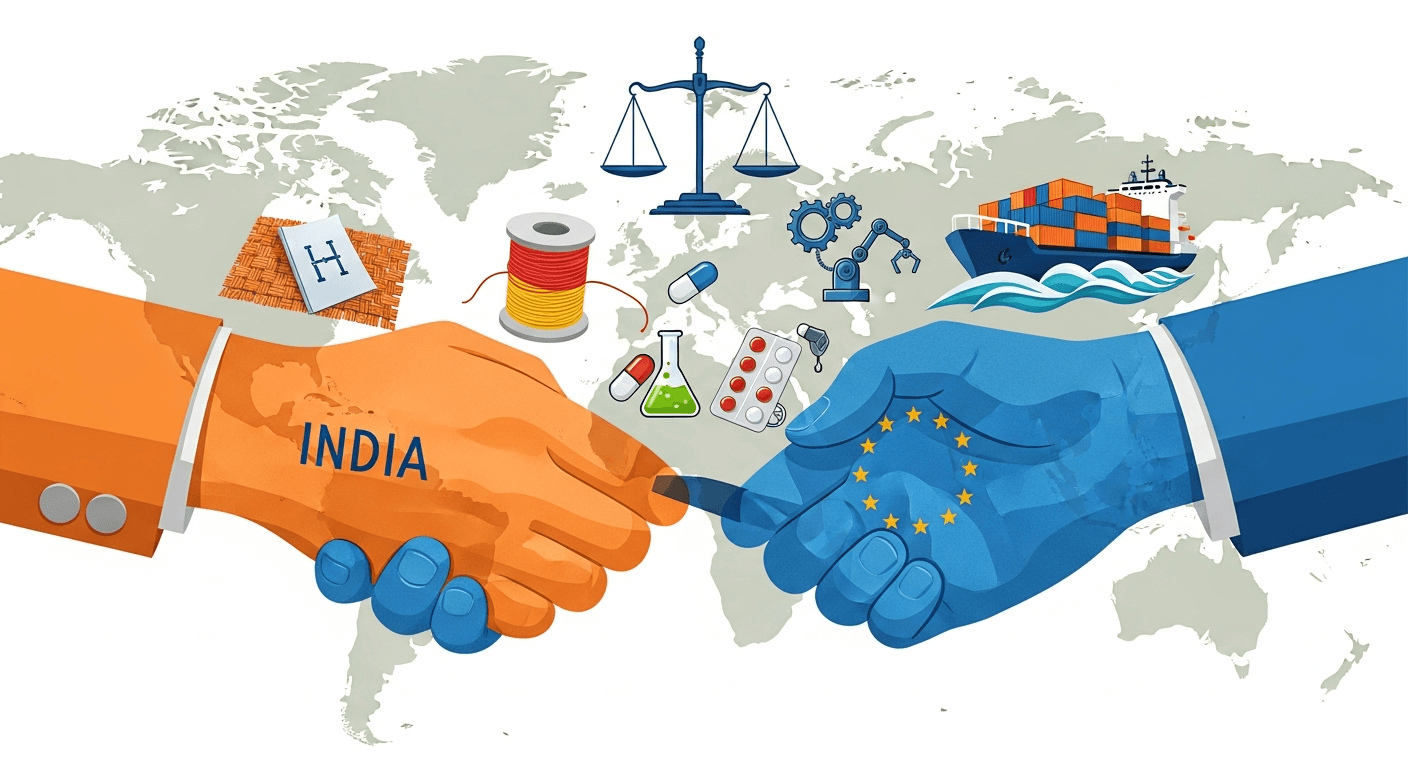
Today, after nearly two decades of starts, stops and intense negotiations, India and the European Union have finalised their Free Trade Agreement — a pact many have called the mother of all deals. I write this as someone who has long watched trade winds shift: the headlines tell us the negotiations are concluded, legal scrubbing is underway and a formal announcement is expected at the summit in New Delhi. What matters to me — and what I want to share with you — is the texture beneath the headlines: the opportunities, the risks and the reforms we must still accelerate to make this moment truly transformative for India.
A quick read on what the pact promises
- Preferential or duty‑free access for a wide range of Indian exports, especially labour‑intensive goods such as textiles, leather, gems & jewellery, footwear and certain chemicals.
- Lower barriers and clearer rules for services — telecom, transport, financial and professional services — which could unlock new markets for Indian professionals and firms.
- Parallel talks on investment protection and Geographical Indications (GI) that aim to protect unique Indian products in Europe and encourage two‑way investment.
- A strategic layer that goes beyond trade: defence cooperation, mobility frameworks and tech‑partnerships that will reposition India within global supply chains.
Why this matters now
Global trade rules are being rewritten in real time — higher tariffs, supply‑chain reconfigurations and geopolitical uncertainty have pushed buyers and suppliers to seek new, reliable partners. For India, a balanced FTA with the EU is more than tariff lines: it is a path to diversify export markets, reduce dependence on any single partner, and attract investment that ties production and technology to Indian soil.
From a practical view:
- Labour‑intensive exporters can see immediate relief on duties that have long constrained their competitiveness in Europe.
- Services firms gain clearer market access and regulatory predictability, which European clients often demand.
- Investors will get stronger legal frameworks, potentially unlocking large European capital in manufacturing, green tech and advanced services.
The cautions I keep returning to
I have written before about the fragility of the global trading system and how bilateral deals will increasingly shape economic realities My thoughts on trade wars and reforms. This FTA is a big step — but not a silver bullet. A few cautions:
- Implementation lag: ratification by the European Parliament and domestic procedures mean benefits won’t be instantaneous. Businesses must plan for staged implementation and transitional rules.
- Non‑tariff barriers: technical standards, climate and sustainability regulations, and rules of origin can blunt gains if domestic producers are unprepared. Policy support to meet standards will be crucial.
- Distribution of gains: unless we combine the FTA with active MSME support, skills upgrading and logistics investment, the benefits may concentrate among a few large exporters.
- Strategic dependencies: closer integration is desirable, but we must avoid creating single‑source dependencies in critical inputs.
What I want policymakers and industry to focus on — now
- Accelerate cost‑reducing reforms in logistics, credit and compliance so our small and medium exporters can meet European standards and delivery timelines.
- Launch focused export‑readiness programs for labour‑intensive sectors (textiles, leather, footwear) that combine quality upgrades, design collaboration and market intelligence.
- Invest in certification labs, testing facilities and GI protection to ensure Indian products meet EU regulatory and brand requirements.
- Use parallel investment instruments to anchor European suppliers here: cluster‑level incentives, ease of doing business in targeted corridors, and collaboration on decarbonisation tech.
A personal take on the strategic angle
I welcome the fact that this agreement sits within a broader strategic agenda. Trade cannot be isolated from security, technology and mobility. A modern economic partnership needs to include measures that make joint production practical and predictable. At the same time, India must hold to the principle of negotiating from national interest — not haste. A balanced deal is worth waiting for; a rushed deal that leaves core sectors exposed is not.
Connect the dots with what I’ve written before
This moment validates a theme I’ve repeatedly emphasised: multilateral vacuum pushes countries towards bilateral, pragmatic partnerships — and that only those who reform at home will fully harvest the gains. For readers who followed my earlier reflections on trade dynamics and the need for domestic cost competitiveness, this FTA is a reminder that policy reforms and trade openings must proceed together Read more of my earlier reflections.
Final thought — opportunity with responsibility
The India–EU FTA is an important strategic win. It can accelerate jobs, technology transfer and deeper engagement with Europe. But an agreement on paper will deliver only if Indian industry modernises rapidly and government complements market access with smart support. I feel hopeful — cautiously so — and I believe the coming months will test our readiness to convert diplomatic achievement into shared prosperity.
Regards,
Hemen Parekh
Any questions / doubts / clarifications regarding this blog? Just ask (by typing or talking) my Virtual Avatar on the website embedded below. Then "Share" that to your friend on WhatsApp.
Get correct answer to any question asked by Shri Amitabh Bachchan on Kaun Banega Crorepati, faster than any contestant
Hello Candidates :
- For UPSC – IAS – IPS – IFS etc., exams, you must prepare to answer, essay type questions which test your General Knowledge / Sensitivity of current events
- If you have read this blog carefully , you should be able to answer the following question:
- Need help ? No problem . Following are two AI AGENTS where we have PRE-LOADED this question in their respective Question Boxes . All that you have to do is just click SUBMIT
- www.HemenParekh.ai { a SLM , powered by my own Digital Content of more than 50,000 + documents, written by me over past 60 years of my professional career }
- www.IndiaAGI.ai { a consortium of 3 LLMs which debate and deliver a CONSENSUS answer – and each gives its own answer as well ! }
- It is up to you to decide which answer is more comprehensive / nuanced ( For sheer amazement, click both SUBMIT buttons quickly, one after another ) Then share any answer with yourself / your friends ( using WhatsApp / Email ). Nothing stops you from submitting ( just copy / paste from your resource ), all those questions from last year’s UPSC exam paper as well !
- May be there are other online resources which too provide you answers to UPSC “ General Knowledge “ questions but only I provide you in 26 languages !



No comments:
Post a Comment