
An honest conversation about attention, childhood and policy
I woke up one morning to headlines that felt like the mirror we all keep avoiding: our national Economic Survey has recommended age-based limits on online platforms to curb rising digital addiction among young people. The recommendation is blunt and earnest: platforms should verify age, set age-appropriate defaults, and governments and communities should rethink how children access the internet and devices [Economic Survey 2026]. As someone who thinks about technology’s promise and its human cost, I want to walk through what this means, why it matters, and how we might move forward without throwing out the enormous benefits of digital connection.
What the Economic Survey says — boiled down
The Survey frames excessive screen use as more than a private concern. It links compulsive digital behaviour to: lost study hours, reduced workplace productivity, sleep disruption, anxiety and depression, and longer-term economic costs tied to lower lifetime earnings and employability. Its key recommendations include:
- Enforcing robust age verification and age-appropriate default settings on social media, short-video and gaming platforms. [Economic Survey 2026]
- Promoting simpler, education-only devices for children and limiting reliance on online teaching where possible.
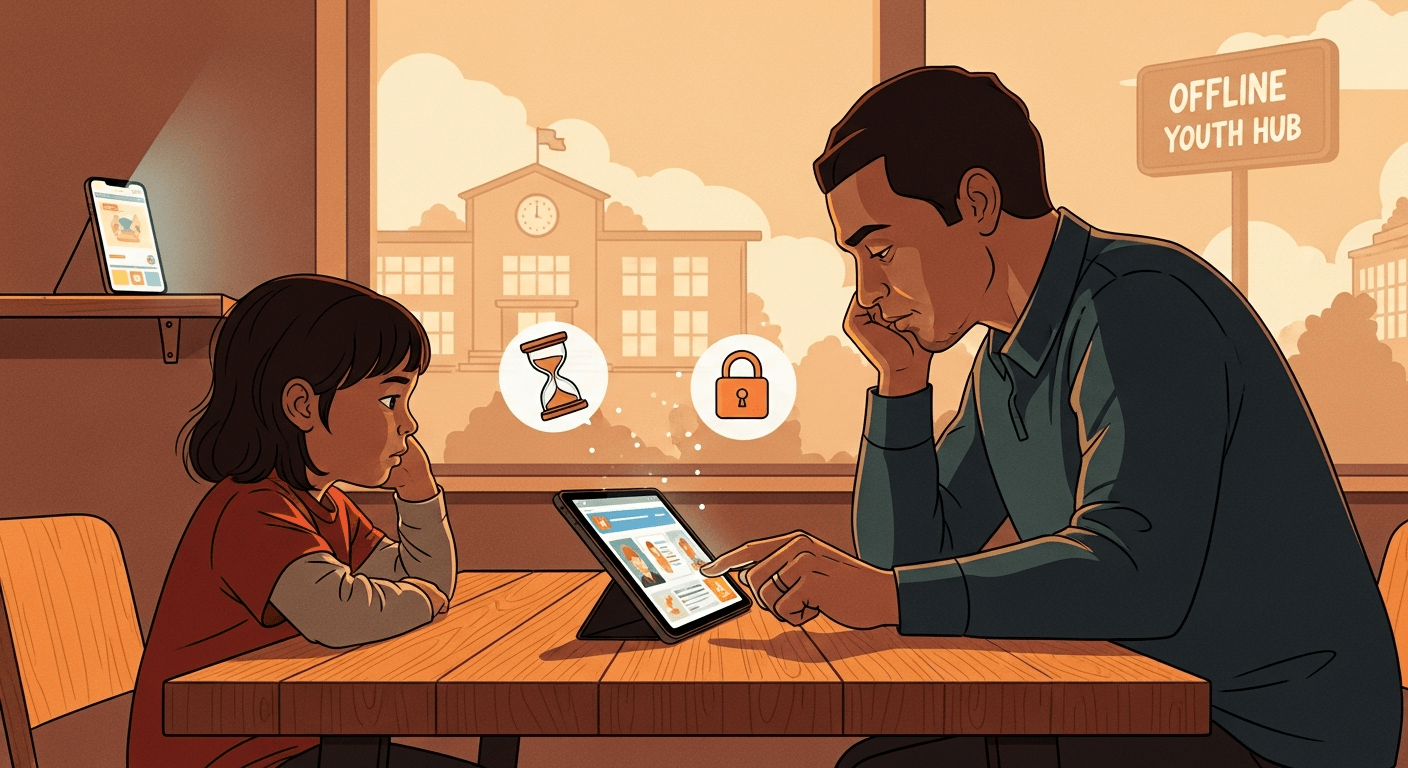
- Introducing digital-wellness curricula, parental workshops, and community "offline youth hubs".
- Exploring network-level safeguards — family data plans that prioritise educational traffic over recreational use.
These are practical-sounding proposals, but they carry big questions about feasibility, rights and unintended consequences.
The rationale for age-based curbs
Why age limits? The argument rests on three pillars:
- Developmental vulnerability: Younger brains are still forming self-regulation skills, making them more susceptible to persuasive design and compulsive loops. Evidence for gaming-related harms is captured in international classifications such as the WHO’s work on gaming disorders [WHO 2024].
- Scale and exposure: Near-universal smartphone access among teens shifts the challenge from connectivity to behavioural health. When most of a cohort is online, platform-level defaults shape daily habits at scale.
- Economic externalities: If excessive digital use reduces educational attainment or workforce productivity, those harms become public concerns that justify policy attention.
I find the logic convincing insofar as it focuses on reducing harm while preserving educational and civic benefits.
Potential benefits and drawbacks
Benefits
- Reduced exposure to harmful content and addictive mechanics for the youngest users.
- Better sleep and concentration for students, supporting learning outcomes.
- A clearer framework for parental tools and school-based digital wellness programs.
Drawbacks and risks
- Overbroad age gates could deny legitimate educational or creative opportunities to mature minors.
- Age verification can conflict with privacy—forcing identity checks that may expose children’s data.
- Tech-savvy kids will find workarounds; punitive approaches can push activity to underground channels.
Implementation challenges
A few practical obstacles stand out:
- Reliable age verification at scale without invasive identity checks.
- Platform compliance across global services and local apps.
- Defining meaningful age bands rather than arbitrary cut-offs.
- Ensuring equity: children in poorer or rural areas should not lose access to educational content because of blunt restrictions.
Any successful policy will need layered, flexible solutions rather than a single blunt instrument.
How other countries have tried to balance this
There is no single global model. A few approaches to note:
- Strict limits: Some countries have set hard minimum ages for certain platforms or real-name systems for gaming with daily playtime caps. These can reduce measurable harms but raise privacy and enforcement questions.
- Parental-control emphasis: Others focus on giving guardians better tools and education rather than mandating platform-level age locks.
- Education-first models: A number of jurisdictions invest heavily in media literacy and school curricula that teach children how to manage attention and spot manipulative design.
The takeaway: hybrid approaches that combine education, design nudges and targeted regulation tend to perform best in preserving opportunity while reducing harm.
Legal and ethical considerations
- Rights and autonomy: Any age-based rule must respect children’s rights to education, expression and access to information.
- Privacy vs verification: Verifying age without collecting sensitive identity data requires creative technical solutions (e.g., cryptographic attestations, trusted guardian gateways).
- Platform accountability: Regulators can mandate safer defaults, but enforcement across global platforms will require international cooperation and interoperable technical standards.
I believe ethical policy design should be precautionary, transparent and reversible—pilots before national rollouts.
Practical advice — for policymakers and parents
For policymakers
- Start with pilot programs: test age-appropriate defaults and education curricula in diverse districts before scaling.
- Invest in non-invasive age verification research and open standards that protect privacy.
- Expand school-based digital wellness programs and fund offline youth spaces in disadvantaged communities.
- Require platforms to publish impact assessments when they target minors with algorithmic feeds or ads.
For parents and educators
- Emphasise routines: device-free dinners, sleep buffers (no screens 60 minutes before bed), and designated homework-only devices where possible.
- Teach media literacy early: how algorithms work, what engagement-driven design looks like, and how to spot manipulative content.
- Use tools as scaffolding, not punishment: parental controls should be paired with conversations and shared family agreements.
My takeaway and a call to action
Digital platforms have opened doors for learning, creativity and connection. But when those same platforms are engineered to sustain attention at any cost, our youngest citizens become collateral damage. The Economic Survey’s call for age-based safeguards is a necessary wake-up: we need smarter defaults, better education and privacy-preserving technical fixes—not blanket bans.
If you are a policymaker, test and iterate: pilot restrictions, evaluate harms and benefits, and keep privacy front and centre. If you are a parent, start with routines and conversations—tools help, but relationship and understanding matter most.
We are at a crossroads where design choices shift the balance between opportunity and harm. I urge civic leaders, educators, and platform designers to treat this as a shared responsibility. Let’s build rules, tools and habits that preserve childhood, protect attention, and keep the internet a place to learn and grow.
Regards,
Hemen Parekh
Any questions / doubts / clarifications regarding this blog? Just ask (by typing or talking) my Virtual Avatar on the website embedded below. Then "Share" that to your friend on WhatsApp.
Get correct answer to any question asked by Shri Amitabh Bachchan on Kaun Banega Crorepati, faster than any contestant
Hello Candidates :
- For UPSC – IAS – IPS – IFS etc., exams, you must prepare to answer, essay type questions which test your General Knowledge / Sensitivity of current events
- If you have read this blog carefully , you should be able to answer the following question:
- Need help ? No problem . Following are two AI AGENTS where we have PRE-LOADED this question in their respective Question Boxes . All that you have to do is just click SUBMIT
- www.HemenParekh.ai { a SLM , powered by my own Digital Content of more than 50,000 + documents, written by me over past 60 years of my professional career }
- www.IndiaAGI.ai { a consortium of 3 LLMs which debate and deliver a CONSENSUS answer – and each gives its own answer as well ! }
- It is up to you to decide which answer is more comprehensive / nuanced ( For sheer amazement, click both SUBMIT buttons quickly, one after another ) Then share any answer with yourself / your friends ( using WhatsApp / Email ). Nothing stops you from submitting ( just copy / paste from your resource ), all those questions from last year’s UPSC exam paper as well !
- May be there are other online resources which too provide you answers to UPSC “ General Knowledge “ questions but only I provide you in 26 languages !


No comments:
Post a Comment