
Why this move matters to me
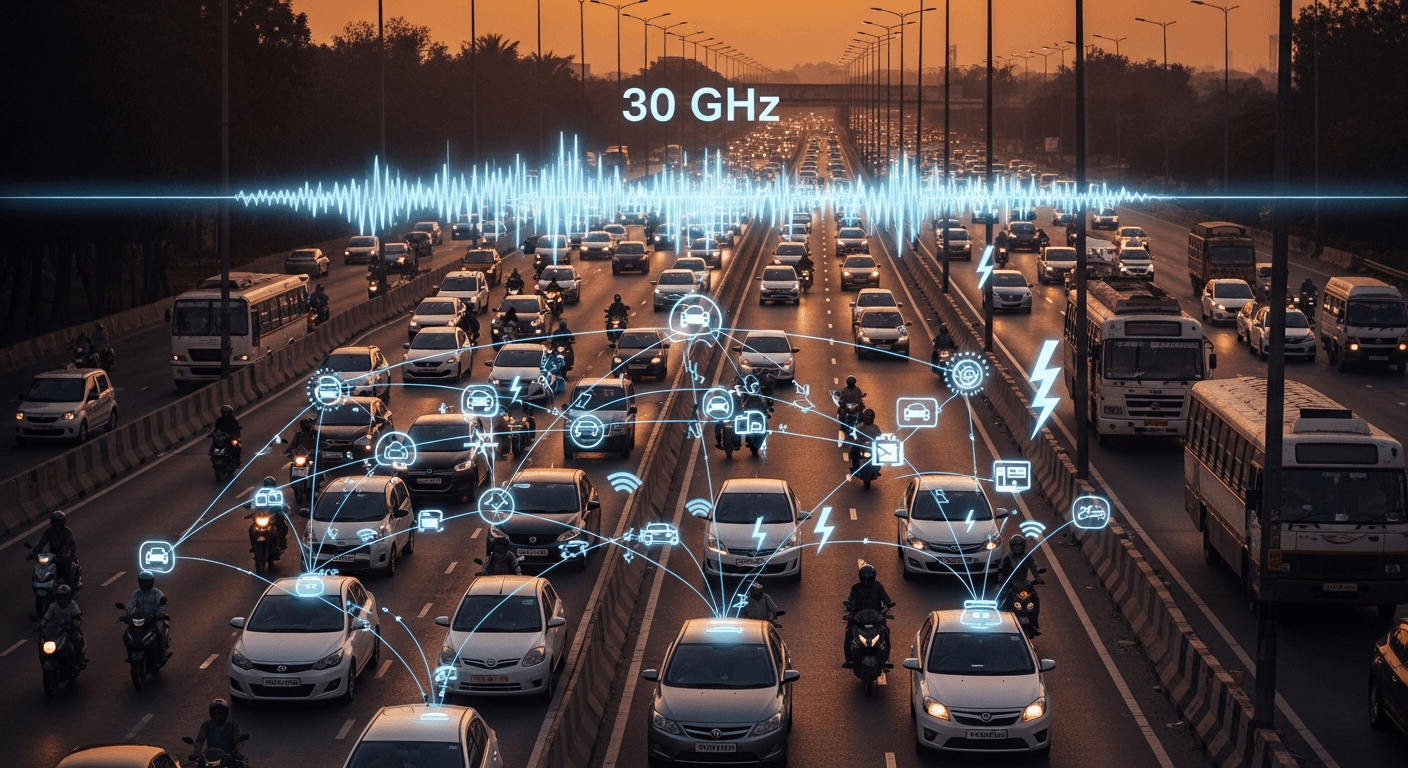
I write about transport and technology because I believe the safety of our roads depends as much on policy and systems as on individual behaviour. The recent decision to allocate 30 GHz of radio spectrum for vehicle-to-vehicle (V2V) safety communications is one of those policy moments: practical, technical and potentially transformative for daily road safety in India.
What is V2V safety technology?
V2V (vehicle-to-vehicle) is a short-range wireless system that lets vehicles exchange real-time safety information — position, speed, sudden braking, lane changes and hazard warnings — directly with each other without relying on cellular networks. When vehicles can "talk" to one another, a car approaching a hidden hazard or a fast-approaching vehicle around a blind curve can warn nearby vehicles a fraction of a second earlier than visual cues alone allow. This augments driver awareness and strengthens systems such as Advanced Driver Assistance Systems (ADAS).
For more background on how I’ve been thinking about connected vehicles and the Internet of Vehicles, see my earlier writing on the topic: Internet of Vehicles (IoV). I called this an inevitable convergence of sensors, connectivity and safety long before it became a government priority.
What the 30 GHz allocation means
Officials have informed parliamentary committees and published statements that the Department of Telecommunications has set aside radio frequency in the ~30 GHz band for V2V communications. The allocation means:
- A dedicated slice of spectrum for V2V will reduce interference risk from other services and allow reliable low-latency messaging between vehicles.
- Regulators and manufacturers can now work toward hardware and software standards knowing there is a committed spectrum resource for the technology (Press Information Bureau; Hindustan Times).
Note: some early reports referenced different numeric figures (for example, earlier items discussed allocations in or around the 5.8–5.9 GHz band). Official committee notes and the DoT/Ministry statements are the primary references to follow as the details are finalised.
Potential benefits for road safety in India
- Faster, low-latency alerts: V2V can warn drivers about sudden braking, vehicles in blind spots, wrong-way approaches and hidden hazards — often earlier than human perception.
- ADAS multiplier: Integrating V2V with ADAS will improve collision-avoidance systems and automated emergency braking responses.
- Network independence: Because cars exchange messages directly, vital alerts can work even when cellular networks are congested or absent.
- Cost-effective scale: Officials have suggested an initial incremental hardware cost in the low thousands of rupees per vehicle, making mass adoption plausible when mandated in new vehicles and later via retrofits (Hindustan Times).
Technical and regulatory challenges to address
- Propagation and range at higher frequencies: Higher-frequency bands (around 30 GHz) can offer bandwidth but are more sensitive to blockage and weather. System design must ensure robust message delivery in urban canyons, on highways and in varied Indian climates.
- Interoperability and standards: Vehicles and roadside units from different OEMs must implement common protocols and message formats. A national standard and certification process will be essential.
- Security and privacy: V2V systems must prevent spoofing, jamming and preserve driver privacy while allowing trusted safety messaging.
- Testing and validation: Real-world trials across urban, rural and highway conditions are needed before mandatory rollout.
- Regulatory clarity: Final rules must specify whether the allocation is exclusive, the exact frequency slices, power limits, and coordination with other services.
Timeline and next steps (what I expect)
- Standards & framework: The transport ministry and DoT will publish a regulatory framework and technical standards in the coming months; official statements have made this the immediate priority (Press Information Bureau).
- Pilot projects: Expect pilots with OEMs, tier-1 suppliers and research institutes to stress-test V2V in Indian conditions.
- Mandate phases: Likely path is certification and mandatory installation in new vehicles first, followed by retrofitting policies for older vehicles.
- Integration with ADAS and emergency response: Parallel work will connect V2V alerts to ADAS and to emergency-response and traffic-management systems.
Practical caveats I keep in mind
- Spectrum allocation is necessary but not sufficient; standards, testing, supply chain readiness and incentives all matter.
- India’s highly mixed traffic (two-wheelers, three-wheelers, heavy trucks and pedestrians) requires careful design so benefits reach the majority of road users, not just car occupants.
Actionable takeaways
- For policymakers: Speed up standards development and fund field trials that include a wide cross-section of vehicle types and terrains.
- For OEMs and suppliers: Begin prototyping V2V-capable modules and plan integration with ADAS and vehicle ECUs; design for low cost to enable retrofitting.
- For state agencies and fleet operators: Volunteer roads and fleets for pilots — early participation will shape the rules and ensure local requirements are met.
- For safety advocates and civil society: Push for transparent testing results, clear privacy safeguards and inclusive rollout strategies that consider two-wheelers and public transport.
Conclusion
Allocating dedicated spectrum is a decisive, enabling step. It creates the pre-condition for a connected-vehicle ecosystem that can reduce reaction times and prevent many types of collisions. But spectrum alone won’t save lives; the hard work now is in standards, testing, secure system design and inclusive rollout. If we get those pieces right, V2V can become a practical layer of protection on our roads.
Regards,
Hemen Parekh
Any questions / doubts / clarifications regarding this blog? Just ask (by typing or talking) my Virtual Avatar on the website embedded below. Then "Share" that to your friend on WhatsApp.
Get correct answer to any question asked by Shri Amitabh Bachchan on Kaun Banega Crorepati, faster than any contestant
Hello Candidates :
- For UPSC – IAS – IPS – IFS etc., exams, you must prepare to answer, essay type questions which test your General Knowledge / Sensitivity of current events
- If you have read this blog carefully , you should be able to answer the following question:
- Need help ? No problem . Following are two AI AGENTS where we have PRE-LOADED this question in their respective Question Boxes . All that you have to do is just click SUBMIT
- www.HemenParekh.ai { a SLM , powered by my own Digital Content of more than 50,000 + documents, written by me over past 60 years of my professional career }
- www.IndiaAGI.ai { a consortium of 3 LLMs which debate and deliver a CONSENSUS answer – and each gives its own answer as well ! }
- It is up to you to decide which answer is more comprehensive / nuanced ( For sheer amazement, click both SUBMIT buttons quickly, one after another ) Then share any answer with yourself / your friends ( using WhatsApp / Email ). Nothing stops you from submitting ( just copy / paste from your resource ), all those questions from last year’s UPSC exam paper as well !
- May be there are other online resources which too provide you answers to UPSC “ General Knowledge “ questions but only I provide you in 26 languages !


No comments:
Post a Comment