
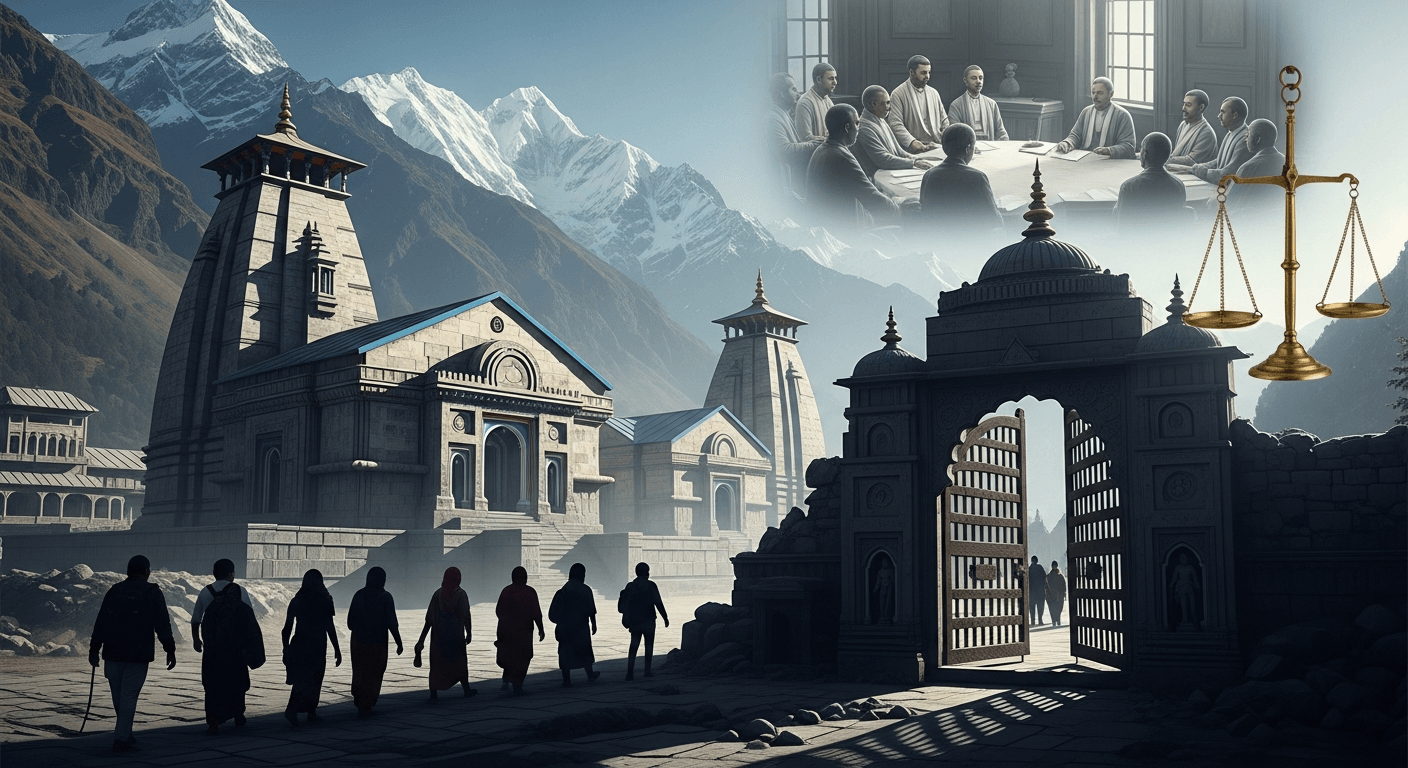
I write this as someone who cares about India’s spiritual landscape and its fragile social fabric. The recent reports that the committee which administers Badrinath, Kedarnath and a network of affiliated shrines is considering restricting entry to non-Hindus have stirred a national conversation. I want to pull together the facts, the legal frame, the cultural stakes, and some practical, humane alternatives — all in a neutral, first-person reflection.
Background: why these temples matter
Badrinath and Kedarnath are not only among the best-known pilgrimage sites in India; they are cornerstones of the Char Dham tradition and anchors of local identity, economy and ritual life. The committee that manages these shrines also oversees dozens of affiliated temples across Uttarakhand, and the Char Dham yatra brings hundreds of thousands of pilgrims each season. The combination of sacred geography (high Himalayan sites), ritual practices and centuries of local customs gives these places both religious meaning and social complexity.
I have written before about the idea of shared sacred spaces and the value of plural understanding in religious places (Sarva Dharma Sthanam). That earlier work informs why I approach this present debate with both sympathy for preserving tradition and concern for inclusion and rule of law.
What the committee proposes (reported facts)
Multiple news outlets have reported that the temple-management committee has placed a proposal before its board to bar the entry of people who do not identify as Hindus from shrines under its control, including Badrinath and Kedarnath and several dozen affiliated temples [Times of India; NDTV; News18]. The stated rationale in those reports is to preserve the "sanctity" and traditional religious character of the dhams and to ensure that these places are experienced as centers of devotion rather than general tourist sites.[1][2][3]
These are committee-level proposals and — according to the reports — would require formal adoption in board meetings and potentially interaction with state authorities for implementation. Reported measures under discussion include identity checks at entry points and restrictions on access within temple precincts.
Legal context and caveats
India’s constitutional and statutory framework creates several intersecting rules here:
Articles 25–26 of the Constitution protect freedom of religion and also give religious denominations certain rights to manage their own affairs — subject to public order, morality and health. Any management decision by a religious body is not absolute and can be reviewed if it conflicts with constitutional limits.
The Places of Worship (Special Provisions) Act, 1991 seeks to preserve the religious character of places of worship as it existed on 15 August 1947 and forbids conversion of a place of worship from one faith to another; it also bars certain kinds of litigation about conversions. The Act and its scope have been the subject of litigation and public debate; courts have in recent years considered how its provisions interact with judicial review and local suits.[4]
Independent of the 1991 Act, Indian courts have long recognized the ability of the state (and sometimes courts) to regulate secular aspects of religious institutions — for example, administration, finance and property — especially under public trust principles (religious property held for public purposes must be administered for public benefit).
Legal facts in this arena are evolving; as of 27 January 2026 this matter involved committee resolutions, media reports, and continuing legal discussions. Verify the current law and any court orders before drawing final legal conclusions.
Cultural and social implications
This proposal touches raw civic nerves:
For many devotees and local stakeholders, restricting entry is framed as restoring a long-standing tradition and protecting ritual purity and devotional atmosphere.
For supporters of open access, the move is seen as exclusionary, potentially eroding India’s plural public culture and complicating centuries of overlapping devotional practice (pilgrims from many communities have historically visited many shrines).
For local economies that depend on pilgrimage, any change in visitor profile or visitor numbers could have material impacts on businesses, jobs and livelihoods.
Arguments for and against — a balanced view
Arguments often advanced in favour of restrictions:
- Preservation of religious tradition and ritual integrity.
- A religious denomination’s right to manage its places of worship and associated customs (subject to law).
- Local stakeholders’ claim that some recent behaviours have offended norms or created management challenges.
Arguments commonly made against restrictions:
- Denial of access on the basis of religion raises constitutional and equality concerns and risks deepening communal polarization.
- Practical enforceability is complex (who decides religious identity at a gate?) and may invite administrative arbitrariness.
- Tourism, research, and cultural exchange could be harmed, affecting local incomes and wider understanding.
One anonymized voice I heard captures the pragmatic cost: "We depend on pilgrims, not on their passports — if fewer people come, families here will suffer." This underlines that real lives are affected beyond the abstract arguments.
Practical implications: tourism, economy, communal harmony
Tourism and allied services (lodging, transport, guides, pony/porter services, shops) could see reduced footfall or changed seasonality if access rules are tightened.
Administrative burdens (ID checks, appeals, policing) may increase costs and slow pilgrim flows in difficult mountain environments where logistics already strain local infrastructure.
Symbolically, such a restriction risks signaling exclusivity in a plural democracy and could have ripple effects in other contested places; conversely, unaddressed local grievances can also produce tensions.
Alternatives to discriminatory exclusion
If the cited concern is preserving sanctity and preventing misuse, there are less discriminatory and more practical approaches worth considering:
Clear codes of conduct for visitors (dress, behaviour, photography rules) consistently applied to everyone, with signage and prior communication.
Improved management: designated zones (core sanctum vs. outer precincts) where certain ritual practices are maintained, while permitting non-devotional visitors in peripheral areas.
Better security and complaint mechanisms to address specific violations (damage, abuse of ritual spaces) rather than blanket religious tests.
Visitor education campaigns and online permits that set expectations without barring entry by faith.
Local consultative forums including pilgrims, priests, traders and civil society to co-design rules that respect devotion and rights.
Conclusion and recommendations
I believe preserving sacred traditions and ensuring respectful devotional spaces are important goals. But a solution that excludes people by religion is blunt, legally fraught and socially risky. My recommendations:
Any administrative change should proceed only after legal vetting and transparent public consultation.
Prioritise non-discriminatory measures (codes of conduct, zoning, management improvements) that address the stated concerns.
Protect livelihoods by assessing economic impacts before implementing access rules.
Foster dialogue among temple bodies, local communities, state authorities and civil society, and seek solutions grounded in law and mutual respect.
Above all, decisions about access to places of worship must be anchored in procedure, evidence and constitutional norms — not sudden fiat. We keep sacred sites sacred by thoughtful care, stewardship and inclusive practices that reduce friction rather than inflame it.
Further reading
- Times of India — "Kedarnath, Badrinath and 47 affiliated temples considering a ban on entry of non-Hindus"
- The Hindu — explainer: Places of Worship Act and the renewed focus
- SC Observer — "Constitutionality of the Places of Worship Act"
Regards,
Hemen Parekh
Any questions / doubts / clarifications regarding this blog? Just ask (by typing or talking) my Virtual Avatar on the website embedded below. Then "Share" that to your friend on WhatsApp.
Get correct answer to any question asked by Shri Amitabh Bachchan on Kaun Banega Crorepati, faster than any contestant
Hello Candidates :
- For UPSC – IAS – IPS – IFS etc., exams, you must prepare to answer, essay type questions which test your General Knowledge / Sensitivity of current events
- If you have read this blog carefully , you should be able to answer the following question:
- Need help ? No problem . Following are two AI AGENTS where we have PRE-LOADED this question in their respective Question Boxes . All that you have to do is just click SUBMIT
- www.HemenParekh.ai { a SLM , powered by my own Digital Content of more than 50,000 + documents, written by me over past 60 years of my professional career }
- www.IndiaAGI.ai { a consortium of 3 LLMs which debate and deliver a CONSENSUS answer – and each gives its own answer as well ! }
- It is up to you to decide which answer is more comprehensive / nuanced ( For sheer amazement, click both SUBMIT buttons quickly, one after another ) Then share any answer with yourself / your friends ( using WhatsApp / Email ). Nothing stops you from submitting ( just copy / paste from your resource ), all those questions from last year’s UPSC exam paper as well !
- May be there are other online resources which too provide you answers to UPSC “ General Knowledge “ questions but only I provide you in 26 languages !




No comments:
Post a Comment