
Lead
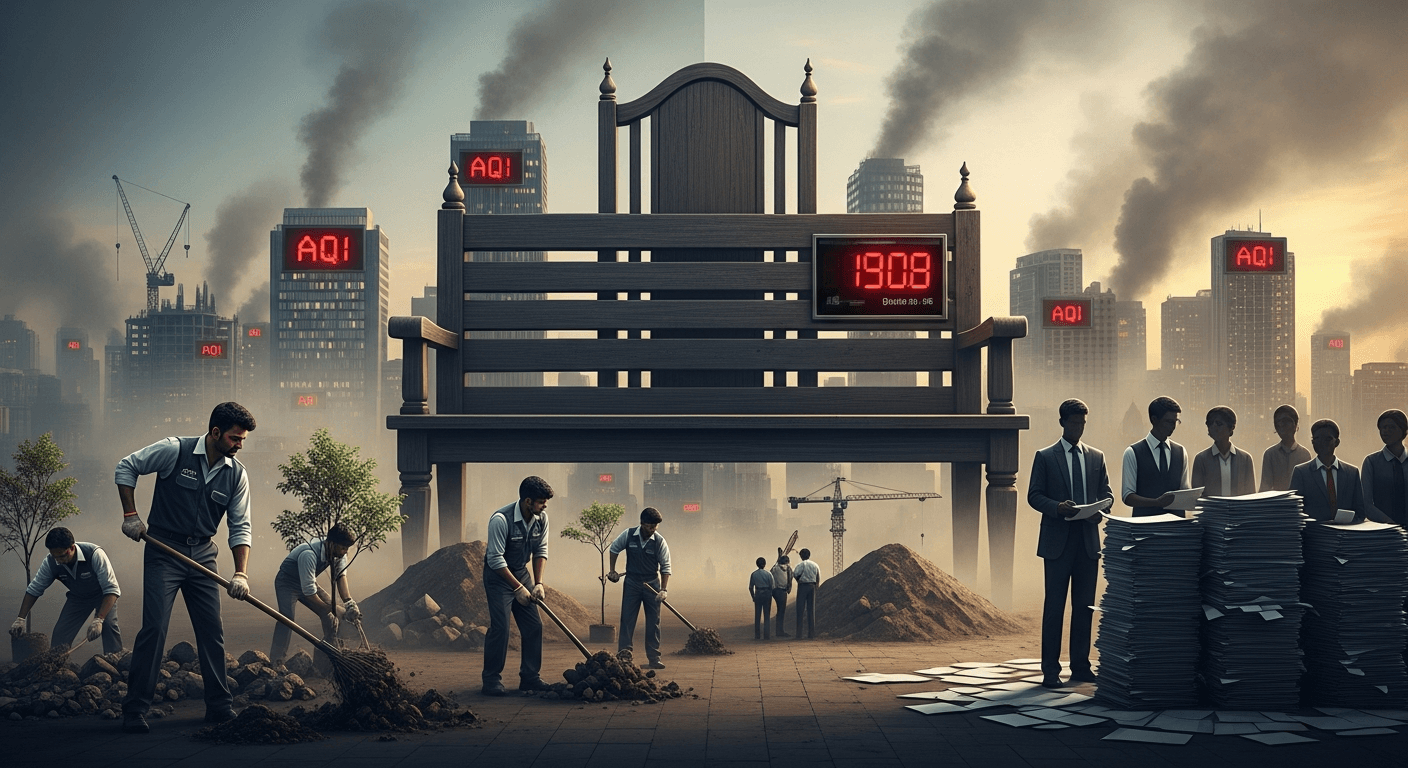
The Bombay High Court has sharply reprimanded the Brihanmumbai Municipal Corporation (BMC) and the Navi Mumbai Municipal Corporation (NMMC) for failing to stem a recent spike in air pollution across the Mumbai metropolitan region — warning, in stark terms, that it may withhold civic commissioners’ salaries if statutory duties are not performed. The bench has framed the deterioration in air quality as an emergency that cannot be met by court hearings alone; it has demanded hard data, ward‑wise monitoring records and swift enforcement while signalling coercive measures if administrations remain lackadaisical (Hindustan Times, NDTV, LiveLaw).
Context and what the court said
A suo motu PIL on air quality, opened in 2023, has returned to the court’s active docket after fresh intervention applications and a documented fall in AQI readings across the region. The bench has criticised both civic bodies for reactive — and apparently court‑prompted — compliance rather than continuous, ward‑level mitigation. It has asked the BMC for daily sensor records for the months leading up to November 2025, ordered fresh inspections of flagged sites in Navi Mumbai and warned of "coercive" penalties, including halting pay, if officers do not act decisively.
"If civic leadership cannot be held to account for the air their citizens breathe, the court will consider harsher remedies."
Mumbai’s air: the background and trajectory
Mumbai’s pollution profile is complex: combustion from vehicles, construction dust, industrial point sources, open burning and secondary particulate formation all contribute. Since late 2025 several mainstream reports documented sustained AQI readings in the ‘poor’ to ‘very poor’ ranges in pockets across the metropolitan region, with media and independent monitors occasionally diverging from municipal data. Authorities have rolled out sensor mandates for construction sites and begun limited installation of monitors, but reporting gaps — particularly ward‑wise and in central dashboards — undermine trust and timely intervention (Times of India, Hindustan Times).
Legal and administrative limits
High Courts in India have broad powers under public interest litigation doctrine and contempt/responsibility mechanisms; they can direct enforcement, ask for data, appoint committees and impose fines. But a court cannot substitute for executive governance: it can compel and even apply coercive sanctions, yet long‑term air quality improvement ultimately requires administrative design, financing and coordination between municipal corporations, the state pollution control board and transport and industry departments. LiveLaw’s coverage summarises the court’s arsenal and the limits of judicial remedy in environmental governance (LiveLaw).
Reactions from the civic bodies
The BMC has defended its actions in court filings, noting stop‑work notices and partial monitor installation at construction sites; the NMMC’s filings drew judicial ire for procedural lapses. Those responses underline two things: authorities are aware of regulatory levers, and they still appear to be taking many steps only after judicial prompting. Whether such measures become sustained operational practice — including central dashboard connectivity and ward‑level accountability — remains the central question.
Implications for policy and citizens
Public health: short‑term spikes in PM2.5 and PM10 translate into increased respiratory visits, exacerbations of chronic disease and lost productivity. Transport and industry: construction and diesel‑dominated fleets are immediate targets for action. Commuters and children in schools are the visible victims; the invisible cost is long‑term morbidity.
What civic bodies must do — short term and long term
Short term
- Publish ward‑wise daily AQI on an open dashboard; connect all site monitors to a central system.
- Enforce a graded response action plan (GRAP) tied to measured AQI bands — immediate stop‑work and fines when thresholds breach.
- Prioritise dust suppression at construction sites, compel covered transport of materials, and restrict diesel generator use during high AQI days.
- Offer temporary public transport incentives (reduced fares, extra buses) and staggered school/work hours on bad days.
Long term
- Maintain a public, high‑resolution emission inventory and source apportionment to prioritise interventions (BMC has started inventory work in earlier initiatives). See my earlier notes on emission inventories and targeted measures (Hemen Parekh blog on emission inventory).
- Invest in public transport, EV fleets for public services, congestion pricing and stricter construction‑permit conditions.
- Build institutional capacity at district and ward levels, and legislate enforceable penalties that are proportionate and dissuasive.
Political and governance analysis
This episode exposes accountability failures and thin operational capacity. Courts can prod, but the root problem is institutional: overlapping jurisdictions (municipal corporations, state pollution board, traffic police), unclear local leadership on air quality, and weak real‑time enforcement. The risk is that punitive judicial measures will create short bursts of compliance without systemic reform. A durable solution needs political will, budgetary commitment and transparent public monitoring.
A call to action
Citizens must demand transparent data and ward‑level accountability. Pressure must be bipartisan and persistent: ask local councillors for monitor dashboards; insist that construction activity be compliant; avoid burning waste and opt for cleaner transport options where feasible. Policymakers should convert the court’s urgency into a multi‑year, funded plan with measurable targets.
References and suggested reading
- Hindustan Times, ‘"Will stop salary": HC raps BMC, NMMC over Mumbai air pollution" — https://www.hindustantimes.com/cities/mumbai-news/hc-unhappy-with-bmc-s-inaction-in-mumbai-warns-of-halting-nmmc-chief-s-salary-101769195950163-amp.html
- NDTV, “Will stop pay: High Court Warns Navi Mumbai Civic Body” — https://www.ndtv.com/india-news/will-stop-pay-high-court-warns-navi-mumbai-civic-body-chief-over-air-quality-10861454
- LiveLaw, “Bombay High Court Proposes Stopping Salaries…” — https://www.livelaw.in/high-court/bombay-high-court/bombay-high-court-proposes-stopping-salaries-of-bmc-nmmc-commissioners-for-their-failure-to-contain-air-pollution-levels-520545
- Times of India coverage on AQI monitoring mandates — https://timesofindia.indiatimes.com/city/mumbai/will-stop-bmc-chiefs-salary-if-aqi-doesnt-improve-bombay-hc/articleshow/127366159.cms
- My earlier commentary on emission inventories and targeted interventions — http://myblogepage.blogspot.com/2024/12/bmc-to-develop-emission-inventory.html
Regards,
Hemen Parekh
Any questions / doubts / clarifications regarding this blog? Just ask (by typing or talking) my Virtual Avatar on the website embedded below. Then "Share" that to your friend on WhatsApp.
Get correct answer to any question asked by Shri Amitabh Bachchan on Kaun Banega Crorepati, faster than any contestant
Hello Candidates :
- For UPSC – IAS – IPS – IFS etc., exams, you must prepare to answer, essay type questions which test your General Knowledge / Sensitivity of current events
- If you have read this blog carefully , you should be able to answer the following question:
- Need help ? No problem . Following are two AI AGENTS where we have PRE-LOADED this question in their respective Question Boxes . All that you have to do is just click SUBMIT
- www.HemenParekh.ai { a SLM , powered by my own Digital Content of more than 50,000 + documents, written by me over past 60 years of my professional career }
- www.IndiaAGI.ai { a consortium of 3 LLMs which debate and deliver a CONSENSUS answer – and each gives its own answer as well ! }
- It is up to you to decide which answer is more comprehensive / nuanced ( For sheer amazement, click both SUBMIT buttons quickly, one after another ) Then share any answer with yourself / your friends ( using WhatsApp / Email ). Nothing stops you from submitting ( just copy / paste from your resource ), all those questions from last year’s UPSC exam paper as well !
- May be there are other online resources which too provide you answers to UPSC “ General Knowledge “ questions but only I provide you in 26 languages !



No comments:
Post a Comment