
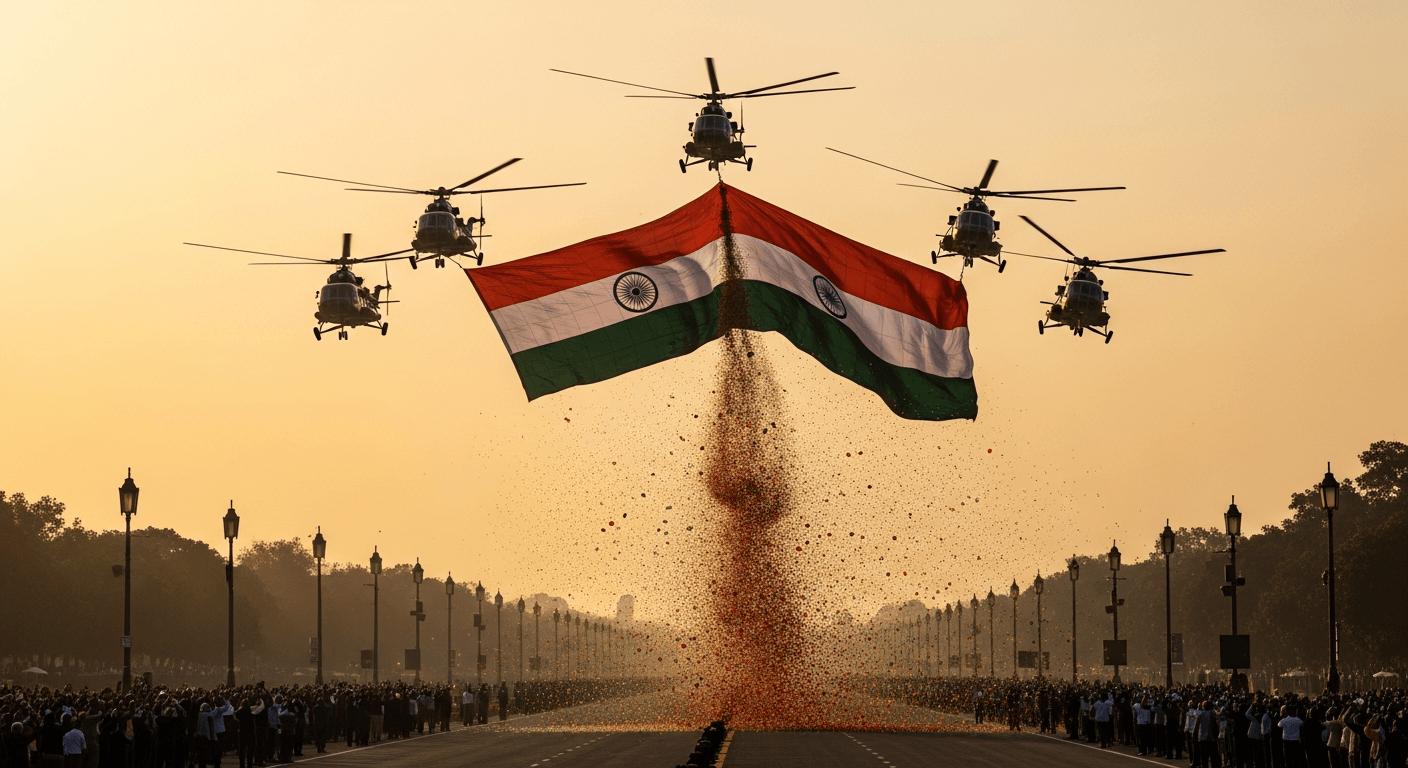
Mi-17 Dhwaj Formation
I watched the Mi-17 helicopters carve an inverted "Y" across the winter sky and let petals fall like a slow, deliberate benediction over Kartavya Path. The sight — military machines moving with ceremonial choreography, the tricolour snapping and petals turning the air into a delicate confetti — felt like a reminder: ritual and technology have long learned to borrow meaning from one another.
The formation and the moment
The "Dhwaj Formation" is a concise, visual language. Four rotorcraft flew in tight geometry, unfurled ensigns and showered flower petals across the ceremonial route. The display reads on several levels at once:
- As spectacle: precise, rehearsed flying that showcases skill and trust between humans and machines.
- As symbol: the flag and the petals are a ritual of collective memory — an aerial salute to a republic built on shared stories.
- As message: airborne platforms still hold the power to create instantaneous, public emotion.
News coverage of the event captured these elements clearly — see reports and visuals from mainstream outlets for the complete footage and official details (Times of India, ANI).
Why the petals matter
Petals are ephemeral; machines are durable. That contrast is powerful. A helicopter is built from alloys, turbines and avionics; a petal is biological, fragile and transient. When petals fall from a machine, two messages merge: the endurance of institutions and the fleeting beauty of civic celebration. The choice to shower petals — rather than, say, fireworks or electronic displays — is a human touch. It connects precision engineering to a softer cultural vocabulary.
There’s also a practical choreography behind the poetry: formation flying requires rigorous planning, redundant safety checks and disciplined coordination. The aesthetic outcome is only possible because of the technical discipline behind it.
Technology, ritual and public trust
Public displays like this do more than mark a date on the calendar. They are a rehearsal in trust. Citizens watch and internalize a narrative: our institutions can marshal complex technology responsibly. In an era of pervasive drones, AI and ubiquitous sensors, those narratives matter. They help shape how people feel about new technologies — whether they meet them with curiosity, pride, suspicion or fear.
My past writing on unmanned systems and airspace management argued that the social aspects of airborne technology deserve as much attention as the technical ones. In pieces where I discussed drone traffic management and swarm behaviour, I emphasised that systems must be designed with public trust and safety at the core (Drone – a – Charya, A Swarm-O-Drone is born). The Dhwaj Formation is an older, human-driven analogue of those ideas: choreography, rules, and communication enable a complex aerial ballet.
A few technical and cultural takeaways
- Precision matters: formation flying demonstrates the training and protocols that make complex airborne operations safe and repeatable.
- Symbolism endures: physical gestures — flags, petals, music — still carry emotional weight in ways that pure data cannot.
- Design for consent: as aircraft in the sky proliferate (manned or unmanned), designing systems that are transparent and reassuring to the public should be a priority.
Closing reflection
Watching machines perform a ritual reminded me that technology is not neutral theatre: it shapes our shared stories. The Mi-17s in the Dhwaj Formation did more than open a parade. They folded engineering into ceremony, and in that fold lies an invitation — to design aerial systems that are not merely capable, but culturally literate and socially accountable.
If we take that invitation seriously, the next generation of aerial displays, safety systems and urban air services can be engineered not only for performance, but for the public imagination they will inevitably enter.
Regards,
Hemen Parekh
Any questions / doubts / clarifications regarding this blog? Just ask (by typing or talking) my Virtual Avatar on the website embedded below. Then "Share" that to your friend on WhatsApp.
Get correct answer to any question asked by Shri Amitabh Bachchan on Kaun Banega Crorepati, faster than any contestant
Hello Candidates :
- For UPSC – IAS – IPS – IFS etc., exams, you must prepare to answer, essay type questions which test your General Knowledge / Sensitivity of current events
- If you have read this blog carefully , you should be able to answer the following question:
- Need help ? No problem . Following are two AI AGENTS where we have PRE-LOADED this question in their respective Question Boxes . All that you have to do is just click SUBMIT
- www.HemenParekh.ai { a SLM , powered by my own Digital Content of more than 50,000 + documents, written by me over past 60 years of my professional career }
- www.IndiaAGI.ai { a consortium of 3 LLMs which debate and deliver a CONSENSUS answer – and each gives its own answer as well ! }
- It is up to you to decide which answer is more comprehensive / nuanced ( For sheer amazement, click both SUBMIT buttons quickly, one after another ) Then share any answer with yourself / your friends ( using WhatsApp / Email ). Nothing stops you from submitting ( just copy / paste from your resource ), all those questions from last year’s UPSC exam paper as well !
- May be there are other online resources which too provide you answers to UPSC “ General Knowledge “ questions but only I provide you in 26 languages !



No comments:
Post a Comment