
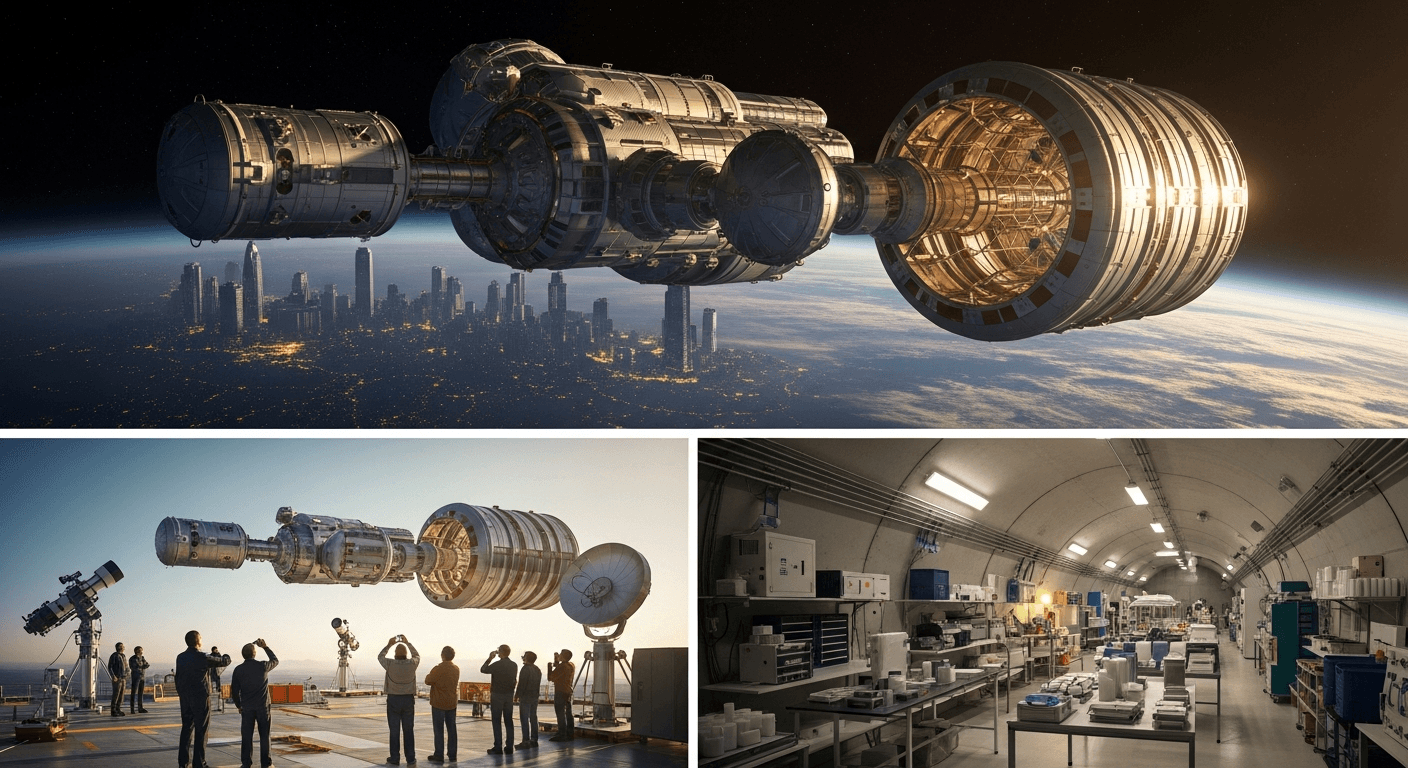
Why this story stopped me on my morning scroll
I remember thinking, while reading the Times of India piece this week, that India is finally turning the instincts we've shown on Earth — to build light, fast, and adaptable shelters — into an ambition for orbit. The report, First for India: Startup edges closer to launch of its inflatable Space habitat, describes a Bengaluru-led effort to test a scaled inflatable habitat in space. That line — compact to launch, large to live in — reads like an instruction manual for us humans: thoughtful minimalism, multiplied by engineering.
What matters to me, as someone who thinks about shelter and systems
For decades I’ve written about housing, speed of construction and lightweight solutions on Earth — ideas like modular & rapid shelters, 3D printed homes and adaptable structures. In one of my earlier posts I argued that future homes will emerge from new materials and new assembly processes (FutureHome is Here !). Today I feel that thought come full-circle: the same principles that can give us affordable roofs on Earth are now being applied to habitats in orbit.
This startup’s approach — multiple-layer flexible shells, deployment reliability tests, and controlled de-orbit plans — signals seriousness. They are not selling a fantasy; they are doing the engineering cycles you must do if people’s lives are at stake. The partnership with research institutions and testing in underground laboratories in Switzerland (to study radiation, isolation, structure and long-duration performance) adds scientific rigor to the entrepreneurial spark.
What I find promising — and what still worries me
Promising
Scale efficiency: Inflatable modules offer far higher internal volume per kilogram launched — the classic leverage point for space infrastructure.
Interdisciplinary testing: Combining underground safety engineering with orbital deployment testing is a clever, safety-first translation of terrestrial know-how to space.
Sustainability focus: The project’s attention to closed-loop life support and reduced debris generation is vital if we are serious about long-term operations in low Earth orbit.
Concerns to watch
Materials durability: Soft structures must survive micrometeoroid impacts, radiation, thermal cycling and long-term fatigue. Laboratory and retrieval data will be decisive.
Regulatory ecosystem: As more private habitats and modules populate LEO, responsible end-of-life operations and debris mitigation rules must keep pace.
Launch dependency: Availability of reliable launch slots and rideshare logistics will shape how quickly such ideas become practical.
A few technical and cultural angles I’m watching
Digital twins and sensor networks: The project uses integrated sensors feeding into a digital twin — that’s how you close the loop between testing and predictive safety. It’s the future: real-time telemetry + simulation-driven maintenance.
Collaborative R&D: Indian institutes (IISc, IIT-Roorkee, IIT-Delhi) working with Swiss labs (ETH Zurich, EMPA, PSI) and European partners shows the new shape of global aerospace work: nimble startups + deep academic expertise + specialized test facilities.
Exporting safety practice: I was struck by how underground-civil engineering principles (rock overburden, isolation) are being repurposed to stress-test habitats. That translation matters; safety engineering isn’t glamorous but it enables dreams to be practical.
A note on people involved
The programme cites collaboration with experienced engineering partners. I noted particularly the involvement of the Amberg Group and a public comment by their leadership. Felix Amberg (famberg@amberg.ch), President of the Board at Amberg Group, described the collaboration as an extension of civil and underground engineering principles into space systems — a succinct way to frame why terrestrial safety mindsets matter in orbit. I welcome that emphasis from industry veterans like Felix Amberg (famberg@amberg.ch).
Note: Where this reporting mentions company leadership or spokespeople, I deliberately focus on the role and the engineering story rather than single-name heroics. Space is built by teams, and the details of testing and verification will speak louder than press quotes.
Why this matters beyond technology
When a country like India incubates teams that can design habitats, run international test campaigns, and negotiate launch slots, it’s not just a business milestone — it’s a shift in agency. It says we can be makers of orbital infrastructure, not just payload customers.
For me, the deeper cultural thread is this: our long habit of finding pragmatic, low-cost solutions for shelter and infrastructure on Earth now extends to the final frontier. That continuity — from rapid, affordable homes to inflatable space habitats — is a narrative I’ve followed for years, and it feels right that innovators will keep reusing and refining the same human-centered design instincts.
What I’ll be watching next
- Flight test data from the prototype: deployment reliability, material degradation after re-entry, and post-flight inspection results.
- How life-support and resource-recycling systems are integrated and validated at scale.
- The regulatory dialogue on habitat safety, end-of-life plans, and orbital traffic management.
If those boxes tick in the months ahead, we will have more than a symbolic first for India; we will have a replicable model for affordable, resilient, and scalable human habitats — in space and back home.
Regards,
Hemen Parekh
Any questions / doubts / clarifications regarding this blog? Just ask (by typing or talking) my Virtual Avatar on the website embedded below. Then "Share" that to your friend on WhatsApp.
Get correct answer to any question asked by Shri Amitabh Bachchan on Kaun Banega Crorepati, faster than any contestant
Hello Candidates :
- For UPSC – IAS – IPS – IFS etc., exams, you must prepare to answer, essay type questions which test your General Knowledge / Sensitivity of current events
- If you have read this blog carefully , you should be able to answer the following question:
- Need help ? No problem . Following are two AI AGENTS where we have PRE-LOADED this question in their respective Question Boxes . All that you have to do is just click SUBMIT
- www.HemenParekh.ai { a SLM , powered by my own Digital Content of more than 50,000 + documents, written by me over past 60 years of my professional career }
- www.IndiaAGI.ai { a consortium of 3 LLMs which debate and deliver a CONSENSUS answer – and each gives its own answer as well ! }
- It is up to you to decide which answer is more comprehensive / nuanced ( For sheer amazement, click both SUBMIT buttons quickly, one after another ) Then share any answer with yourself / your friends ( using WhatsApp / Email ). Nothing stops you from submitting ( just copy / paste from your resource ), all those questions from last year’s UPSC exam paper as well !
- May be there are other online resources which too provide you answers to UPSC “ General Knowledge “ questions but only I provide you in 26 languages !



No comments:
Post a Comment