
Politically Backward? The Question on Brahmins
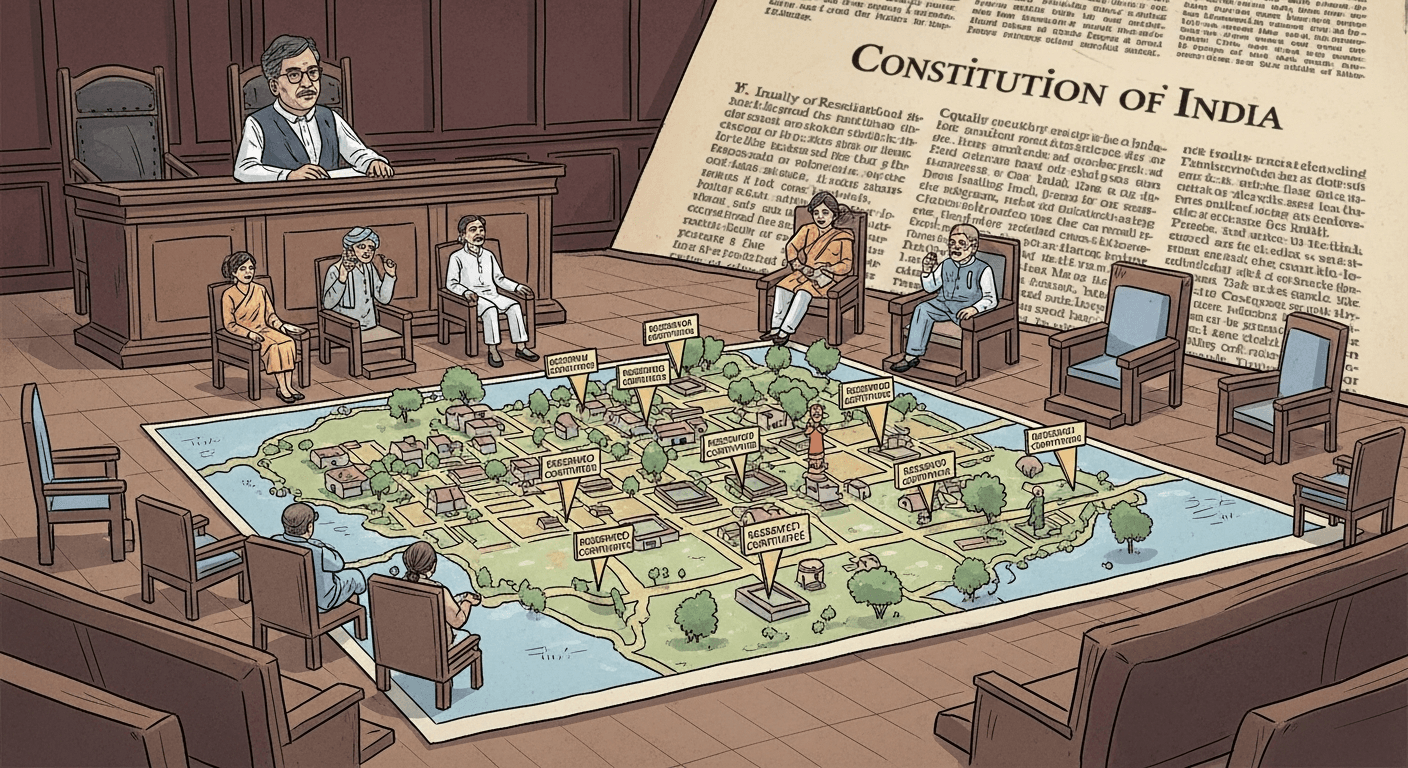
I want to unpack a question the Supreme Court has agreed to examine: can a community traditionally seen as socially and educationally forward — for example, Brahmins — be classified as "politically backward" for the purpose of reservation in local bodies? This is a specialised but important issue because it touches on how we define and remedy democratic exclusion as much as social disadvantage.
Why this matters now
Recently the top court took notice of a petition asking whether under-representation in elected local bodies can make a group eligible for reservation of constituencies. This debate has been reported in the press and sits alongside a broader constitutional conversation about how reservations should be tailored today Can Brahmins be ‘politically backward'? SC to examine.
A quick background on India’s reservation architecture
- Constitutional basis: Articles 15(4) and 16(4) allow the State to make special provisions for the advancement of "socially and educationally backward classes" (SEBCs) in matters of education and public employment.
- Local bodies: Articles 243D(6) and 243T(6) permit reservation of seats in panchayats and municipal bodies in favour of backward classes, subject to objective criteria and empirical inquiry.
- Identification and inquiry: Article 340 authorises the President to appoint commissions to investigate SEBCs; states also maintain backward classes commissions and lists.
- Key judicial guideposts: The 1992 Indira Sawhney judgment placed important limits on reservation (including the oft-cited 50% ceiling) and introduced concepts such as the "creamy layer" for OBCs. Later rulings clarified that reservation policy must rest on empirical data and sustained inquiry rather than mere assertion.
Important precedents and recent developments
- Indira Sawhney (1992) set out major principles for SEBC reservations, including the idea of non-arbitrariness and the 50% ceiling in ordinary circumstances.
- Later decisions built on the need for empirical studies before creating or extending reservations in local bodies; the courts have stressed objective commissions and data-driven exercises in constituency reservations (triple test and related guidance).
- In 2010 and subsequent cases, the Court observed that political backwardness (lack of elected representatives) does not automatically track social or educational backwardness — but it can be a separate ground meriting attention when backed by data.
- A 2024 Constitution Bench allowed sub-classification within reserved categories so that the most marginalised within a broad reserved list can be specifically protected — a step showing the Court’s willingness to accept nuanced, evidence-led measures for substantive equality.
What does "politically backward" mean?
Put simply, political backwardness refers to systematic under-representation in elected bodies and decision-making institutions. Indicators might include:
- very low numbers of elected representatives from the group at village/ward/municipal levels
- persistent absence from leadership roles in panchayats or municipal committees
- structural barriers to candidate selection within party politics
It is distinct from social or educational backwardness: a community can be socio-economically advanced yet politically marginalised in local governance.
Arguments in favour of recognising political backwardness
- Democracy as remedy: Reservation of constituencies can help bring excluded voices into local governance where redistribution and public services are negotiated.
- Functional fairness: If empirical studies show systematic under-representation, targeted reservation of seats may restore balance and improve responsiveness.
- Consistency with local-body law: Articles 243D and 243T explicitly allow reservations in local bodies for backward classes; political backwardness could be a legitimate dimension of the inquiry.
Arguments against recognising it (or against easy expansion)
- Original constitutional scheme: Articles 15 and 16 were phrased around socially and educationally backward classes. Extending reservation on purely political grounds risks departing from the constitutional language without careful amendment or precedent.
- Slippery slope and politicisation: If political under-representation alone qualifies a group, many forward well-off groups could seek reserved constituencies, potentially diluting remedial intent.
- Data and implementation challenges: Measuring political backwardness reliably and avoiding manipulation by state authorities would be difficult. There are also risks of increasing overall reservation percentages beyond recognized limits.
Possible implications
- Local politics: Recognising political backwardness could change who wins and how representation is distributed in panchayats and municipal bodies.
- Reservation doctrine: A favourable ruling may prompt states to revisit constituency reservation rules and design empirical commissions; an adverse ruling would reaffirm tighter links between social backwardness and affirmative action.
- Policy responses: The debate can push governments to strengthen candidate support measures, party-level inclusion, and broader civic-engagement programmes beyond quotas.
My balanced takeaway
The question before the Court is not merely academic: it asks whether our remedies for exclusion should look beyond social and economic markers to the functioning of local democracy itself. I lean toward a cautious, evidence-first approach. If reliable, independent data show systemic under-representation of a group in elected offices, then targeted, time-bound measures aimed at restoring democratic balance deserve consideration — provided they do not erase the remedial purpose of caste-based reservations or undermine constitutional safeguards.
Next steps to watch
- The Court’s request for responses and any orders asking states to produce constituency-wise empirical data.
- Whether the Court frames a firm test for political backwardness or confines itself to procedural requirements (commissions, surveys, proportion limits).
- Policy adjustments by states on how they collect and present data for reservation decisions.
I’ll be watching how the Court balances the competing values of democratic representation and historical remedial justice — and I will write again as the story unfolds.
Regards,
Hemen Parekh
Any questions / doubts / clarifications regarding this blog? Just ask (by typing or talking) my Virtual Avatar on the website embedded below. Then "Share" that to your friend on WhatsApp.
Get correct answer to any question asked by Shri Amitabh Bachchan on Kaun Banega Crorepati, faster than any contestant
Hello Candidates :
- For UPSC – IAS – IPS – IFS etc., exams, you must prepare to answer, essay type questions which test your General Knowledge / Sensitivity of current events
- If you have read this blog carefully , you should be able to answer the following question:
- Need help ? No problem . Following are two AI AGENTS where we have PRE-LOADED this question in their respective Question Boxes . All that you have to do is just click SUBMIT
- www.HemenParekh.ai { a SLM , powered by my own Digital Content of more than 50,000 + documents, written by me over past 60 years of my professional career }
- www.IndiaAGI.ai { a consortium of 3 LLMs which debate and deliver a CONSENSUS answer – and each gives its own answer as well ! }
- It is up to you to decide which answer is more comprehensive / nuanced ( For sheer amazement, click both SUBMIT buttons quickly, one after another ) Then share any answer with yourself / your friends ( using WhatsApp / Email ). Nothing stops you from submitting ( just copy / paste from your resource ), all those questions from last year’s UPSC exam paper as well !
- May be there are other online resources which too provide you answers to UPSC “ General Knowledge “ questions but only I provide you in 26 languages !



No comments:
Post a Comment