
Reluctant Heirs
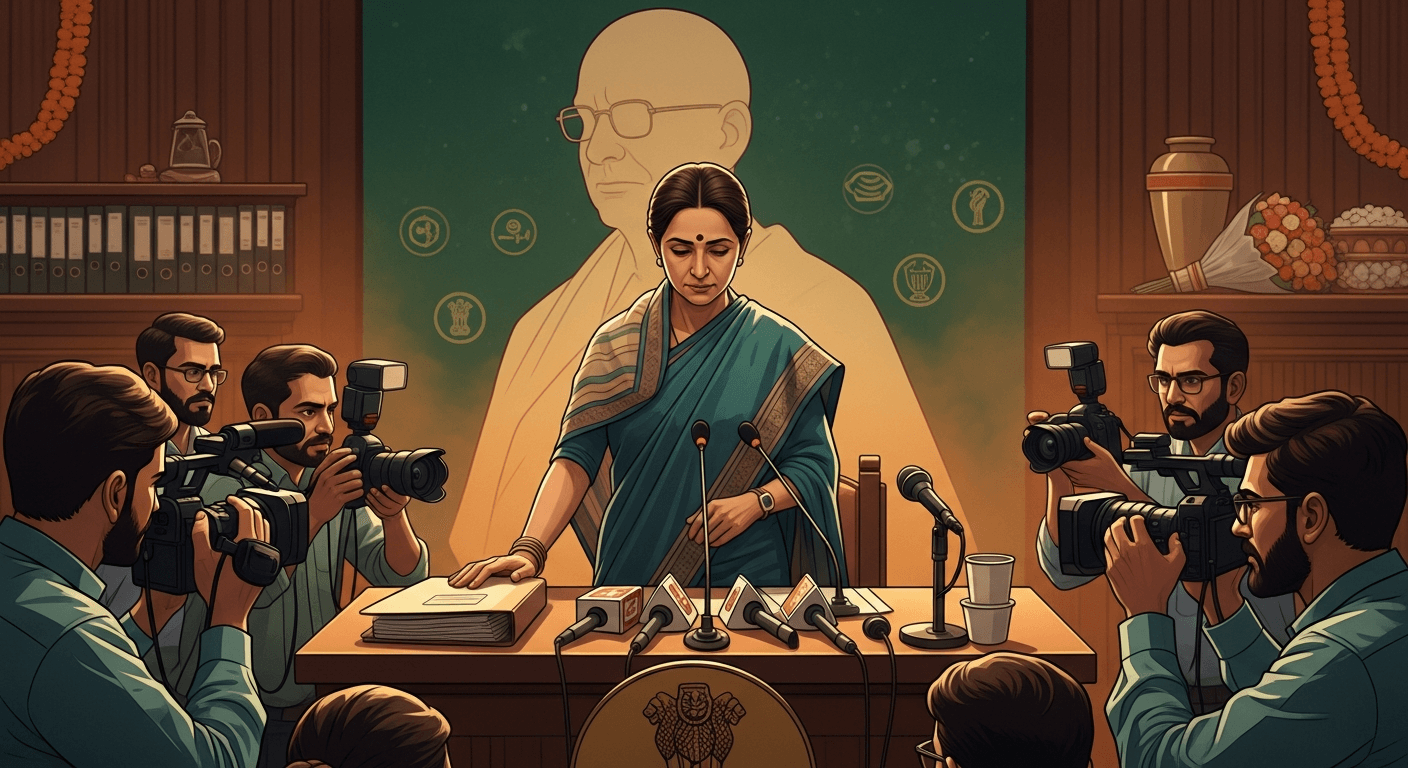
I have been watching a sequence of political moments unfold that feel at once deeply personal and unmistakably public: a grieving household, a party searching for continuity, and a seat of power being filled by the widow of a recently deceased leader. In the last week, a Rajya Sabha MP was sworn in as a state deputy chief minister shortly after her husband's sudden death — a swift transition that crystallised a question I've been turning over for years: what does it mean when spouses inherit political mantles?
Mourning, Mandate, Momentum
I write this still sensitive to the human side. When loss is fresh, any talk of succession can feel jarring. Yet parties and coalitions operate with calendars, legislatures and elections. The interplay of public grief and political urgency often produces rapid choices that try to honour legacy while stabilising governance.
- There is an element of continuity: a familiar family name can reassure supporters and cadres that local projects, patronage networks, and administrative routines will continue.
- There is a performative aspect: public displays of respect, ceremony and the image of unity often matter as much as the constitutionality of appointments.
- There is democratic friction: voters and critics rightly ask whether succession respects merit, process and representative choice.
Wives as Stewards — Not Stereotypes
Too often, the shorthand is to call these women "placeholders". That erases agency and flattens complexity. Some step into frontline politics for the long haul, learning the machinery of governance and carving independent profiles. Others serve as caretakers of a brand until a more formal leadership contest is possible.
From my vantage point, the important distinctions are:
- Stewardship versus entitlement: Is the elevation framed as a temporary stewardship to steady a coalition, or as automatic entitlement because of family ties?
- Preparedness versus debut: Does the person have a track record — social work, legislative experience, organisational engagement — or are they entering politics at the highest executive level with little public-facing experience?
- Choice versus imposition: How much did local legislators, party workers and voters participate in the decision?
What I’ve Seen Before — Patterns, Not Exceptions
This is not a new phenomenon in our polity. We have seen similar arcs where a wife, often propelled by grief and party calculations, becomes the public face of continuity. The outcomes vary wildly. In some cases, the successor consolidates power and becomes a formidable politician; in others, they remain symbolic custodians while real decisions stay with senior leaders.
In past pieces I’ve written about inheritance and political economy — the ways family ties shape access to power and wealth — and these episodes offer living illustrations of those dynamics (Begging Bowl Syndrome).
The Gendered Optics
There is a double bind here. When a woman rises to power via a family link, critics charge dynasticism; when she rises on her own record, punditry often treats her as an exception. I refuse to reduce these women to symbols of nepotism alone. Instead, I try to look at how gender, grief, and institutional weakness intersect to create these rapid successions.
Practical Questions I Keep Asking
- Does the transition include a roadmap for democratic validation — a timely by-election, an internal party contest, or transparent legislative endorsement?
- Are the responsibilities and portfolios being handed with clear expectations and administrative support, not merely ceremonial trappings?
- Is there a timeline for the new leader to seek a direct electoral mandate within constitutional windows?
What Parties Should Consider (A Short Checklist)
- Short-term: Provide administrative teams and mentors so the new office-holder can function effectively while learning the role.
- Medium-term: Schedule a transparent intra-party endorsement or a prompt by-election so legitimacy rests on voter choice, not only on sympathy or family name.
- Long-term: Invest in succession planning and leadership pipelines that reduce the reflex to default to family names in moments of crisis.
My Personal Take
I am sympathetic to the human tragedy at the heart of these transitions. At the same time, democracy demands processes that go beyond the comforting logic of familial continuity. I believe in a compassionate politics where grief is respected, but governance is not held hostage by sentiment. When a spouse accepts the mantle, they deserve the institutional scaffolding to govern well — training, clear portfolios, and a fast route to democratic validation.
Dynastic reflexes are not destiny. Parties can choose to institutionalise choices so that transitions are predictable, transparent and more meritocratic. That doesn’t erase family influence overnight, but it does make power less fragile — and more accountable.
Regards,
Hemen Parekh
Any questions / doubts / clarifications regarding this blog? Just ask (by typing or talking) my Virtual Avatar on the website embedded below. Then "Share" that to your friend on WhatsApp.
Get correct answer to any question asked by Shri Amitabh Bachchan on Kaun Banega Crorepati, faster than any contestant
Hello Candidates :
- For UPSC – IAS – IPS – IFS etc., exams, you must prepare to answer, essay type questions which test your General Knowledge / Sensitivity of current events
- If you have read this blog carefully , you should be able to answer the following question:
- Need help ? No problem . Following are two AI AGENTS where we have PRE-LOADED this question in their respective Question Boxes . All that you have to do is just click SUBMIT
- www.HemenParekh.ai { a SLM , powered by my own Digital Content of more than 50,000 + documents, written by me over past 60 years of my professional career }
- www.IndiaAGI.ai { a consortium of 3 LLMs which debate and deliver a CONSENSUS answer – and each gives its own answer as well ! }
- It is up to you to decide which answer is more comprehensive / nuanced ( For sheer amazement, click both SUBMIT buttons quickly, one after another ) Then share any answer with yourself / your friends ( using WhatsApp / Email ). Nothing stops you from submitting ( just copy / paste from your resource ), all those questions from last year’s UPSC exam paper as well !
- May be there are other online resources which too provide you answers to UPSC “ General Knowledge “ questions but only I provide you in 26 languages !


No comments:
Post a Comment