
I write often about practical ways societies shift toward cleaner, more resilient energy systems. Kerala’s renewable energy story is one of land constraints, strong community institutions, and creative engineering — and it contains lessons any region can use when integrating variable renewables into an already-loaded grid.
Overview: steady progress from rooftops to reservoirs
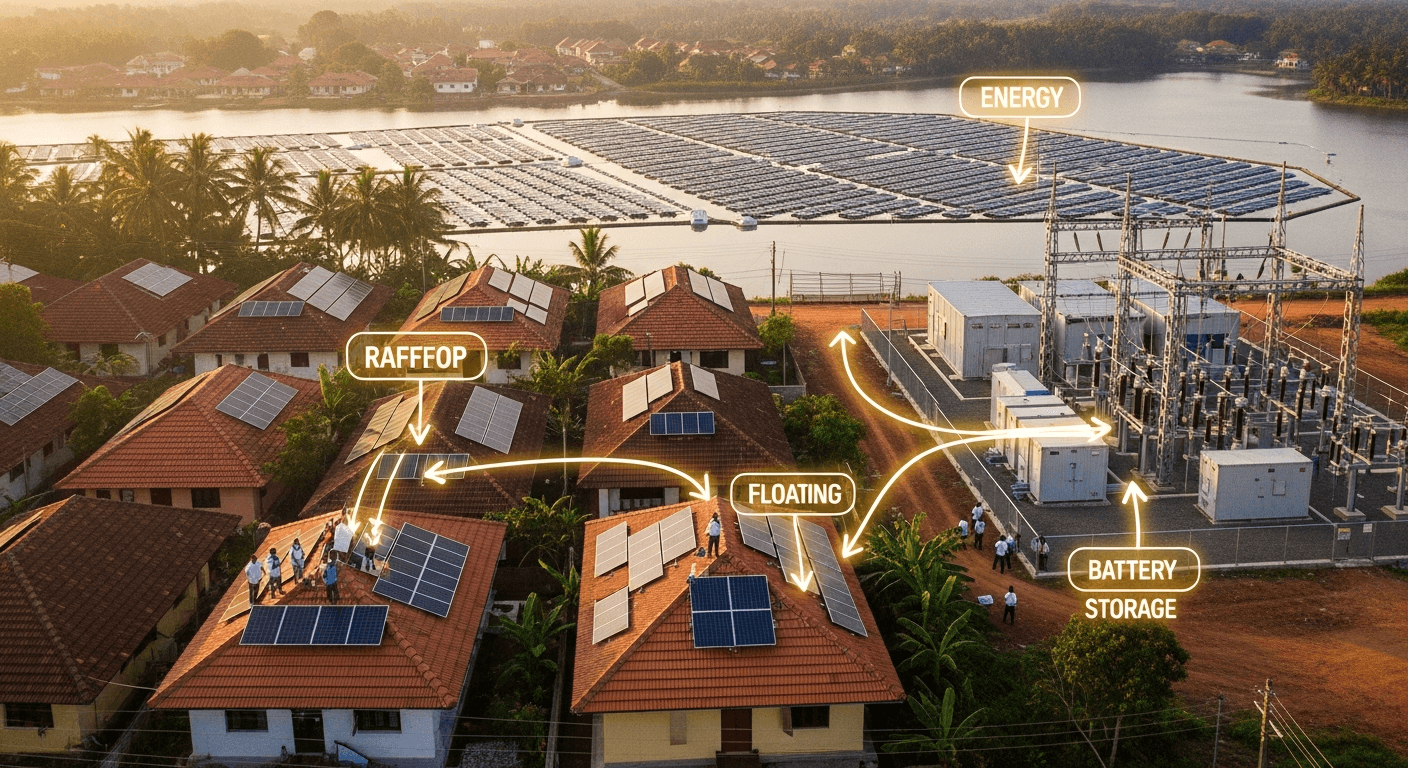
Kerala has moved quickly from rhetoric to results. The state has prioritized distributed solar (roof-top) and floating PV to work around scarce land, complemented by small hydro, targeted wind pockets and pilot storage projects. By mid‑2024 Kerala’s renewable portfolio showed a notable growth in solar and small hydro, while policy documents and utility plans began emphasizing storage and flexibility to manage integration (KSEBL; CSTEP, 2024) (CEA, 2024).
What stands out to me is not just capacity numbers but the strategy: maximize what fits locally (rooftops, water surface), couple it with storage and demand-side measures, and align incentives so communities see direct benefits (ANERT; Draft Kerala Power Policy, 2024).
Key projects and models worth noting
- Rooftop solar (SOURA / DISCOM‑driven models): Large-scale rollout targeted households, institutions and low‑income homes, with DISCOM-backed financing models to bring prosumer status to more citizens (ANERT; KSEBL).
- Floating solar: Kerala has pursued floating projects in reservoirs and tanks (e.g., projects modeled after Kayamkulam and planned West Kallada pilots), which unlocks large capacity without land tradeoffs and often raises capacity factors vs land PV (Climate Risk Horizons; KSEB documents 2023–24).
- Wind and small hydro: Wind potential is geographically concentrated; small hydro (run-of‑river and dam‑toe) taps locally available hydropower without major resettlement. Both continue as complementary resources (WRI/CSTEP assessments, 2024).
- Mini‑grids & islanded solutions: Battery‑managed solar microgrids serve remote hamlets and tribal hamlets where grid reach is limited — a pragmatic match of technology to local need (KSEBL reports).
- Pumped hydro / tidal considerations: Given Kerala’s terrain and ecological sensitivities, pumped storage is treated as an option for larger storage needs but requires careful siting and social consent; tidal/OTEC remain exploratory (Draft Kerala Power Policy; CSTEP, 2024).
Policy measures that made scale possible
Kerala’s approach combined state programs and central schemes:
- DISCOM‑led rooftop programs (SOURA) and targeted subsidy/financing for low‑income households lowered upfront barriers (ANERT; KSEBL).
- Net metering and streamlined interconnection rules for rooftop and distributed generators created predictable pathways for prosumers (state regulations tied to MNRE guidelines).
- Incentives and fiscal support for floating PV and aggregated rooftop tenders (Draft Kerala Power Policy) encouraged new business models where the utility or local government aggregates many small sites.
These policy building blocks are practical: clear permitting, predictable billing rules, and targeted subsidies for the hardest to reach households.
Grid‑integration measures: technical and operational
Kerala’s engineers and planners are pushing on five practical fronts to integrate renewables safely:
- Smart inverters and standardized interconnection to manage voltage and reactive power at the distribution edge.
- Short‑term forecasting and day‑ahead solar/wind forecasts to reduce uncertainty for dispatch planning.
- Battery energy storage systems (BESS) co‑located with solar (and allocation of central BESS support for key sites) to smooth evening ramps and reduce costly short‑term market purchases (KSEB planning docs, 2024).
- Demand response and time‑of‑use signals — especially targeting large commercial and aggregated residential loads — to shift consumption into daytime solar windows.
- Targeted network upgrades (transformer capacity, 11kV/33kV reinforcements) and dynamic feeder management to accommodate two‑way flows from prosumers.
These measures — a mix of hardware, software and market signals — are where theory meets practice.
Community engagement and local ownership
Kerala’s gains are social as much as technical. Successful examples feature:
Cooperative or land‑owner companies for floating projects so local stakeholders earn a steady share of revenue.
Free or subsidized installations for economically vulnerable households (Green Income Project, ANERT) that build social license and distribute benefits.
Training programs for local installers and maintenance technicians so after‑sales quality and long‑term performance are sustainable.
When communities feel ownership of assets and revenue, opposition collapses and maintenance improves.
Challenges still to solve
- Curtailment & intermittency: As solar grows, daytime generation sometimes exceeds local demand or export capability, requiring storage or market solutions.
- Land‑use & ecological limits: Floating PV reduces land pressure but raises environmental questions if not sited carefully; pumped hydro siting is contentious.
- Financing: Aggregation and bankable contractual structures are essential to attract long‑tenor finance for BESS and floating parks.
- Grid constraints: Distribution transformers and some feeders have capacity ceilings; upgrading them is capital‑intensive and needs clear prioritization.
Kerala is managing these challenges with phased projects and policy tweaks — a useful model for other dense regions.
Practical lessons for other regions
- Policy: Let the utility lead distributed programs where land is scarce; provide predictable tariffs and clear interconnection rules.
- Technical: Pair solar with storage and smart inverters; invest in forecasting and transformer capacity where distributed generation is dense.
- Social: Share revenue with host communities; target subsidies to expand prosumer access to low‑income households.
- Financing: Use aggregation, VGF and DISCOM balance‑sheet support to attract long‑term capital for BESS and floating PV.
- Planning: Map reservoir and rooftop potential first, then plan staged storage to resolve curtailment rather than postponing upgrades.
Action‑oriented conclusion: five recommendations
- Prioritize aggregated rooftop and floating PV projects with clear revenue‑sharing for local communities.
- Mandate and fund grid upgrades (transformer/33kV/11kV) in high‑prosumer zones to avoid bottlenecks.
- Pair new solar capacity with storage procurement targets and fast‑track BESS pilots at substations.
- Standardize smart inverter technical requirements and short‑term forecasting for DISCOM operations.
- Use DISCOM‑driven financing models (co‑investment, VGF, aggregation) to lower the cost of capital for community projects.
Regards,
Hemen Parekh
Any questions / doubts / clarifications regarding this blog? Just ask (by typing or talking) my Virtual Avatar on the website embedded below. Then "Share" that to your friend on WhatsApp.
Get correct answer to any question asked by Shri Amitabh Bachchan on Kaun Banega Crorepati, faster than any contestant
Hello Candidates :
- For UPSC – IAS – IPS – IFS etc., exams, you must prepare to answer, essay type questions which test your General Knowledge / Sensitivity of current events
- If you have read this blog carefully , you should be able to answer the following question:
- Need help ? No problem . Following are two AI AGENTS where we have PRE-LOADED this question in their respective Question Boxes . All that you have to do is just click SUBMIT
- www.HemenParekh.ai { a SLM , powered by my own Digital Content of more than 50,000 + documents, written by me over past 60 years of my professional career }
- www.IndiaAGI.ai { a consortium of 3 LLMs which debate and deliver a CONSENSUS answer – and each gives its own answer as well ! }
- It is up to you to decide which answer is more comprehensive / nuanced ( For sheer amazement, click both SUBMIT buttons quickly, one after another ) Then share any answer with yourself / your friends ( using WhatsApp / Email ). Nothing stops you from submitting ( just copy / paste from your resource ), all those questions from last year’s UPSC exam paper as well !
- May be there are other online resources which too provide you answers to UPSC “ General Knowledge “ questions but only I provide you in 26 languages !



No comments:
Post a Comment