
By Hemen Parekh (hcp@recruitguru.com)
A short note on a recent ultimatum
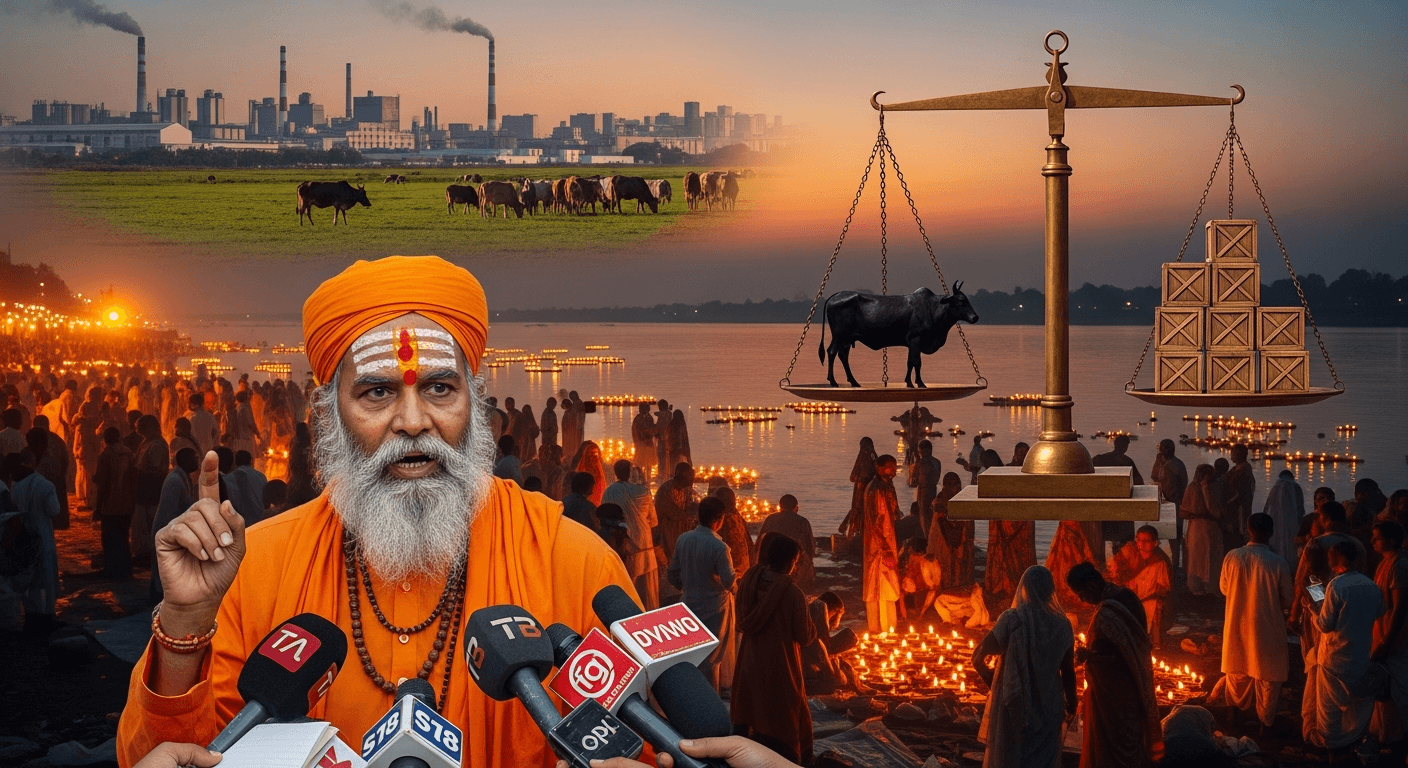
A prominent Hindu seer recently told the Uttar Pradesh chief minister to declare the cow as “rajya mata” (state mother) and to ban bovine meat exports within 40 days — a demand framed as a test of political and cultural commitment. Multiple news outlets carried the story and its wider reactions; for example see reporting by The Times of India and The Economic Times for contemporaneous coverage.Declare cow ‘rajya mata', ban beef export in 40 days and Stop beef export to prove commitment as Hindu sympathiser.
As someone who watches how culture, policy, and livelihoods intersect, I want to unpack the background, likely legal and economic ramifications, and who stands to be affected if the demand were translated into policy.
Historical and political context
Cow protection has been a recurring and emotive political theme in India for decades. It intersects religion, identity, and rural economies. Several states already have statutory restrictions on cow slaughter and varying rules on transportation and sale of cattle. Movements for stricter protections have periodically produced political mobilization and at times social conflict. The symbolism around the cow — whether as a sacred animal, an economic asset in dairying, or a political emblem — makes any policy pronouncement more than an administrative change.
Religious leaders and seers often play a visible role in these debates. Their pronouncements can shape public sentiment and put pressure on elected officials to act quickly. When faith figures mount public campaigns — as in the recent instance where a seer issued an ultimatum — the state can face both moral pressure and the practical challenge of balancing constitutional duties, economic realities, and law-and-order concerns.
I have written previously about strengthening livestock-based livelihoods and how policy can be shaped to protect both animals and farmers; for instance, I explored ideas around more structured support for dairy and cattle-rearing in an earlier piece on surrogate cow farms.Surrogate Cow Farms
Legal implications of an export ban
A unilateral, immediate ban on bovine meat exports from a state would raise quick legal questions:
- Jurisdiction: Export controls and trade are regulated under central laws and international trade commitments. A state-level diktat on exports would need coordination with central authorities and customs enforcement.
- Classification and enforcement: Indian exports of meat are frequently recorded as ‘buffalo meat’ for commercial purposes. If authorities sought to ban all bovine-origin exports, they would need laboratory-testing protocols, chain-of-custody documentation, and mechanisms to verify species origin — an operationally intensive task.
- Constitutional concerns: Any law that appears to target particular communities by restricting occupations or foodways can face legal challenge on grounds of equality and fundamental rights. Courts have previously examined whether food choices and occupational freedoms fall under the right to life and livelihood.
In short, a 40-day ultimatum to enact an enforceable export ban is likely to collide with legal, administrative, and technical realities.
Economic effects and the meat industry
A beef (or more accurately, bovine meat) export ban from a large producer state would have immediate economic consequences:
- Export revenue: Reports have suggested that certain states contribute a disproportionately large share of India’s bovine meat exports. Disrupting that flow would hit processors, cold-chain operators, and the foreign exchange that comes from exports.
- Downstream producers: Abattoirs, meat-processing units, and allied logistics firms would see order cancellations and idle capacity. That ripple would extend to packaging suppliers, freight, and ports.
- Informal market displacement: A sudden ban can push trade into informal or clandestine channels, raising the risk of further law-and-order challenges and exploitation.
Policy design would need to manage compensation, alternate market linkages, and timelines to avoid sharp unemployment shocks.
Social and political reactions
- Political parties: A demand coming from religious leadership typically forces responses across the political spectrum. Parties that emphasize cultural identity may express sympathy or call for action, while those focussed on constitutional safeguards and minority rights may highlight legal prudence and livelihood protection. The immediate effect is often politicization — debates move from administrative feasibility to campaigning narratives.
- Minority communities: Muslim, Dalit, and certain tribal communities are disproportionately represented among small traders, abattoir workers, and meat processors. A ban — if it reduces legal employment in the sector — raises acute concerns about income loss and social exclusion. Historically, measures perceived as targeting dietary practices or occupations of minority groups have elicited alarm and calls for protection.
- Civil society and courts: Civil society organizations, labour groups, and industry lobbyists typically press for measured transitions and safeguards; courts may be asked to adjudicate on balancing cultural sentiment with constitutional protections and livelihoods.
Impacts on farmers, traders, and workers
- Farmers: For many smallholders, cattle economics is mixed — milk sales, draught value, and eventual sale of older animals all matter. If slaughter and legal market access are curtailed without compensatory options, farmers may face prolonged maintenance costs and reduced returns.
- Traders and butchers: Small traders and operators in the meat value chain are vulnerable to rapid policy shifts. Employment loss here is concentrated and often informal, making social protection difficult without deliberate interventions.
- Industry workers: Abattoir and processing-unit workers — including many low-skilled and contract workers — would face immediate income shocks. Re-skilling, wage support, and temporary relief would be essential to prevent humanitarian distress.
A humane and practical policy approach would pair any regulatory intent with structured timelines, compensation schemes, alternatives for affected workers, and clear scientific protocols to prevent fraud and mislabeling.
What a balanced response looks like
If the goal is genuine cow protection coupled with social justice, the options are multi-pronged rather than binary:
- Strengthen dairy and allied incomes to make live animal ownership sustainable;
- Invest in traceability and scientific testing if species origin is a concern for exports;
- Phase any restrictions with consultation: industry, veterinary services, workers’ unions, and affected communities must be part of the design;
- Provide targeted compensation, transitions, and job-placement support for displaced workers.
Conclusion
Demands like the recent ultimatum make headlines because they tap deep cultural symbols. But turning that symbolism into law is complex: it requires legal authority, administrative infrastructure, economic mitigation, and social safeguards. As a society, we can seek policies that respect cultural sentiment while protecting livelihoods and the rule of law. That balance is hard to achieve quickly — and that is why political theatre and practical governance sometimes move at very different speeds.
Regards,
Hemen Parekh (hcp@recruitguru.com)
Any questions / doubts / clarifications regarding this blog? Just ask (by typing or talking) my Virtual Avatar on the website embedded below. Then "Share" that to your friend on WhatsApp.
Get correct answer to any question asked by Shri Amitabh Bachchan on Kaun Banega Crorepati, faster than any contestant
Hello Candidates :
- For UPSC – IAS – IPS – IFS etc., exams, you must prepare to answer, essay type questions which test your General Knowledge / Sensitivity of current events
- If you have read this blog carefully , you should be able to answer the following question:
- Need help ? No problem . Following are two AI AGENTS where we have PRE-LOADED this question in their respective Question Boxes . All that you have to do is just click SUBMIT
- www.HemenParekh.ai { a SLM , powered by my own Digital Content of more than 50,000 + documents, written by me over past 60 years of my professional career }
- www.IndiaAGI.ai { a consortium of 3 LLMs which debate and deliver a CONSENSUS answer – and each gives its own answer as well ! }
- It is up to you to decide which answer is more comprehensive / nuanced ( For sheer amazement, click both SUBMIT buttons quickly, one after another ) Then share any answer with yourself / your friends ( using WhatsApp / Email ). Nothing stops you from submitting ( just copy / paste from your resource ), all those questions from last year’s UPSC exam paper as well !
- May be there are other online resources which too provide you answers to UPSC “ General Knowledge “ questions but only I provide you in 26 languages !




No comments:
Post a Comment