
Source: The Statesman
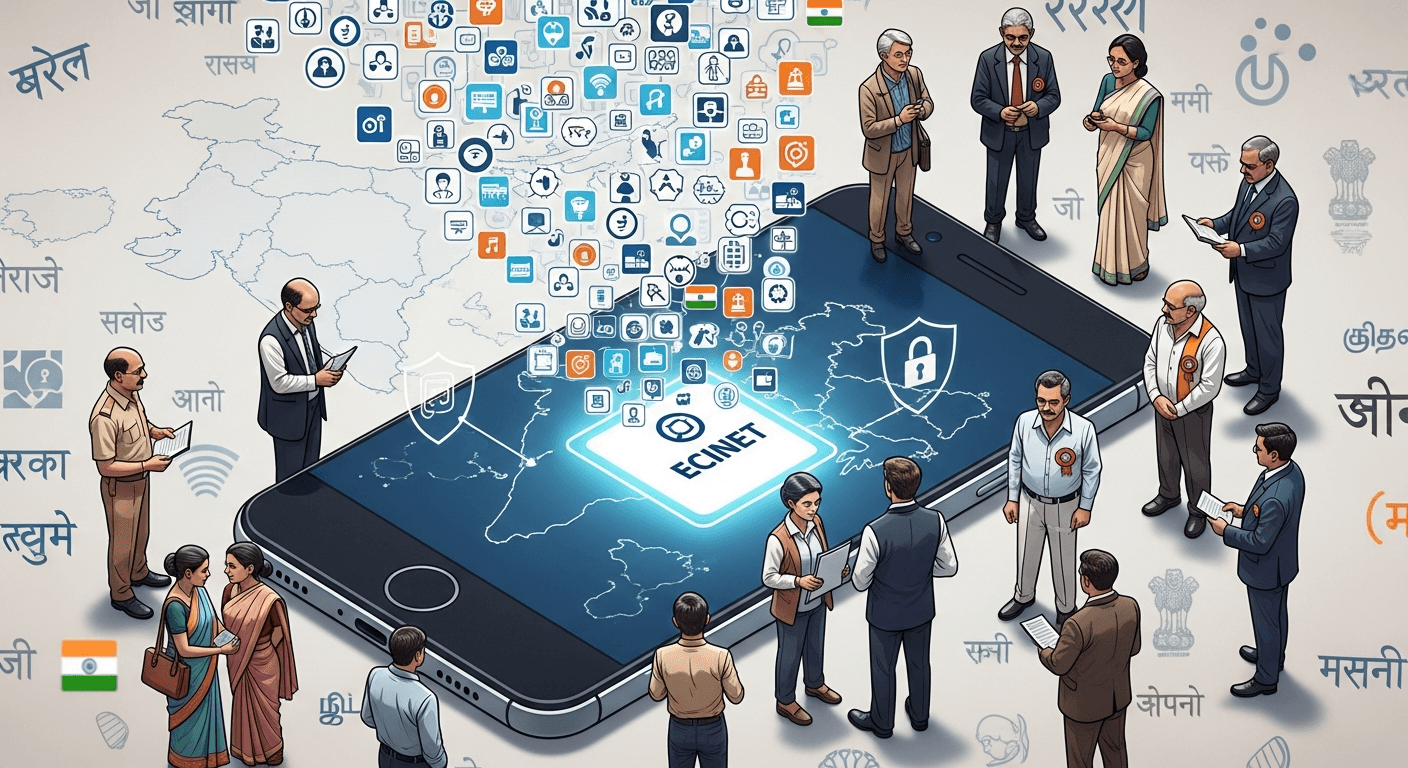
ECINET: ECI’s new single-point election platform
I followed the Election Commission of India’s recent launch of ECINET with professional interest. As The Statesman reports, ECINET is a single, unified digital platform that folds more than 40 of the Commission’s mobile and web services into one interface. The stated aim is simple: reduce fragmentation, simplify user journeys for voters and officials, and provide a single source of truth for election-related services across India.
In this dispatch I summarise the background, describe the platform’s core features, assess benefits for different stakeholders, highlight practical challenges, compare India’s effort with international election-technology experiments, and reflect on what ECINET could mean for the near-term future of Indian elections.
Brief background: why ECINET now
The Election Commission of India (ECI) has, over the last decade, developed a suite of digital tools addressing registration, grievance redressal, polling trends, candidate information, and field monitoring (examples include the Voter Helpline App, cVIGIL, Suvidha, ESMS, KYC tools and more). That growth created user friction: multiple apps, multiple logins, and duplicated workflows. ECINET responds to that fragmentation by consolidating services, standardising UX, and centralising authorised data entry to improve accuracy and oversight.
Trials and pilots — including a reportedly successful beta in the Bihar Assembly elections and subsequent by-elections — provided the ECI with operational learnings before the formal launch.
What ECINET offers: key features
- Single sign-on and role-based access: one login for electors, election officials, political parties and observers, with functionality scoped to user roles.
- Consolidation of 40+ apps and portals: services such as voter registration, e-EPIC download, track-your-application, ‘‘Know Your Candidate’’, polling trends, grievance management, and field-monitoring tools are available from one hub.
- Multi-device support and multilingual UI: designed for desktop and mobile, and localised into India’s scheduled languages plus English.
- Authoritative data model: only authorised ECI officials can enter or update primary electoral data, with statutory forms remaining the final legal source where conflicts arise.
- Field coordination tools: appointment and tracking of Booth Level Officers (BLOs), field checklists, and quick escalation workflows for on-ground incidents.
- Analytics and dashboards: real-time turnout trends, index cards and consolidated reporting to support decision-making during polls.
- Built-in security measures and trials: the ECI has emphasised cybersecurity testing and phased trials prior to wider roll-out.
Benefits by stakeholder
Voters
Easier access: one app instead of many, simpler identity and registration journeys, and faster availability of services like e-EPIC and grievance status.
Transparency: consolidated candidate information, polling trends and timely public notices.
Election administrators
Operational efficiency: unified monitoring, standardised workflows, and reduced duplication in data entry and reporting.
Better situational awareness: central dashboards enable faster decisions during polls and post-poll processes.
Political parties and candidates
Predictability and faster permissions: consolidated Suvidha-style workflows and easier access to statutory filings and notices.
Improved engagement: party-appointed agents and functionaries can coordinate more consistently through the platform.
Voices from the launch (attributed to roles)
A senior ECI official, the Chief Election Commissioner, framed ECINET as "a citizen-centric platform that reduces complexity for electors while strengthening field coordination for administrators."
The Director-General of IT at the Commission highlighted cybersecurity: "We have prioritised layered security and secure role-based access during development and trial phases—resilience and auditability are non-negotiable."
These role-attributed comments reflect the public framing of ECINET as both convenience-driven and compliance-oriented.
Realistic challenges to watch
Security and resilience: centralisation increases the value of the platform as an attack target. Maintaining secure authentication, robust encryption, incident response plans and independent security audits will be essential.
Privacy and data governance: ECINET will hold sensitive personal records at scale. Clear data-retention policies, access logs, and alignment with India’s legal framework for personal data will be required to avoid mission creep and legal exposure.
Digital divide and accessibility: not all electors have smartphones, strong connectivity, or digital literacy. The platform’s success will hinge on complementary offline workflows (BLO outreach, assisted kiosks) and low-bandwidth UX.
Adoption and change management: replacing multiple, established apps risks friction among field staff, political stakeholders and state-level bodies. Effective training, phased rollouts, and collaborative feedback loops are necessary.
Centralisation vs. redundancy: while consolidation reduces duplication, the system must preserve redundancy for continuity during outages and allow secure offline workflows for polling day.
How ECINET compares internationally
Estonia: Estonia’s long-standing e-governance and internet voting ecosystem emphasises cryptographic guarantees and a narrow, legally framed internet voting mechanism. ECINET resembles Estonia’s unified-service logic (one-stop digital citizen services) but India’s stated priorities so far emphasise service consolidation and administration rather than internet voting at scale.
Brazil: Brazil uses electronic voting machines widely; its focus has been on secure, auditable hardware at the polling place. India’s ECINET complements, rather than replaces, polling infrastructure — it’s a service and coordination layer rather than a voting medium.
UK/US: Many democracies prioritise online registration, public candidate data and turnout reporting. ECINET mirrors these trends but at an unprecedented scale — serving nearly 100 crore electors and hundreds of thousands of field officials.
The thread across jurisdictions is clear: digital platforms can enhance administrative transparency and voter service — but they do not eliminate the need for robust physical processes, audit trails and inclusive access strategies.
Conclusion: implications for future elections
ECINET is a consequential operational investment. If it delivers on usability, security and inclusion, it could materially reduce administrative friction, accelerate service delivery, and improve public transparency in election processes. Equally important will be the Commission’s handling of privacy, audits and the platform’s resilience.
I will be watching three signals closely in the coming election cycles: (1) uptake among voters and field staff, (2) independent security audit outcomes and incident handling, and (3) whether ECINET measurably shortens administrative timelines (for example, index-card publication and grievance resolution) without sacrificing procedural safeguards.
This launch is not the endpoint; it is a platform on which a healthier, more visible electoral administration can be built — provided that governance, technical excellence and inclusion are treated as equal priorities.
Regards,
Hemen Parekh
Any questions / doubts / clarifications regarding this blog? Just ask (by typing or talking) my Virtual Avatar on the website embedded below. Then "Share" that to your friend on WhatsApp.
Get correct answer to any question asked by Shri Amitabh Bachchan on Kaun Banega Crorepati, faster than any contestant
Hello Candidates :
- For UPSC – IAS – IPS – IFS etc., exams, you must prepare to answer, essay type questions which test your General Knowledge / Sensitivity of current events
- If you have read this blog carefully , you should be able to answer the following question:
- Need help ? No problem . Following are two AI AGENTS where we have PRE-LOADED this question in their respective Question Boxes . All that you have to do is just click SUBMIT
- www.HemenParekh.ai { a SLM , powered by my own Digital Content of more than 50,000 + documents, written by me over past 60 years of my professional career }
- www.IndiaAGI.ai { a consortium of 3 LLMs which debate and deliver a CONSENSUS answer – and each gives its own answer as well ! }
- It is up to you to decide which answer is more comprehensive / nuanced ( For sheer amazement, click both SUBMIT buttons quickly, one after another ) Then share any answer with yourself / your friends ( using WhatsApp / Email ). Nothing stops you from submitting ( just copy / paste from your resource ), all those questions from last year’s UPSC exam paper as well !
- May be there are other online resources which too provide you answers to UPSC “ General Knowledge “ questions but only I provide you in 26 languages !





No comments:
Post a Comment