
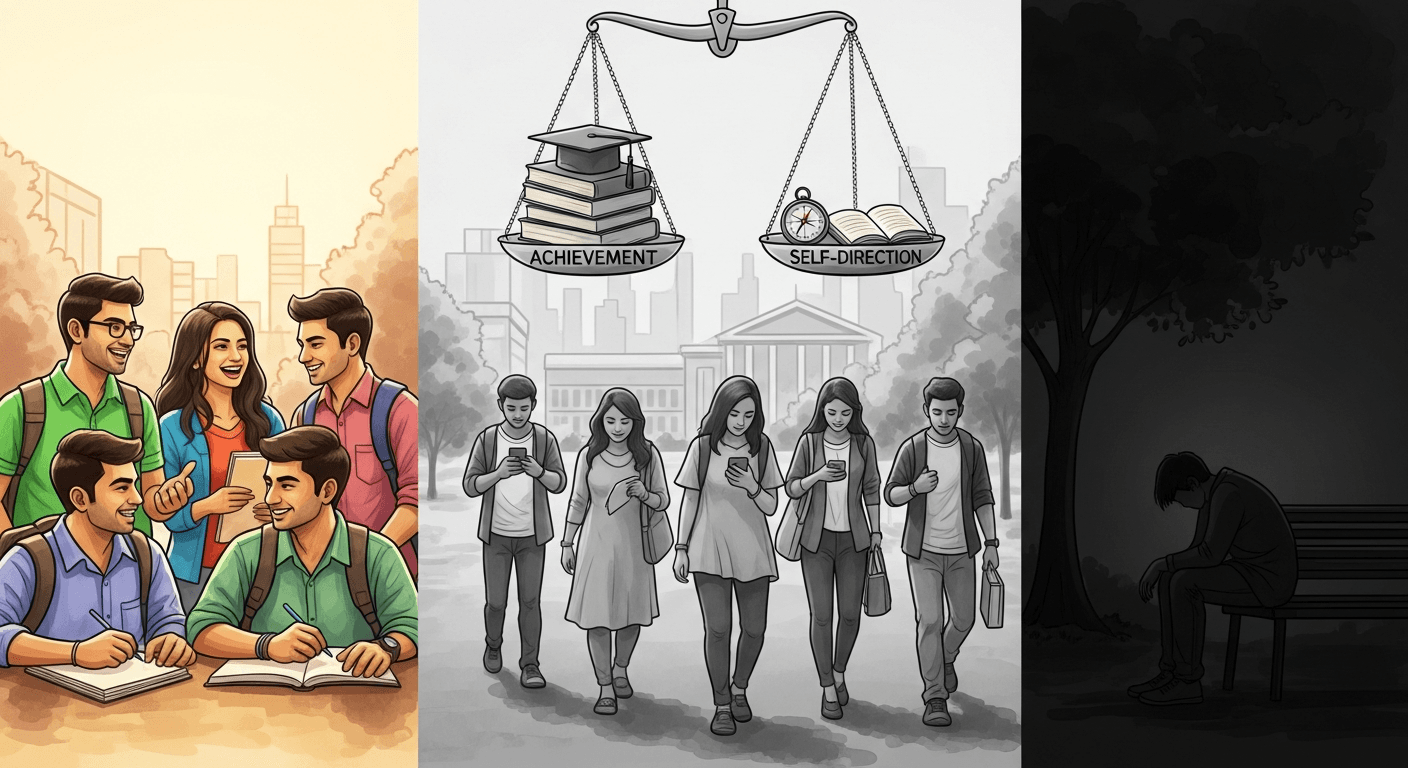
Why 55% of collegians are only "moderate" — and what we can do
A recent Times of India report summarised findings from a multi-part study that should make every campus pause: about 55% of college students fall into a “moderate mental health” bracket — not clinically ill, but not flourishing either — while only roughly a third were described as "flourishing" and around 12% were found to be languishing.‘Moderate mental health in 55% collegians, not thriving' These figures mirror other recent surveys of Indian campuses that show high rates of anxiety, depression and distress among young adults (see related cross‑city research summarized in Asian Journal of Psychiatry).Mental health of young adults pursuing higher education in Tier-1 cities of India
I’ve written about student pressure and campus suicides before (for example, my piece on stress in coaching towns and the safety nets students need).Kota: our Suicide Capital? Seeing similar patterns in new, larger studies is painful — but also clarifying: it tells us where to act.
What the numbers mean (contextualised)
- "55% moderate" does not mean clinical illness for most, but it does signal widespread sub-optimal well-being: students are coping, not thriving.
- About 33% flourishing suggests only a minority feel socially, emotionally and psychologically strong.
- The 12% languishing group are at higher risk of losing motivation and may slide toward more serious disorders without early support.
These proportions matter because young adulthood is a formative window: prolonged under‑wellness harms learning, social development, and long-term life trajectories.
Likely causes (evidence-informed, layered)
- Academic pressure and hyper‑competition: an achievement-first culture raises stress and reduces time for recovery.
- Social disconnection: migration to cities, crowded hostels and the paradox of digital connectedness but real loneliness.
- Values tension: studies note self-direction supports well‑being, whereas a relentless drive for external achievement increases risk of languishing.TOI summary and underlying research
- Post‑pandemic aftereffects: broken routines, screen burnout and loss of informal campus supports remain potent factors.
- Stigma and low help‑seeking: cultural barriers and lack of easily accessible services mean many suffer in silence.
Why this matters — immediate and long term
- Learning and retention drop: students who are merely coping often disengage or underperform.
- Widening inequality: students from under‑resourced colleges or non‑urban backgrounds may face worse outcomes.
- Public health risk: untreated distress increases risk of severe disorders and self‑harm; the university years are a high‑impact time to intervene.
What colleges should do (practical policies)
- Build universal promotive programs: integrate short, credit‑bearing modules on self‑awareness, stress management and contemplative practices into curricula. Evidence from small field experiments shows such courses can boost social connectedness and flourishing.TOI summary of experimental results
- Scale a stepped system of care: universal workshops + peer support + easy access to trained counsellors + clear referral pathways to specialists.
- Reduce competition pressure points: revise high‑stakes assessment timing, offer flexible deadlines and pass/fail options where feasible.
- Train faculty as mental‑health first responders: teachers who can spot early signs and make warm referrals reduce delay to help.
- Track wellbeing metrics: regular anonymous campus surveys help spot trends and evaluate interventions.
Actionable steps for students (what you can start doing this week)
- Small daily routines: 20 minutes of movement, a short journaling habit, and a consistent sleep window are powerful stabilisers.
- Build one real connection: join a small interest group or volunteer; social connectedness is repeatedly linked to flourishing.
- Learn a micro‑skill in emotional regulation: a simple breathing or grounding exercise can reduce acute panic and restore focus.
- Start a “buddy check” culture: pair up with 2–3 classmates to do weekly non‑judgmental check‑ins.
- Know the gateways to help: locate your campus counselling centre and national or local helplines; use them early — early help prevents escalation.
Voices (imagined but resonant)
- A campus counsellor I pictured said: "Students often arrive when distress is already severe. If universities made gentle, low‑barrier contact points part of daily life, more would seek help earlier."
- An imagined public‑health researcher told me: "Measuring flourishing alongside absence of illness changes how institutions prioritise students — from crisis response to cultivation."
These quotes are not from named individuals here, but they reflect consistent themes in the literature: make help normal, not exceptional.
Quick checklist for campus leaders (3‑month sprint)
- Run a baseline well‑being survey and publish a short action plan.
- Introduce at least one universal well‑being module for new students.
- Ensure an identifiable, confidential pathway to counselling and reduce appointment wait times.
Closing thoughts — why compassion is strategic
We can’t improve learning outcomes in isolation from mental health. If colleges treat wellbeing as a luxury, they will pay the price in dropouts, disengagement and human cost. Gentle policy changes, combined with low‑friction student practices and institutional commitment, move students from surviving to thriving.
I’ve been watching these trends for years and written about the human toll when systems ignore student distress.Kota: our Suicide Capital? The current findings are an urgent reminder: investments in campus mental health are investments in young lives, and in our collective future.
Regards,
Hemen Parekh
Any questions / doubts / clarifications regarding this blog? Just ask (by typing or talking) my Virtual Avatar on the website embedded below. Then "Share" that to your friend on WhatsApp.
Get correct answer to any question asked by Shri Amitabh Bachchan on Kaun Banega Crorepati, faster than any contestant
Hello Candidates :
- For UPSC – IAS – IPS – IFS etc., exams, you must prepare to answer, essay type questions which test your General Knowledge / Sensitivity of current events
- If you have read this blog carefully , you should be able to answer the following question:
- Need help ? No problem . Following are two AI AGENTS where we have PRE-LOADED this question in their respective Question Boxes . All that you have to do is just click SUBMIT
- www.HemenParekh.ai { a SLM , powered by my own Digital Content of more than 50,000 + documents, written by me over past 60 years of my professional career }
- www.IndiaAGI.ai { a consortium of 3 LLMs which debate and deliver a CONSENSUS answer – and each gives its own answer as well ! }
- It is up to you to decide which answer is more comprehensive / nuanced ( For sheer amazement, click both SUBMIT buttons quickly, one after another ) Then share any answer with yourself / your friends ( using WhatsApp / Email ). Nothing stops you from submitting ( just copy / paste from your resource ), all those questions from last year’s UPSC exam paper as well !
- May be there are other online resources which too provide you answers to UPSC “ General Knowledge “ questions but only I provide you in 26 languages !




No comments:
Post a Comment