
Census 2027: Caste, Data, Consequences
Introduction
I write this as someone who has followed India’s census debates for years: the notification that the Registrar General has listed 33 questions for the houselisting phase of Census 2027 is more than an administrative step. It sets the frame for India’s first fully digital decadal count in which caste enumeration will be captured in the population phase — a historic move with technical, social and political consequences. In this post I explain the context, unpack the 33 parameters, and offer a balanced read on implications, methodology and what policymakers should watch for. (The official list of the 33 items is available in recent government notifications and press coverage.)[1][2]
Why the census matters: a brief history
India’s modern decennial census began under colonial rule; the post‑Independence series continued every ten years until 2011. The 2011 count remains the last completed nationwide census. The 2021 exercise was postponed because of the pandemic and subsequent decisions. Census data is the backbone of planning, delimitation, resource allocation and many welfare programmes — and the inclusion (or exclusion) of caste has been politically contested for decades.[3]
Why caste data matters
- Policy calibration: caste‑wise counts can reveal uneven outcomes across education, employment and amenities and can feed targeted welfare programmes and affirmative action.
- Legal and institutional design: more granular data can inform debates on reservation, social justice budgets and the delimitation of representation.
- Scholarship and public accountability: researchers and civil society gain a more precise evidence base to study inequality and track change.
At the same time, caste data can be politically weaponised, misinterpreted or poorly implemented if methodology and safeguards are not robust.
The 33 parameters: what they cover (plain English)
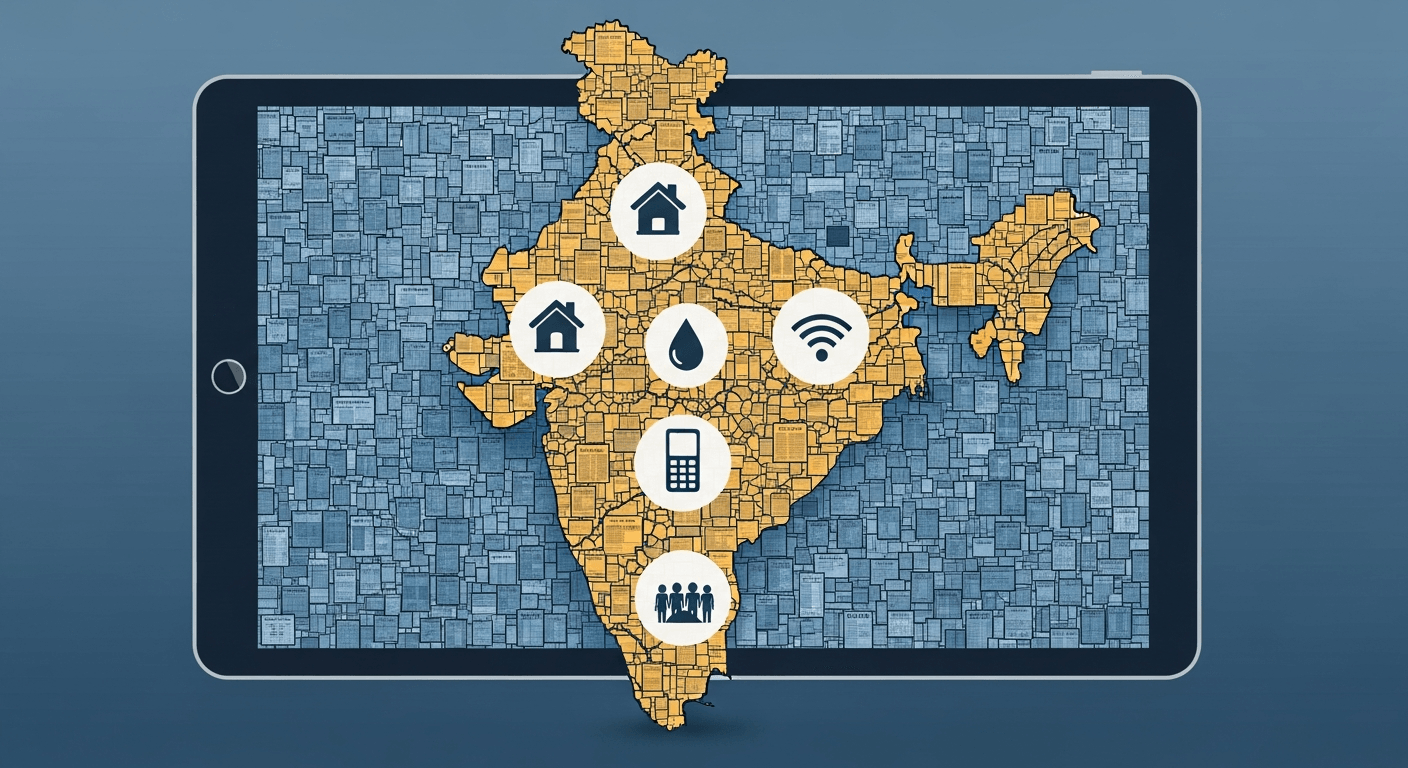
The houselisting and housing questionnaire (Phase I) notified by the Registrar General lists 33 items that are primarily about housing, household composition, amenities and assets. I summarise them in grouped form and explain why each group matters:
1) House & structure (items 1–7)
- Building number, census house number, predominant materials for floor/wall/roof, use and condition of the house.
- Why it matters: these capture housing quality and inform planning for shelter, retrofitting, disaster management and financing.
2) Household composition (items 8–15)
- Household number, total residents, name and sex of household head, whether the head belongs to SC/ST/Other, ownership status, number of rooms, number of married couples.
- Why it matters: basic demographics and household structure affect entitlement design for housing, subsidies and family‑centred schemes. The SC/ST/Other field is a cursory indicator in Phase I; the detailed caste enumeration will occur in Phase II.[1][2]
3) Water, sanitation, energy and amenities (items 16–24)
- Main drinking water source and availability, lighting source, latrine access and type, wastewater outlet, bathing facility, kitchen availability and LPG/PNG connection, main cooking fuel.
- Why it matters: these are standard welfare indicators tied to health, women’s safety, and service provisioning.
4) Connectivity, devices and media (items 25–29)
- Radio/transistor, television, internet access, laptop/computer, telephone/mobile/smartphone.
- Why it matters: digital inclusion, information access, and livelihoods increasingly depend on these variables; they also matter for the feasibility of self‑enumeration and digital outreach.
5) Transport and food (items 30–32)
- Bicycle/scooter/motorcycle; car/jeep/van; main cereal consumed.
- Why it matters: asset ownership signals household economic status; cereal preference is a new proxy for dietary patterns and food policy planning.
6) Contact (item 33)
- Mobile number for census‑related communications only.
- Why it matters: required for authentication of self‑enumeration and follow‑up. Authorities have said mobile numbers will be used only for census communications and that aggregated data release will respect privacy rules.[1][2]
Methodology and privacy concerns
Several procedural changes are notable: this will be India’s first fully digital census, enumerators will use mobile apps, and a self‑enumeration portal is planned. These raise both opportunities and risks:
- Data security and storage: encryption, access controls and clear retention schedules are essential. The government has said individual‑level data will not be made public, and aggregated caste and socio‑economic data will be released. But policymakers must publish a clear data governance framework, independent audits and incident response protocols.
- Self‑enumeration & digital divide: while self‑enumeration improves convenience, uneven digital literacy and mobile access risk differential non‑response. The houselisting questionnaire already asks about internet and device access precisely to map this gap.[2]
- Question framing & response quality: caste is sensitive and multi‑layered. The census will record self‑declared caste, but without independent verification; that means counselling, enumerator training and clear guidance are critical to reduce errors and gaming.
- Aggregation and categorisation: states have different classifications (what’s OBC in one state may be general in another). The census must document how sub‑caste entries will be standardised if national aggregation is intended.
Political and civil‑society reactions (summary)
- Political parties: the demand for a caste count has been a persistent call from many opposition groups and some state governments; the central decision to include caste enumeration reflects those political pressures. At the same time, debates persist about whether the data should be published in specific cross‑tabulations or withheld in aggregated form for privacy and social harmony.
- Civil society and scholars: reactions are mixed. Many welcome the potential to quantify historical disadvantage; others warn about methodology, the risk of misuse, and the need for clear safeguards and independent oversight. Some academic voices have emphasised that a census is the most authoritative instrument to measure social inequality — provided procedures preserve integrity and transparency.[4]
Potential uses for policy and social justice
- Targeted welfare: accurate sub‑caste and socio‑economic linkages can better target scholarships, health interventions and livelihoods programs.
- Monitoring affirmative action: the data will strengthen evaluation of existing reservation policies and identify underserved pockets.
- Research and planning: granular data can enable richer intersectional analysis (caste × gender × region × education).
FAQs (short)
Q: Will individual caste details be published? A: The government has said individual‑level data will not be released; aggregated caste and socio‑economic tables are expected, subject to the Census Commissioner’s release protocols.[1]
Q: Can people refuse to disclose caste? A: Officials have said respondents will have the option not to disclose caste. Implementation and non‑response handling rules will need to be transparent.
Q: How will the census handle digital exclusion? A: The houselisting questionnaire explicitly asks about internet and device ownership; enumerator outreach and assisted enumeration will be necessary in low‑connectivity areas.[2]
Conclusion — my practical prescription
I welcome the potential of caste enumeration to sharpen policy. But the promise will be realised only if four things happen: (1) a transparent, legally grounded data governance framework; (2) rigorous methodology, including harmonisation protocols for caste entries; (3) robust training and calibration of enumerators; and (4) public communication that explains why the data are collected, how they will be used, and how privacy will be protected. I have argued earlier for digitisation, simplification and public transparency in census design — these are the same priorities now that the nation stands on the verge of this historic count.[5]
Regards,
Hemen Parekh
Any questions / doubts / clarifications regarding this blog? Just ask (by typing or talking) my Virtual Avatar on the website embedded below. Then "Share" that to your friend on WhatsApp.
References
[1] "Census 2027 to capture caste data; 33 parameters notified," Economic Times. https://economictimes.indiatimes.com/news/india/census-2027-to-capture-caste-data-33-parameters-notified/articleshow/127181111.cms
[2] "33 questions notified for first phase of Census 2027," Hindustan Times (summary of the gazette notification and list). https://www.hindustantimes.com/india-news/census-2027-33-questions-notified-for-first-phase-of-census-includes-internet-access-main-cereal-consumed-101769137342703.html
[3] Background on the history and timing of Census 2027, Wikipedia and related coverage. https://en.wikipedia.org/wiki/2027censusof_India
[4] Scholarly and civil‑society perspectives on caste enumeration (selection). See analyses in The Hindu BusinessLine and academic commentary.
[5] My earlier reflections on census design and caste data collection (selected posts by me): "Caste Census data to drive policy changes" and "Census 2021: Unprecedented Opportunity." https://myblogepage.blogspot.com/2025/08/caste-census-data.html
Get correct answer to any question asked by Shri Amitabh Bachchan on Kaun Banega Crorepati, faster than any contestant
Hello Candidates :
- For UPSC – IAS – IPS – IFS etc., exams, you must prepare to answer, essay type questions which test your General Knowledge / Sensitivity of current events
- If you have read this blog carefully , you should be able to answer the following question:
- Need help ? No problem . Following are two AI AGENTS where we have PRE-LOADED this question in their respective Question Boxes . All that you have to do is just click SUBMIT
- www.HemenParekh.ai { a SLM , powered by my own Digital Content of more than 50,000 + documents, written by me over past 60 years of my professional career }
- www.IndiaAGI.ai { a consortium of 3 LLMs which debate and deliver a CONSENSUS answer – and each gives its own answer as well ! }
- It is up to you to decide which answer is more comprehensive / nuanced ( For sheer amazement, click both SUBMIT buttons quickly, one after another ) Then share any answer with yourself / your friends ( using WhatsApp / Email ). Nothing stops you from submitting ( just copy / paste from your resource ), all those questions from last year’s UPSC exam paper as well !
- May be there are other online resources which too provide you answers to UPSC “ General Knowledge “ questions but only I provide you in 26 languages !


No comments:
Post a Comment