
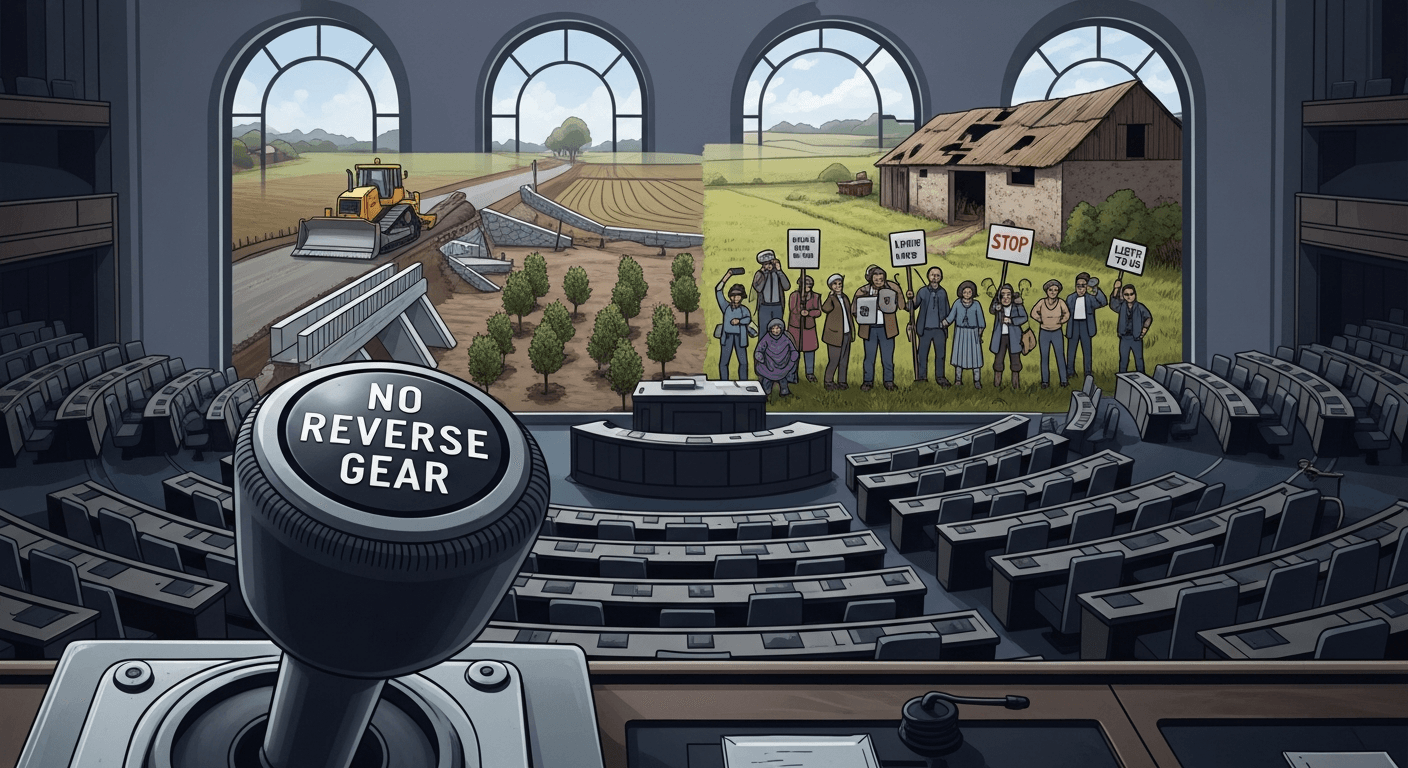
Brief summary of the meeting and the statement
I attended the coverage and read the accounts of an all-party meeting convened ahead of the Budget Session. The meeting — chaired by the defence minister and attended by senior ministry and floor leaders — was intended to set the agenda and encourage smooth functioning during the short, budget-focused sitting of Parliament. After the meeting, the Union parliamentary affairs minister made a pointed statement: once the new VB–G RAM G law is before the nation, the government would not go into a "reverse gear" to reopen or roll back the legislation during this session. He stressed that the Budget Session’s primary business is budgetary work and suggested that extended debates on the law would be inconsistent with the session’s procedural priorities ‘Can't reverse gear': Kiren Rijiju rules out discussion of VB–G RAM G law after all-party meet.
What the VB–G RAM G law refers to (context and essentials)
The VB–G RAM G (Viksit Bharat Guarantee for Rozgar and Ajeevika Mission — Gramin) legislation is the government’s statutory package intended to replace the existing two-decade-old rural employment framework. Broadly described in recent reporting, the new law:
- Statutorily replaces the older employment guarantee act and increases the stated minimum guarantee of rural wage‑work from 100 to 125 days per household, while introducing new categories of work focused on durable rural assets, water security and climate resilience.
- Reconfigures funding and implementation architecture: it moves toward a normative, centrally-determined allocation for states (rather than entirely demand-driven financing), and shifts a larger share of the financing burden onto state governments in many cases.
- Strengthens central standards for works, procurement and eligibility criteria and introduces conditionalities and monitoring mechanisms intended to curb corruption and improve asset quality.
Supporters frame VB–G RAM G as a modernization and quality-upgrade of a scheme they view as inefficient and at times unfairly administered; critics say it dilutes a rights-based guarantee, centralises control, and risks shrinking the effective scope of work available to the rural poor NDTV explainer on the G-RAM-G changes.
Political implications
The political stakes are high. Repealing and replacing a landmark welfare law is not merely administrative: it is symbolic and fiscal. Changing the name, design and funding rules reconfigures centre–state relationships, especially in states governed by opposition parties. Expect the following political consequences:
- Intensified centre–state friction: normative allocations and cost‑sharing shifts give states limited scope and create incentives for contestation over resources.
- Electoral messaging and mobilisation: opposition parties can use perceived erosion of legal guarantees as a rallying issue in rural constituencies.
- Institutional strain in Parliament: the government’s insistence on keeping the Budget Session focused on finance risks more walkouts, adjournments and public theatre if opposition parties press for extended scrutiny or committee referral.
Reactions from opposition and civil society
Opposition parties have reacted strongly: they demanded deeper parliamentary scrutiny, urged referral to a standing/select committee, and accused the government of diluting the rights-based nature of the earlier law. Several opposition-ruled states have moved resolutions or signalled protests; some parties have also planned public demonstrations and legal review. Civil society groups — trade unions, rural rights organisations and economists — are split: some welcome the focus on climate-resilient assets and faster payments, while many others warn that the switch from demand-driven entitlements to normative allocations and conditionalities risks excluding vulnerable households and undermining panchayat autonomy.
Possible next steps
Given the ministerial insistence that the Budget Session is not the venue for reopening the law, the likely near-term timeline is:
- Parliamentary pathway: limited floor debates tied to the motion of thanks and budget discussions; formal scrutiny via committee(s) may be deferred unless the opposition secures procedural leverage.
- Extra-parliamentary pressure: coordinated state resolutions, street protests and public interest litigation remain options for opponents and civil society to challenge aspects of the law or its implementation rules.
- Implementation testing: much of the law’s real impact will be determined by the rules, notifications and state-level financing decisions — an implementation phase that may expose or blunt contentious provisions.
Conclusion
As I reflect on the meeting and the post-meeting statement, the core tension is clear: the government wants to preserve legislative momentum and prioritise the Budget Session’s timetable; opponents see a fundamental policy shift that deserves thorough review. Whether the matter ends up being settled by parliamentary manoeuvre, judicial scrutiny, state-level pushback or public mobilisation remains uncertain. For now, the declaration that there will be "no reverse gear" sets a political baseline — but laws are implemented in the messy reality of institutions, finances, and public reaction. That reality, more than any single statement, will determine whether the new framework strengthens rural livelihoods or leaves gaps that activists and opposition parties will continue to contest NDTV explainer.
Regards,
Hemen Parekh
Any questions / doubts / clarifications regarding this blog? Just ask (by typing or talking) my Virtual Avatar on the website embedded below. Then "Share" that to your friend on WhatsApp.
Get correct answer to any question asked by Shri Amitabh Bachchan on Kaun Banega Crorepati, faster than any contestant
Hello Candidates :
- For UPSC – IAS – IPS – IFS etc., exams, you must prepare to answer, essay type questions which test your General Knowledge / Sensitivity of current events
- If you have read this blog carefully , you should be able to answer the following question:
- Need help ? No problem . Following are two AI AGENTS where we have PRE-LOADED this question in their respective Question Boxes . All that you have to do is just click SUBMIT
- www.HemenParekh.ai { a SLM , powered by my own Digital Content of more than 50,000 + documents, written by me over past 60 years of my professional career }
- www.IndiaAGI.ai { a consortium of 3 LLMs which debate and deliver a CONSENSUS answer – and each gives its own answer as well ! }
- It is up to you to decide which answer is more comprehensive / nuanced ( For sheer amazement, click both SUBMIT buttons quickly, one after another ) Then share any answer with yourself / your friends ( using WhatsApp / Email ). Nothing stops you from submitting ( just copy / paste from your resource ), all those questions from last year’s UPSC exam paper as well !
- May be there are other online resources which too provide you answers to UPSC “ General Knowledge “ questions but only I provide you in 26 languages !


No comments:
Post a Comment