
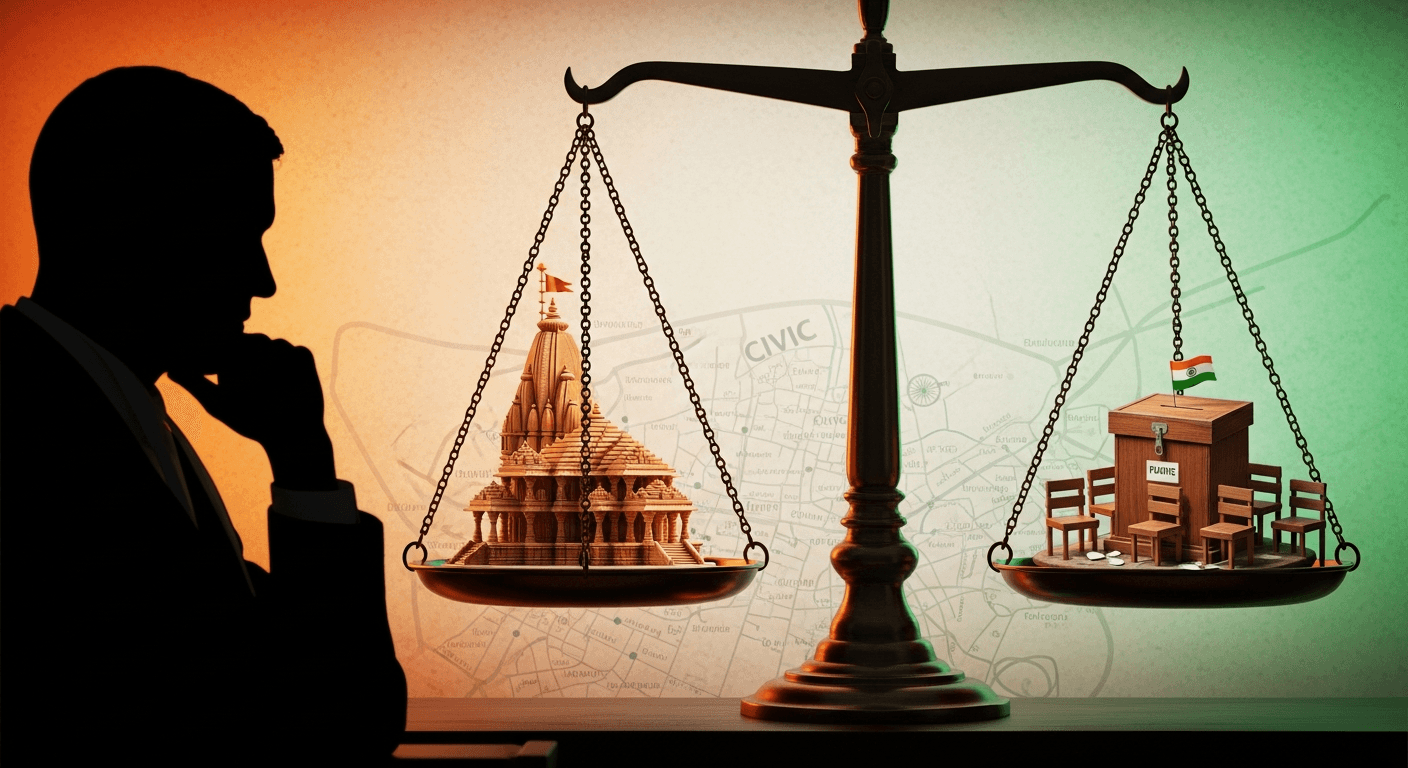
Why this question made me pause
A headline stopped me this morning: the Supreme Court has agreed to examine whether communities widely considered "socially and educationally forward" can nonetheless be politically backward — that is, under‑represented in local elected bodies and therefore eligible for reserved panchayat constituencies Times of India. What looks like a technical legal point is really a moral and political crossroad for democracy.
Two different meanings of "backward"
I keep returning to one core observation: India treats backwardness as a multi‑dimensional idea, but public imagination often flattens it.
- Social and educational backwardness points to historical exclusion from schools, professions and dignity. It's what most reservation policy started to address.
- Political backwardness focuses on representation — who sits in gram sabhas, panchayats and municipal councils. A community might have good literacy and incomes yet still be almost invisible in elected local leadership.
The Supreme Court’s willingness to examine this distinction is a reminder that rights and remedies must track the problem they aim to fix. If seats are empty of a community’s voice, that absence matters in a way that social indicators alone do not capture.[^times]
Why this is not an abstract debate
I’ve written before about the cascade effect of quota politics — how a grant of reservation to one community triggers claims across many others, and how well‑intentioned fixes can open Pandora’s box of competing entitlements[^divide]. The present legal question has three practical risks and one opportunity:
Risks
- Policy arithmetic: Allowing reservation based purely on political under‑representation could create an expanding set of claimants and politicize the mechanics of democratic inclusion.
- Perverse incentives: Political under‑representation can be both a cause (discrimination) and an effect (low political mobilization). Reserving seats is a blunt tool if it doesn't encourage durable civic engagement.
- Backlash and fragmentation: When forward‑looking social status is juxtaposed with political scarcity, public discourse can harden into identity grievance rather than policy deliberation.
Opportunity
- Corrective representation: If the goal is to ensure meaningful participation, targeted reservations in local bodies — designed with data and reviewed periodically — could accelerate inclusion where it truly lags.
Three principles I would ask policymakers and courts to keep front of mind
Evidence before entitlement: Any move to reserve seats on the basis of political backwardness must rest on careful, transparent data about representation and barriers to entry at the local level.
Narrow, time‑bound remedies: Reservations that correct a specific structural deficit (in a set of constituencies, for a defined period) reduce the risk of permanent carve‑outs that distort political competition.
Complement, don’t substitute: Reserved seats should be paired with investments in civic education, leadership pipelines, and party reforms that make it easier for under‑represented groups to contest and win on merit over time.
What I predicted earlier — and why it matters now
This is not new territory for me. Years ago I warned that quota expansion — however politically tempting — risks multiplying claims and eroding the simple arithmetic of justice into a puzzle of competing special pleas. I argued then that unless reforms are coupled with systemic fixes (education, opportunity, party renewal), we trade one inequality for another[^divide]. Today's court reference is a precise reiteration of that dilemma: the law must be technically right and politically wise.
A personal note
I believe our democratic challenge is not merely to allocate slices of power but to make the processes of power accessible. Representation is about dignity — of being seen, heard and able to shape decisions that affect your neighborhood, school and fields. If the Court's examination leads to smarter, data‑driven policy that enlarges civic capability rather than shrinks it, that will be a result worth the fuss.
Regards,
Hemen Parekh
Any questions / doubts / clarifications regarding this blog? Just ask (by typing or talking) my Virtual Avatar on the website embedded below. Then "Share" that to your friend on WhatsApp.
Get correct answer to any question asked by Shri Amitabh Bachchan on Kaun Banega Crorepati, faster than any contestant
Hello Candidates :
- For UPSC – IAS – IPS – IFS etc., exams, you must prepare to answer, essay type questions which test your General Knowledge / Sensitivity of current events
- If you have read this blog carefully , you should be able to answer the following question:
- Need help ? No problem . Following are two AI AGENTS where we have PRE-LOADED this question in their respective Question Boxes . All that you have to do is just click SUBMIT
- www.HemenParekh.ai { a SLM , powered by my own Digital Content of more than 50,000 + documents, written by me over past 60 years of my professional career }
- www.IndiaAGI.ai { a consortium of 3 LLMs which debate and deliver a CONSENSUS answer – and each gives its own answer as well ! }
- It is up to you to decide which answer is more comprehensive / nuanced ( For sheer amazement, click both SUBMIT buttons quickly, one after another ) Then share any answer with yourself / your friends ( using WhatsApp / Email ). Nothing stops you from submitting ( just copy / paste from your resource ), all those questions from last year’s UPSC exam paper as well !
- May be there are other online resources which too provide you answers to UPSC “ General Knowledge “ questions but only I provide you in 26 languages !



No comments:
Post a Comment