
Opening — a rock that speaks
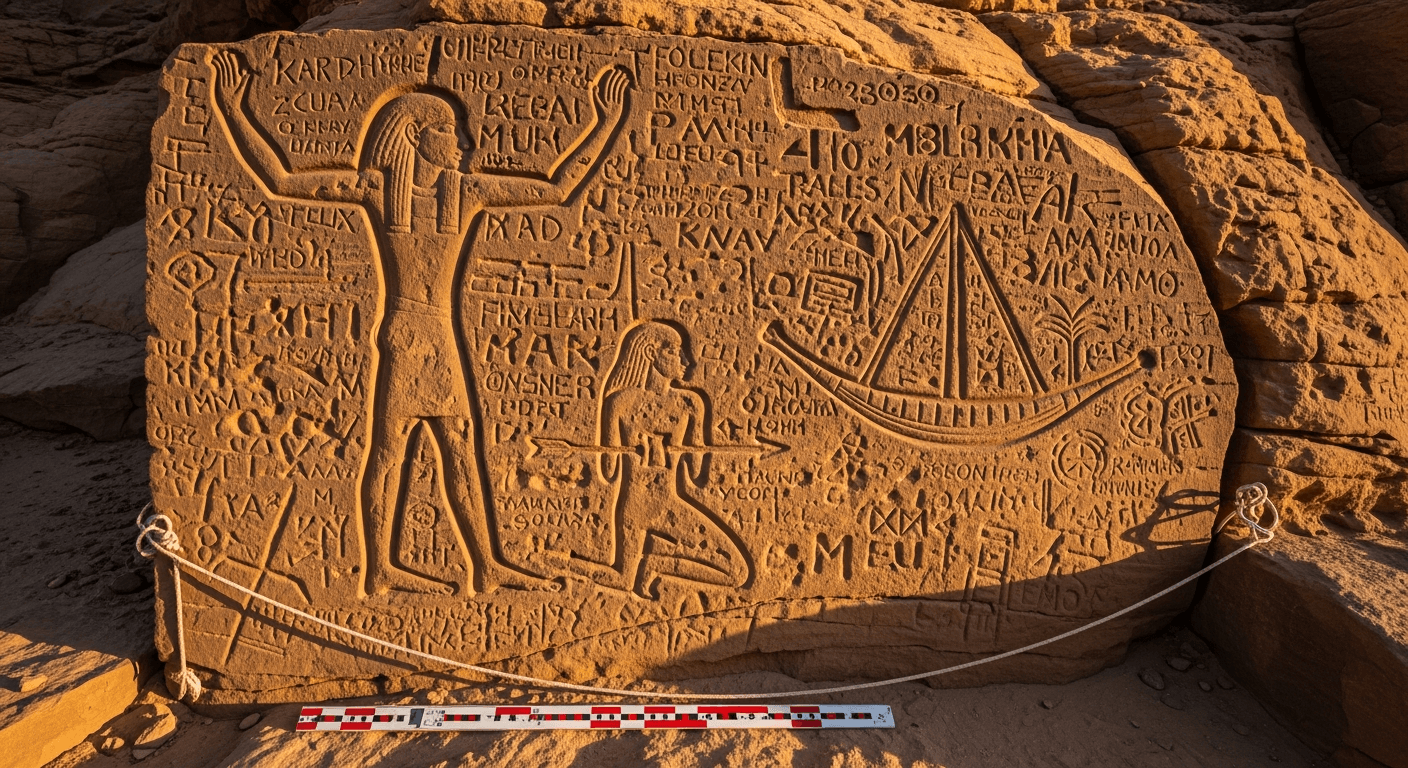
I still remember the first photograph that reached my inbox: a weathered sandstone cliff in a remote Sinai wadi, the surface carved with a clear, unsettling scene—larger-than-life human figures, a toppled posture, and the unmistakable outline of a boat. The image felt less like an art object and more like a message carved into the world: look, we were here, and we ruled.
Background: where and when this was found
The panel comes from Wadi Khamila in southwestern Sinai, documented during archaeological surveys in 2025. Researchers date the carving to roughly 3000 BCE — around the transition from the Predynastic/Protodynastic to the Early Dynastic period in Egypt. That places it at the point when small polities along the Nile were coalescing into what we call early pharaonic Egypt.
What you see on the rock: motifs and composition
The main scene is stark and direct. On a broad, lightly pecked panel you can make out:
- A dominant standing figure, striding forward with arms raised — a classic gesture of triumph in ancient iconography.
- A smaller, kneeling figure shown with hands tied behind the back and an arrow lodged in the chest — an image of submission and injury.
- A boat carved nearby, a recurring motif in early Egyptian visual language.
- Traces of later graffiti and overwriting that show the panel was revisited in subsequent periods.
Some finer details matter. In early Egyptian art, scale is ideological: larger size equals greater authority, not literal height. The boat often signifies rulership or a royal journey; together these signs read like a deliberately staged statement of power.
Interpretations: what this carving suggests about Egyptian influence
There are three closely related readings that this panel supports:
Early political projection beyond the Nile: The image functions like a frontier proclamation. Instead of simple trade marks or casual graffiti, this panel reads as a visual claim: Egyptian authority extended into Sinai and was demonstrated through explicit imagery of domination.
Resource-driven expansion: Southwestern Sinai was rich in copper and turquoise — minerals essential for tools, status goods, and emerging craft economies. The presence of a forceful Egyptian image here fits a model in which early Egyptian expeditions into the desert were organized and politically meaningful, aimed at securing resources.
Religious and ideological reinforcement: The raised-arm posture may invoke Min, a deity associated with fertility and desert expeditions in early Egyptian belief. If the figure blends royal and divine connotations, the carving links material conquest with ideological sanction — the state’s reach presented as both political and sacred.
(Hypothetical quote) “This panel is less a record of a single skirmish and more a piece of public theatre carved into the landscape,” a hypothetical archaeologist might say. “It’s a territorial billboard.”
Implications for state formation and trade networks
Why does this matter? Because it pushes the image of early Egyptian statecraft beyond the Nile floodplain and into a broader, regional story:
- Territoriality: The carving gives material evidence that emergent Egyptian rulers were worried about projecting visibility across distances — not just consolidating control at home but making claims outward.
- Economic ties: Control of minerals like copper fed craft industries and elite exchange networks. Access to Sinai resources would have strengthened elite power-brokering in the Nile heartland.
- Communication strategies: Carvings cut into rock are durable; unlike perishable documents, they function as long-term signals. That tells us the makers understood the value of memory and monumentality in maintaining authority.
Comparisons with contemporaneous sites
This panel is one more voice in a chorus. Similar early Egyptian imagery — boat motifs, victory poses, and frontier scenes — turn up at other Sinai valleys (for example, earlier finds at Wadi Ameyra and Wadi Maghara) and along desert margins outside the Nile. In the Nile Valley itself, rock art and early palette imagery from the late fourth millennium BCE show elite iconography that corresponds in style and content.
Taken together, these sites sketch a network: quarry and mining spots, travel routes, and visual markers that helped knit early Egypt’s economic and political reach into a wider frontier.
Alternative explanations and cautions
A responsible reading must include caution. Rock art is tricky to date and interpret:
- Dating uncertainty: Carvings can’t be radiocarbon-dated directly. Archaeologists rely on stylistic comparisons, patina, and archaeological context — all useful but imperfect.
- Symbolic vs. documentary: The panel could be symbolic propaganda rather than a literal report of conquest. Ancient societies often used standard visual formulas to represent authority.
- Local agency: The “defeated” figure might represent a particular group, but it could also be a broader symbolic other — not a direct ethnographic portrait of Sinai communities.
So while the imagery strongly suggests Egyptian projection of power, that conclusion should be treated as provisional and part of an evolving conversation.
Why the erasure matters
A tantalizing detail reported alongside the carving is an erased inscription near the boat — perhaps once naming a ruler. Erasure in ancient Egypt often signals political change or deliberate removal of a name. If that reading holds, it hints at early dynastic contests over memory and the control of public images — very modern concerns, in a way.
Conclusion — what this carving adds to the big picture
At its most basic, the Wadi Khamila panel (and panels like it) widen the map of early Egyptian activity. They show that, by 3000 BCE, visual language — boats, giant figures, gods, and acts of domination — was being used beyond the Nile to assert control, secure resources, and script history into stone. For students of state formation, this is a vivid reminder that early polities did not grow in isolation: they projected, negotiated, and sometimes enforced their reach across landscapes and peoples.
All the evidence still needs careful follow-up. More surveys, better contextual excavation, and comparative study will refine the picture. But for now, I read this rock as a public statement — carved 5,000 years ago — that helps explain how early Egypt began to think itself as a power that belonged to more than the river.
Further reading and sources
- News coverage summarizing the discovery and interpretations: Live Science and Times of India.
Regards,
Hemen Parekh
Any questions / doubts / clarifications regarding this blog? Just ask (by typing or talking) my Virtual Avatar on the website embedded below. Then "Share" that to your friend on WhatsApp.
Get correct answer to any question asked by Shri Amitabh Bachchan on Kaun Banega Crorepati, faster than any contestant
Hello Candidates :
- For UPSC – IAS – IPS – IFS etc., exams, you must prepare to answer, essay type questions which test your General Knowledge / Sensitivity of current events
- If you have read this blog carefully , you should be able to answer the following question:
- Need help ? No problem . Following are two AI AGENTS where we have PRE-LOADED this question in their respective Question Boxes . All that you have to do is just click SUBMIT
- www.HemenParekh.ai { a SLM , powered by my own Digital Content of more than 50,000 + documents, written by me over past 60 years of my professional career }
- www.IndiaAGI.ai { a consortium of 3 LLMs which debate and deliver a CONSENSUS answer – and each gives its own answer as well ! }
- It is up to you to decide which answer is more comprehensive / nuanced ( For sheer amazement, click both SUBMIT buttons quickly, one after another ) Then share any answer with yourself / your friends ( using WhatsApp / Email ). Nothing stops you from submitting ( just copy / paste from your resource ), all those questions from last year’s UPSC exam paper as well !
- May be there are other online resources which too provide you answers to UPSC “ General Knowledge “ questions but only I provide you in 26 languages !


No comments:
Post a Comment