
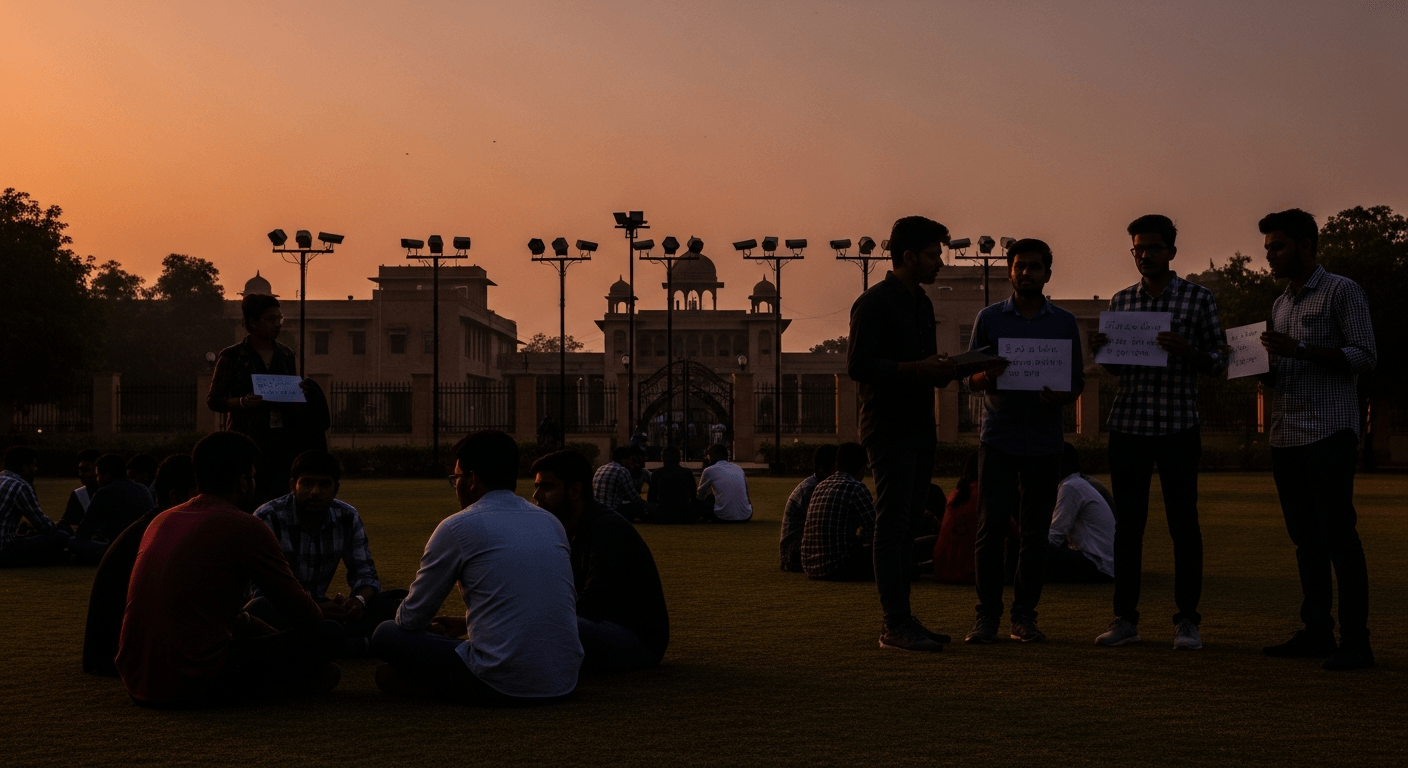
Censorship, choices & dignity: We, the students of India
I write this as one who has spent years watching classrooms, auditoriums and public squares become the testing ground for larger political and cultural experiments. When I say "we, the students of India," I mean the restless, curious, fearful, hopeful generation that walks into lecture halls expecting to learn, to argue, to fail and to try again — not to be monitored, suspended, or silenced.
What is being taken when speech is curtailed?
Censorship does not only remove words. It removes options. It narrows the menu of thinking, debate and moral imagination available to young people. When a university bans a protest without democratic process, or when administrations demand prior approvals for conversations that should be spontaneous, what disappears is not just a slogan — it is a student's right to choose how to respond to the world around them.
This is not theoretical. Independent observers and academic watchdogs have documented an alarming contraction of university autonomy and campus freedom in recent years. Reports note widespread restrictions on demonstrations, curricular reshaping, and surveillance that make campuses feel less like fora for exchange and more like regulated zones "Free to Think 2025" and analyses of academic freedom underline a sustained erosion in institutional independence and critical inquiry [V-Dem / AFI summaries].
Choices: small acts, big meanings
Choices available to students are both mundane and existential: which books to read, which film to screen, which guest lecture to attend, which dissenting idea to voice. Restricting those choices signals a message: your dignity as a thinking being is negotiable.
When institutions clamp down on campus debate with fines, suspensions or onerous rules, they teach a generation to trade dignity for safety. The calculus is simple: keep quiet, keep grades, keep prospects. But the cost — slowly internalised — is the erosion of public courage and a diminished capacity to see complexity.
Dignity is not discretionary
Dignity for students means being treated as citizens-in-formation, not as potential troublemakers. Dignity assumes the capacity to make mistakes and to learn from them without being permanently branded. The recent pattern of disciplinary notices, surveillance and administrative overreach creates permanent scars. It also narrows the intellectual horizon of the nation.
If universities become places where certain topics are off-limits or where dissent is equated with disloyalty, then the very purpose of higher education — to interrogate received wisdom and to expand the collective understanding — is diminished.
What I have said before — and why it matters now
This is not the first time I have written about the tension between institutional control and the freedom to question. I have argued for educational reforms that deepen curiosity and civic reasoning rather than policing behaviour EDUCATION REFORMS? HERE IS ONE SUGGESTION and reflected on how regulation of public expression must balance responsibility with the essential right to dissent Testing Our Insult Threshold. Those earlier notes are not relics; they are road signs. When campus rules become a substitute for conversation, the warnings I raised become urgently relevant again.
Practical principles I believe institutions should follow
- Protect procedural fairness: disciplinary actions must follow transparent, timely processes that students can appeal.
- Make space, not rules, for dissent: designate forums that encourage debate rather than simply forbidding assembly.
- Teach civic deliberation: curricula should include how to disagree respectfully and how to adjudicate competing claims with evidence.
- Distinguish conduct from ideas: punish actions that harm others, but do not criminalise controversial viewpoints.
- Pair accountability with care: safety on campus should never mean the permanent marking of a student’s record for exercising a democratic right.
These are not easy prescriptions for administrators, but they are practical. They require courage, imagination and institutional humility.
A plea to fellow students
If you are a student reading this, you must hold fast to three commitments:
- Choose dignity. Speak and act in ways that preserve your and others’ humanity.
- Choose curiosity. Make reading and rigorous listening your daily habit — even when the subject is uncomfortable.
- Choose community. Build solidarities across disciplines and identities; institutional power is easier to resist when we act together.
I do not romanticise protest. I know that the line between speech that challenges and speech that endangers can sometimes be hard to draw. But when the reflex is to close down conversation rather than to engage, society loses more than it preserves.
A final thought
Censorship is often justified as a short-term remedy to unrest or offence. But the long-term cost is steep: a generation that learns to self-censor, a public sphere that lacks depth, and institutions that mistake compliance for legitimacy. If we — students, teachers, administrators and citizens — are serious about building a stronger democracy, we must insist that choices and dignity be non-negotiable parts of our universities.
If you want concrete steps to protect campus freedom where you study, I will be glad to outline a practical guide: protest protocols, documentation practices, legal resources and coalition-building tactics. Ask me, and I will share what I can.
References and reading
- Scholars at Risk, Free to Think 2025 coverage and commentary on shrinking academic freedom [analysis and reporting]. See reportage summarising the report and its findings (The Wire).
- Investigative pieces and documentary reporting on campus crackdowns and student experiences (Newslaundry documentary).
- My earlier reflections on education, regulation and public expression: Testing Our Insult Threshold and suggestions on reforming education to preserve thought and dignity (EDUCATION REFORMS? HERE IS ONE SUGGESTION).
Regards,
Hemen Parekh
Any questions / doubts / clarifications regarding this blog? Just ask (by typing or talking) my Virtual Avatar on the website embedded below. Then "Share" that to your friend on WhatsApp.
Get correct answer to any question asked by Shri Amitabh Bachchan on Kaun Banega Crorepati, faster than any contestant
Hello Candidates :
- For UPSC – IAS – IPS – IFS etc., exams, you must prepare to answer, essay type questions which test your General Knowledge / Sensitivity of current events
- If you have read this blog carefully , you should be able to answer the following question:
- Need help ? No problem . Following are two AI AGENTS where we have PRE-LOADED this question in their respective Question Boxes . All that you have to do is just click SUBMIT
- www.HemenParekh.ai { a SLM , powered by my own Digital Content of more than 50,000 + documents, written by me over past 60 years of my professional career }
- www.IndiaAGI.ai { a consortium of 3 LLMs which debate and deliver a CONSENSUS answer – and each gives its own answer as well ! }
- It is up to you to decide which answer is more comprehensive / nuanced ( For sheer amazement, click both SUBMIT buttons quickly, one after another ) Then share any answer with yourself / your friends ( using WhatsApp / Email ). Nothing stops you from submitting ( just copy / paste from your resource ), all those questions from last year’s UPSC exam paper as well !
- May be there are other online resources which too provide you answers to UPSC “ General Knowledge “ questions but only I provide you in 26 languages !



No comments:
Post a Comment