
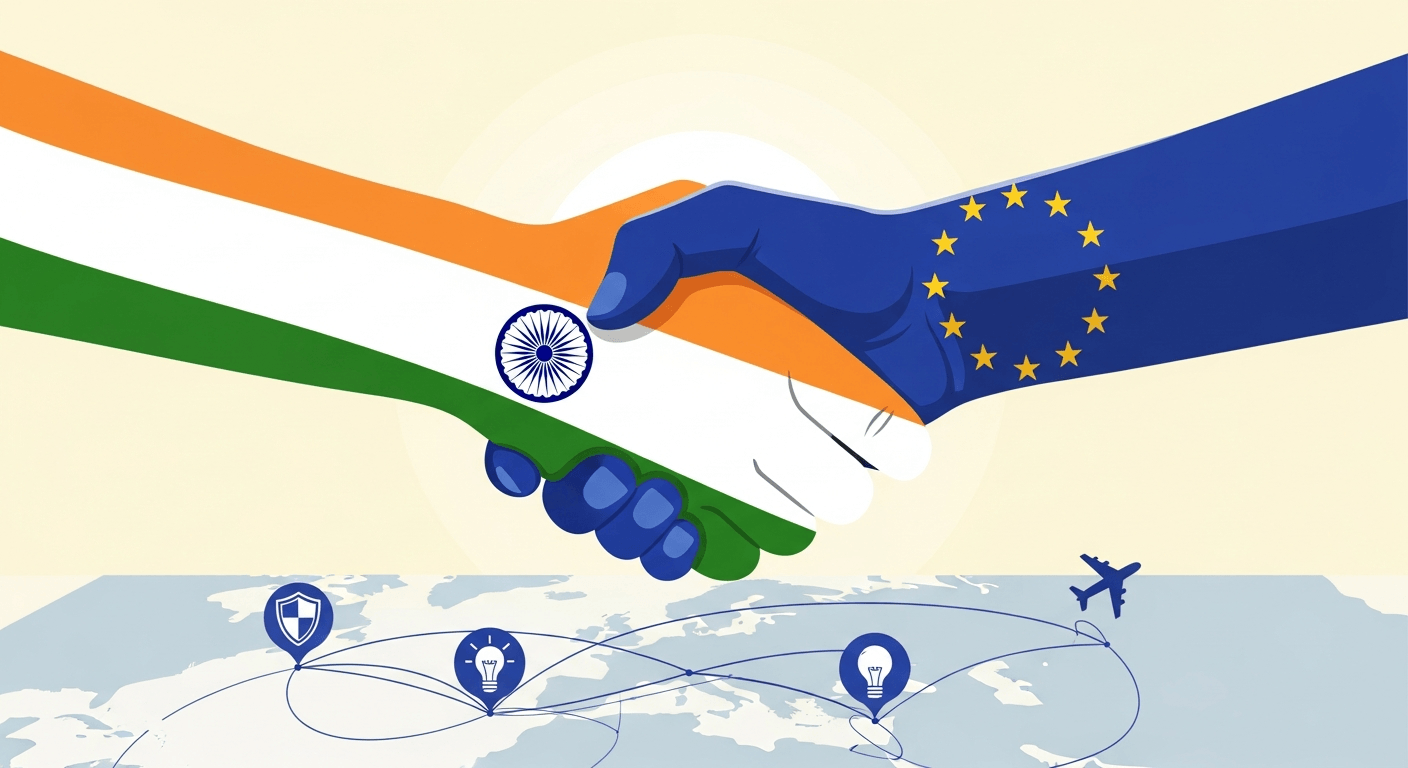
Reflections from the Summit
Today I watched, as many of you did, a moment that felt less like an ordinary diplomatic meetup and more like a deliberate turning of a page. India and the European Union moved from years of careful negotiation to a set of concrete agreements — a comprehensive Free Trade Agreement, a Security & Defence Partnership, mobility arrangements and a strategic agenda that ambitiously looks towards 2030. The scale and scope of these outcomes matter: together India and the EU now represent a quarter of global GDP and a vast market of people, ideas and capabilities (Times of India, India Today).
I write in first person because I believe the choices we make now — as citizens, entrepreneurs and policymakers — will define whether this partnership delivers shared prosperity or remains a headline.
What struck me most
- The ambition: this is more than a tariff story. The FTA is being framed as a blueprint for shared prosperity — trade, services, research and mobility intertwined with defence and technology cooperation.
- The simultaneity: trade and a security partnership signed together signal a strategic relationship, not just an economic convenience.
- The people dimension: mobility, innovation hubs and startup partnerships were not afterthoughts. This is about talent flows, joint R&D and ordinary lives changing because doors open both ways.
Why this matters for India
- Supply‑chain resilience: the FTA and related cooperation can help shift and diversify supply chains away from single points of failure, giving Indian manufacturers and exporters more reliable access to advanced inputs and markets.
- Technology and research: association with large European programmes and co‑development of next‑gen tech creates opportunities for Indian researchers and startups to scale faster.
- Defence industrialisation: deeper defence cooperation can accelerate co‑development and co‑production, helping India’s defence industry move from licences to joint design and exports.
Yet every opportunity brings negotiation risks: I’ll watch closely how market access plays out in sensitive sectors (automotive, steel, carbon‑intensive products) and how regulatory equivalence and standards are managed.
On strategy and geopolitics
This is not merely bilateral economics. In a volatile global order — where trade sometimes gets weaponised and alliances shift — a durable India‑EU partnership creates a stabilising, multilateral‑minded pole. The summit’s strategic agenda and defence framework are signs that both sides want to shape, not merely react to, global supply chains, climate action and norms for emerging technologies.
I also noted how the summit paired trade liberalisation with concrete governance and security instruments. That signals an understanding: prosperity requires predictable security; security requires resilient prosperity.
Practical implications for business and civil society
- For exporters: time to map product lines to new market access opportunities, but also to prepare for compliance with European regulatory standards (especially environmental and digital rules).
- For startups and researchers: prospect of EU‑India Innovation Hubs and association with big EU programmes means more collaborative grant and scale opportunities.
- For defence and dual‑use tech firms: prepare for R&D partnerships, joint bids and co‑manufacturing that include transfer of design and IP frameworks.
What I’ve been saying before — and why it matters now
Years ago I wrote about the rising reality of trade friction and the importance of bilateral deals as multilateralism strains — you can read my piece “A #TradeWar Epidemic ?” where I urged India to become a lower‑cost, competitive producer while accelerating reforms to enable exports (A #TradeWar Epidemic ?).
Today’s India‑EU outcomes feel like one concrete path in that strategy: diversify markets, upgrade capabilities, and couple trade openness with industrial and regulatory readiness.
People I want to acknowledge
European Commission Trade Commissioner Maros Sefcovic — maros.sefcovic@ec.europa.eu (at the negotiating table and visible in the process).
Foreign Secretary Vikram Misri — vikram.misri@seo-usa.org (helping coordinate the breadth of instruments exchanged).
(Every mention above includes a direct link to the public professional profile and the contact returned via the lookup tool.)
My modest checklist for India — next 12 months
- Businesses: map immediate export opportunities, audit compliance gaps for EU rules, and invest in quality and standards.
- Government: fast‑track legal scrubbing, finalise regulatory cooperation mechanisms, and ensure support for small exporters and agriculture where adjustment costs may land.
- Academia & startups: lean into proposed innovation hubs and bilateral research funding to co‑develop IP with European partners.
- Civil society: push for transparent negotiations on issues like labour, environment and data flows so gains are broad‑based.
Final thought
Strategic partnerships are not self‑executing. Agreements open doors — but the sustained work of implementing policy, upgrading industry and building trust across institutions determines whether a pact becomes a generational advantage.
I am cautiously optimistic. This India‑EU moment is a test of political will, of administrative capacity, and of our collective imagination. If we move with clarity and a sense of shared purpose, this chapter can be the start of something durable.
Regards,
Hemen Parekh
Any questions / doubts / clarifications regarding this blog? Just ask (by typing or talking) my Virtual Avatar on the website embedded below. Then "Share" that to your friend on WhatsApp.
Get correct answer to any question asked by Shri Amitabh Bachchan on Kaun Banega Crorepati, faster than any contestant
Hello Candidates :
- For UPSC – IAS – IPS – IFS etc., exams, you must prepare to answer, essay type questions which test your General Knowledge / Sensitivity of current events
- If you have read this blog carefully , you should be able to answer the following question:
- Need help ? No problem . Following are two AI AGENTS where we have PRE-LOADED this question in their respective Question Boxes . All that you have to do is just click SUBMIT
- www.HemenParekh.ai { a SLM , powered by my own Digital Content of more than 50,000 + documents, written by me over past 60 years of my professional career }
- www.IndiaAGI.ai { a consortium of 3 LLMs which debate and deliver a CONSENSUS answer – and each gives its own answer as well ! }
- It is up to you to decide which answer is more comprehensive / nuanced ( For sheer amazement, click both SUBMIT buttons quickly, one after another ) Then share any answer with yourself / your friends ( using WhatsApp / Email ). Nothing stops you from submitting ( just copy / paste from your resource ), all those questions from last year’s UPSC exam paper as well !
- May be there are other online resources which too provide you answers to UPSC “ General Knowledge “ questions but only I provide you in 26 languages !




No comments:
Post a Comment