
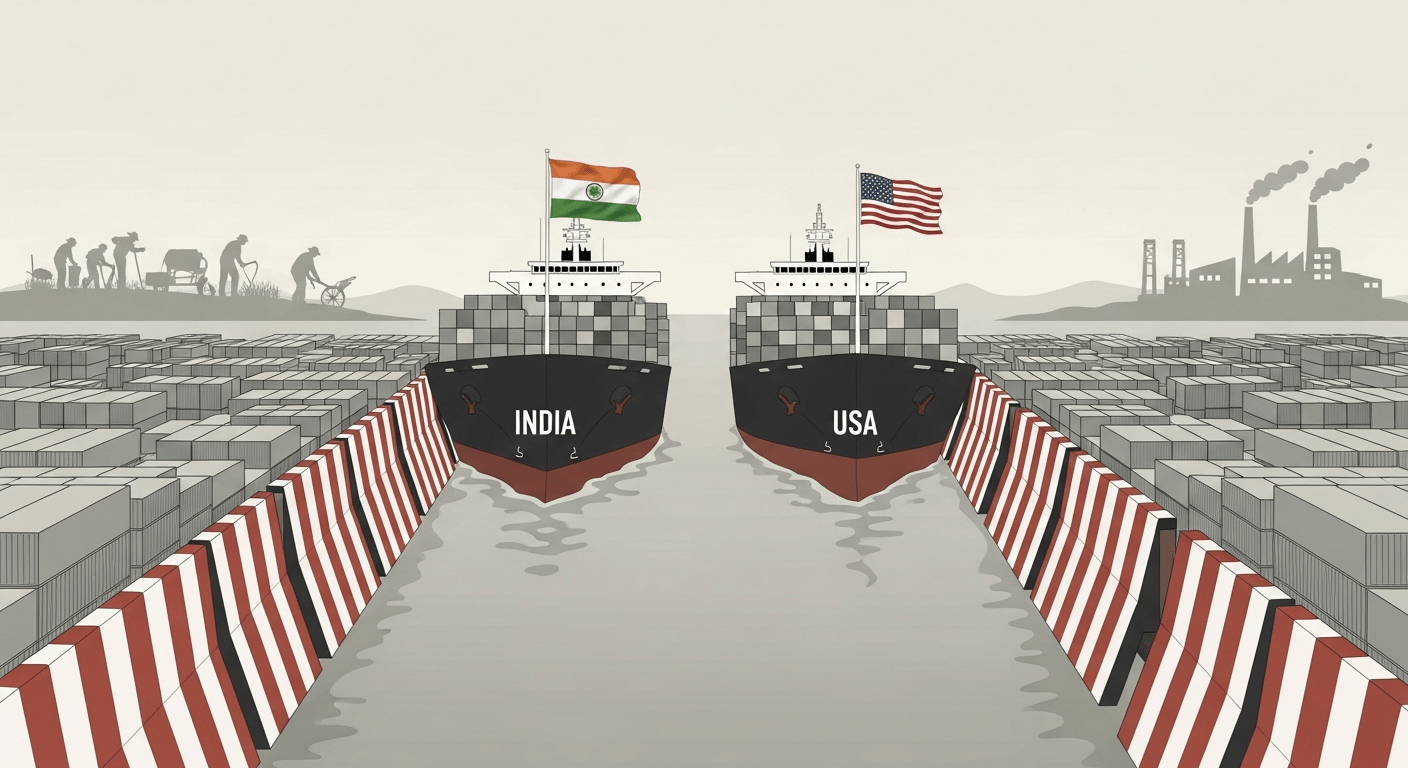
I start with a short lede: India’s commerce minister has said delays in a bilateral India–US trade deal are not a sign of disappointment — rather a reflection that “every country looks after its own interests.” The statement matters because it frames the current pause as deliberate bargaining, not breakdown, and helps set expectations for exporters, investors and supply‑chain managers watching tariff relief and market access talks.
Background
India and the United States began intensive negotiations in 2025 aiming for a first‑phase bilateral trade arrangement that could ease steep reciprocal tariffs and expand market access. The two sides have worked through multiple rounds focused on lowering duties, resolving tariff penalties tied to energy purchases, and negotiating access for agricultural and labour‑intensive manufactured goods. Key sticking points have included agricultural market access (sensitive crops and dairy), safeguards for small farmers and MSMEs, tariff rollbacks linked to energy policy, and rules of origin and standards for critical technologies and medical goods.
What the minister’s update said
The minister’s recent comment — that every country must protect its interests and that negotiations continue in a friendly manner — is a reminder that timing will follow convergence, not deadlines. It signals two practical positions:
- India will not accept terms perceived as harmful to farmers, fishermen, or domestic MSMEs.
- Negotiations are ongoing and constructive but conditional: agreement only when both sides perceive balanced gains.
Taken as policy language, “every country has to…” implies a negotiating posture built around reciprocity, calibrated concessions, and safeguards rather than rush‑to‑sign deadlines. It also suggests New Delhi expects phased deliverables rather than a single omnibus package.
What this means
For Indian exporters: The continuation of high US tariffs — in some categories raised substantially in recent years — keeps near‑term pain for exporters who depend on the US market, particularly labour‑intensive textiles and certain engineering goods. But a cautious negotiating stance increases the chance of durable concessions (e.g., tariff rollbacks tied to enforceable safeguards) rather than temporary fixes.
For US businesses: The US negotiating team is pressing for greater agricultural access and reduced non‑tariff barriers. A negotiated, phased deal could open Indian demand for US row crops, processed foods and advanced inputs — but only if sensitive protections around procurement, subsidies and standards are resolved.
For global supply chains: A balanced agreement would reduce tariff uncertainty, incentivise investment in India as a manufacturing hub, and diversify sourcing. Conversely, protracted uncertainty keeps firms hedging — moving some capacity to alternative markets or delaying investment until tariff clarity emerges.
"A durable deal is worth waiting for; temporary relief can cost more in the long run,"
Implications and likely policy interpretations
Policymakers in New Delhi appear to favour an incremental, WTO‑consistent framework that protects key domestic constituencies while offering market access in targeted sectors. Washington is likely to seek measurable, phased outcomes on duties, standards alignment and procurement. Expect compromises that include limited tariff rollbacks in exchange for targeted market access and monitoring mechanisms.
Next steps
- Continued technical rounds between negotiating teams over the next weeks to months.
- Possible agreement on a first tranche that addresses immediate tariff pain points while leaving complex agriculture and services issues for later phases.
- Timelines will be event‑driven: announcements when mutual verification and domestic consultations are complete, rather than calendar dates.
I’ve written earlier about trade diplomacy needing patience and strategic sequencing; this episode reinforces that view. Markets and exporters should prepare for conditional progress — plan contingencies, push for clarity from trade bodies, and watch for phased commitments rather than one big headline.
Regards,
Hemen Parekh
Any questions / doubts / clarifications regarding this blog? Just ask (by typing or talking) my Virtual Avatar on the website embedded below. Then "Share" that to your friend on WhatsApp.
Get correct answer to any question asked by Shri Amitabh Bachchan on Kaun Banega Crorepati, faster than any contestant
Hello Candidates :
- For UPSC – IAS – IPS – IFS etc., exams, you must prepare to answer, essay type questions which test your General Knowledge / Sensitivity of current events
- If you have read this blog carefully , you should be able to answer the following question:
- Need help ? No problem . Following are two AI AGENTS where we have PRE-LOADED this question in their respective Question Boxes . All that you have to do is just click SUBMIT
- www.HemenParekh.ai { a SLM , powered by my own Digital Content of more than 50,000 + documents, written by me over past 60 years of my professional career }
- www.IndiaAGI.ai { a consortium of 3 LLMs which debate and deliver a CONSENSUS answer – and each gives its own answer as well ! }
- It is up to you to decide which answer is more comprehensive / nuanced ( For sheer amazement, click both SUBMIT buttons quickly, one after another ) Then share any answer with yourself / your friends ( using WhatsApp / Email ). Nothing stops you from submitting ( just copy / paste from your resource ), all those questions from last year’s UPSC exam paper as well !
- May be there are other online resources which too provide you answers to UPSC “ General Knowledge “ questions but only I provide you in 26 languages !



No comments:
Post a Comment