
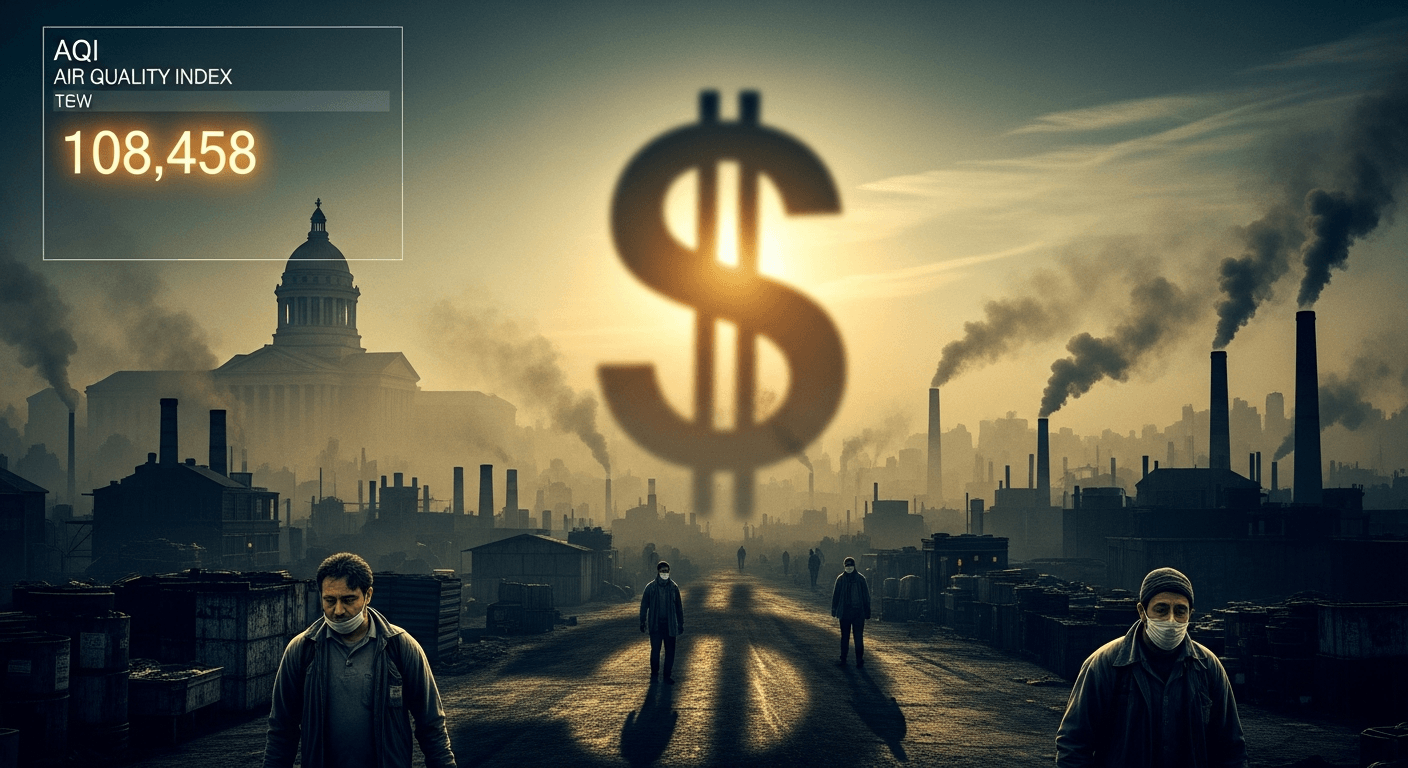
When air chokes growth
I read the Times of India report about the Bombay High Court asking civic authorities to examine how poor air quality is weighing on the economy with a mix of relief and impatience “Examine poor air’s impact on economy, suggests HC”. Relief because the court is pushing a necessary lens — the economic lens — and impatience because we have known, argued and designed solutions for this for years.
Why the economic question matters
Health harms from air pollution are already well documented. But health is only the door to a larger house of losses: lost labour output, higher healthcare spending, reduced consumer spending, damaged assets (solar panels, monuments, crops), and degraded attraction for tourism and investment. The Lancet’s state-level economic assessments make clear that these losses are substantial and measurable — not abstract moral claims but GDP-line items that choke growth (see deeper analysis in the state-level studies) Health and economic impact of air pollution in the states of India.
When a court suggests we must examine this impact, it is not a rhetorical flourish. It is a prompt for policymakers to stop treating air quality as only an environmental or public-health issue and start treating it as an economic failure that reduces productivity and wealth.
What a rigorous economic scan should include
A credible economic review must do more than tally mortality or hospital bills. It should quantify:
- Lost labour output due to premature deaths and chronic morbidity (absenteeism + presenteeism).
- Sectoral impacts (construction, tourism, outdoor services, retail footfall).
- Damage to physical capital (panels, building facades, electronics) and to agricultural yields.
- Investor and talent migration effects (how firms and skilled people relocate away from polluted hubs).
- Hidden welfare losses: childhood cognitive impacts, school absenteeism and long-run human-capital deficits.
Good recent work by independent analysts and consultancies has already mapped many of these channels (see economic framing and business impacts in industry reports), and those datasets should feed any court-ordered or government-led audit.
Practical steps civic bodies can take now
The Bombay High Court suggested transparency (daily AQI dashboards) and stronger monitoring — sensible immediate asks. But I’d push for a two-track approach: fast public measures and medium-term structural fixes.
Fast public measures (days to months):
- Publish a public hourly AQI dashboard for metro and adjoining zones; connect it to real-time advisories for schools, construction, and outdoor labour.
- Targeted temporary controls when AQI spikes (construction curbs, traffic management) while protecting livelihoods with cash or work-shift allowances for daily-wage workers.
- Make enforcement data public: audits of listed red-category industries, recorded fines, closure actions — all traceable online.
Medium-term fixes (months to years):
- Invest in cleaner public transport, accelerate a credible EV transition with charging infrastructure, and decongest urban cores by incentivising decentralised offices and micro-hubs.
- Introduce pollution-cost internalisation (user charges, differentiated permits or Pigovian levies) so the private incentives align with public health and economic resilience.
- Strengthen monitoring: more sensors, independent audits, citizen-led ambient monitoring panels and third-party verification of mitigation claims.
I have written about some of these ideas before — from an integrated logistics perspective to market-based measures that shift incentives away from polluting behaviour (see my earlier posts on transport and Pigovian approaches) Transport : an Integrated Logistic Plan ? and Pigovian Tax for Polluters ?. These are not silver bullets but they are part of the toolbox we must use.
Equity matters when regulators act
Any shock treatment — as was suggested in court — must be calibrated for equity. Banning activities or halting construction without targeted compensation hits the poorest first: daily-wage labourers, street vendors, informal-sector workers. Economic remedies must pair curbs with social protection: wage support, short-term public works, and rapid reskilling for cleaner livelihoods.
Why courts and data transparency are important
Courts can prod executive action. When judicial benches insist on economic analysis, they force agencies to account for trade-offs explicitly rather than offering platitudes. Transparency — published audits, real-time AQI maps, and clear enforcement logs — reduces the chance that mitigation plans exist only on paper.
The court’s nudge to civic agencies to examine economic impact is a necessary step. But it must be followed by a mandate: collect data, publish it, and measure progress in economic and health terms. If mitigation reduces lost workdays, increases consumer footfall, and lowers healthcare spending — those gains will be visible in budgets and business decisions.
My ask to policymakers (short, actionable)
- Commission a time-bound economic impact study that quantifies sectoral losses and distributional effects.
- Require civic bodies to publish daily AQI, enforcement actions and audit reports on a single state-level portal.
- Pair strict short-term controls with wage-protection funds for vulnerable workers.
- Move from ad-hoc orders to a multi-year, funded air-quality investment plan tied to economic recovery and jobs.
Parting thought
Air quality is not an optional amenity. It is an economic input. When the air is bad, the cost shows up in the ledger: lower output, higher health bills, and lower investor confidence. Courts can prod; civic bodies must act; businesses must join the clean-air coalition. And citizens should demand transparent metrics that let us judge whether action is working.
If we treat cleaner air as infrastructure — as we treat roads, power, and digital connectivity — then the investments become not a cost but a growth accelerator.
Regards,
Hemen Parekh
Any questions / doubts / clarifications regarding this blog? Just ask (by typing or talking) my Virtual Avatar on the website embedded below. Then "Share" that to your friend on WhatsApp.
Get correct answer to any question asked by Shri Amitabh Bachchan on Kaun Banega Crorepati, faster than any contestant
Hello Candidates :
- For UPSC – IAS – IPS – IFS etc., exams, you must prepare to answer, essay type questions which test your General Knowledge / Sensitivity of current events
- If you have read this blog carefully , you should be able to answer the following question:
- Need help ? No problem . Following are two AI AGENTS where we have PRE-LOADED this question in their respective Question Boxes . All that you have to do is just click SUBMIT
- www.HemenParekh.ai { a SLM , powered by my own Digital Content of more than 50,000 + documents, written by me over past 60 years of my professional career }
- www.IndiaAGI.ai { a consortium of 3 LLMs which debate and deliver a CONSENSUS answer – and each gives its own answer as well ! }
- It is up to you to decide which answer is more comprehensive / nuanced ( For sheer amazement, click both SUBMIT buttons quickly, one after another ) Then share any answer with yourself / your friends ( using WhatsApp / Email ). Nothing stops you from submitting ( just copy / paste from your resource ), all those questions from last year’s UPSC exam paper as well !
- May be there are other online resources which too provide you answers to UPSC “ General Knowledge “ questions but only I provide you in 26 languages !





No comments:
Post a Comment