
Why Ellison’s warning hit me
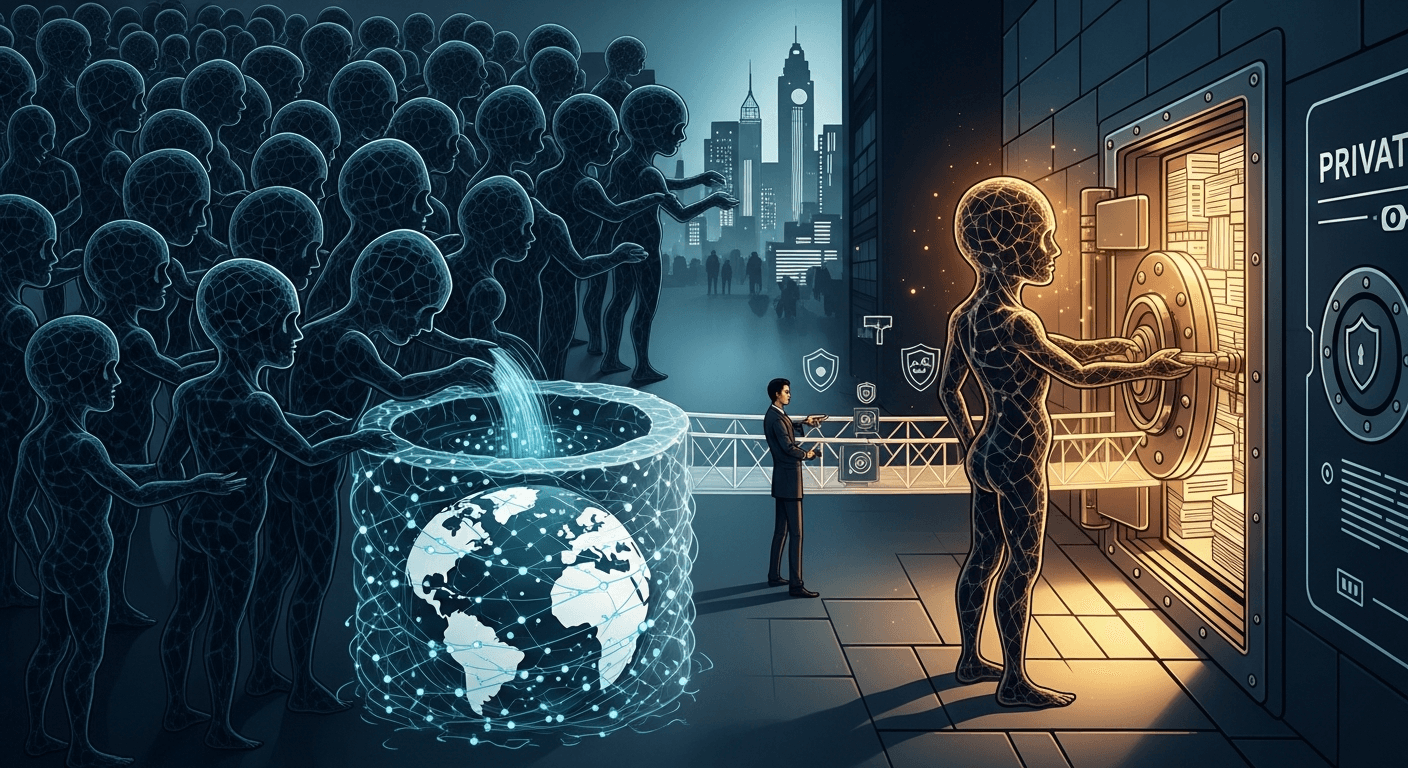
When I first read Larry Ellison (larry.ellison@oracle.com) lay out what he calls the biggest flaw in models like ChatGPT and Gemini — that they are trained on essentially the same publicly available internet data — I felt an odd mix of relief and urgency. Relief, because someone with scale and influence was naming a problem many of us have felt; urgency, because the solution he proposes forces companies and societies to make hard choices about ownership, security and value.
Ellison made those points in public forums and earnings calls, and the coverage is clear: when every model drinks from the same internet well they start to taste the same Times of India and in his longer keynote remarks at Oracle events (see his Oracle AI World address) YouTube.
"All the large language models—OpenAI, Anthropic, Meta, Google, xAI—they're all trained on the same data. It's all public data from the internet," said Larry Ellison (larry.ellison@oracle.com). This, he argues, is pushing AI toward commoditization.
What he named, in plain terms
- Models trained only on public web data are limited in contextual value for enterprises. They may be brilliant at general knowledge but poor at company-specific judgment.
- The next big opportunity — and the place where true differentiation lives — is making models reason safely over private, proprietary data at inference time.
- Oracle is doubling down on this thesis with infrastructure and patterns (RAG, vector search, secure inference) to let models access private data without exposing it.
I agree with the diagnosis, but my view adds two practical caveats.
My view: four pragmatic angles
1) Differentiation requires two moves
- Build or access private data in usable form (clean schemas, vectors, provenance). That is the painful engineering part.
- Build secure, auditable inference pipelines that keep raw private data inside the owner’s control while letting a model reason over derived representations.
2) Hallucination and commoditization are related but distinct
- When models hallucinate (confidently state false information), that is a reliability problem rooted in architecture and objectives. When models converge because they share identical public training corpora, that’s a market-structure problem.
- The first can be mitigated with verification, RAG with citation, confidence estimation and ensemble checks. The second requires unique, high-value private signals.
3) Private data is necessary but not sufficient
- Proprietary records (ERP, EMR, transaction logs) are gold — but only if they are accessible, high-quality, and legally sharable. Novel techniques (secure enclaves, homomorphic encryption, differential privacy, zero-trust architectures) are needed to unlock them without creating new privacy risks.
4) Competition will not sit still
- Rivals may use synthetic data, federated learning, or new multi-model orchestration strategies to reduce Oracle’s proposed moat. Differentiation will instead look like a layered stack: curated private data + strong governance + low-latency inference + human-in-the-loop validation.
Where I’ve said similar things before
I’ve written about data-as-value and the invisible contributors to AI before — in particular, my piece on data orphanhood, where I argued that billions of people contribute the signals that train these systems but rarely share in the value or governance (A Case of 900 Million Orphans). That concern sits at the heart of this debate: who owns the future intelligence if not the owners and stewards of the private data?
Risks and trade-offs for enterprises
- Security vs. utility: stronger locks on data reduce attack surface but may increase latency and complexity for inference.
- Vendor lock-in: shipping derivative vectors and specialized pipelines to a cloud provider can accelerate value capture — and vendor dependency.
- Legal and ethical obligations: health records, financial data and personal identifiers carry regulatory constraints that vary by country.
Practical checklist for leaders who heard Larry Ellison (larry.ellison@oracle.com) and want to act
- Map your high-value data: Which datasets, if a model could reason over them, would change decisions?
- Clean and index for retrieval: invest in vectorization, metadata, and provenance tracking now, not later.
- Secure the inference path: adopt RAG with audit trails and redaction, consider private endpoints or on-prem inference for very sensitive workloads.
- Measure and monitor hallucination: instrument answers with sources, confidence scores and human escalation paths.
- Consider multi-model strategies: ensembles or protocol-based model selection can reduce hallucination and boost reliability without requiring a proprietary foundational model.
A short, human ending
I love the excitement around frontier models — they feel like creative collaborators — but Ellison’s point is a useful corrective. The most valuable intelligence will not come from bigger, public-only brains. It will come from models that can securely, privately, and audibly reason about the unique data that runs a company, a hospital, or a city.
We should celebrate the open advances (they pushed the field forward) — and simultaneously invest in the unseen plumbing that lets AI become truly useful where it matters most.
Regards,
Hemen Parekh
Any questions / doubts / clarifications regarding this blog? Just ask (by typing or talking) my Virtual Avatar on the website embedded below. Then "Share" that to your friend on WhatsApp.
Get correct answer to any question asked by Shri Amitabh Bachchan on Kaun Banega Crorepati, faster than any contestant
Hello Candidates :
- For UPSC – IAS – IPS – IFS etc., exams, you must prepare to answer, essay type questions which test your General Knowledge / Sensitivity of current events
- If you have read this blog carefully , you should be able to answer the following question:
- Need help ? No problem . Following are two AI AGENTS where we have PRE-LOADED this question in their respective Question Boxes . All that you have to do is just click SUBMIT
- www.HemenParekh.ai { a SLM , powered by my own Digital Content of more than 50,000 + documents, written by me over past 60 years of my professional career }
- www.IndiaAGI.ai { a consortium of 3 LLMs which debate and deliver a CONSENSUS answer – and each gives its own answer as well ! }
- It is up to you to decide which answer is more comprehensive / nuanced ( For sheer amazement, click both SUBMIT buttons quickly, one after another ) Then share any answer with yourself / your friends ( using WhatsApp / Email ). Nothing stops you from submitting ( just copy / paste from your resource ), all those questions from last year’s UPSC exam paper as well !
- May be there are other online resources which too provide you answers to UPSC “ General Knowledge “ questions but only I provide you in 26 languages !


No comments:
Post a Comment