
Lede
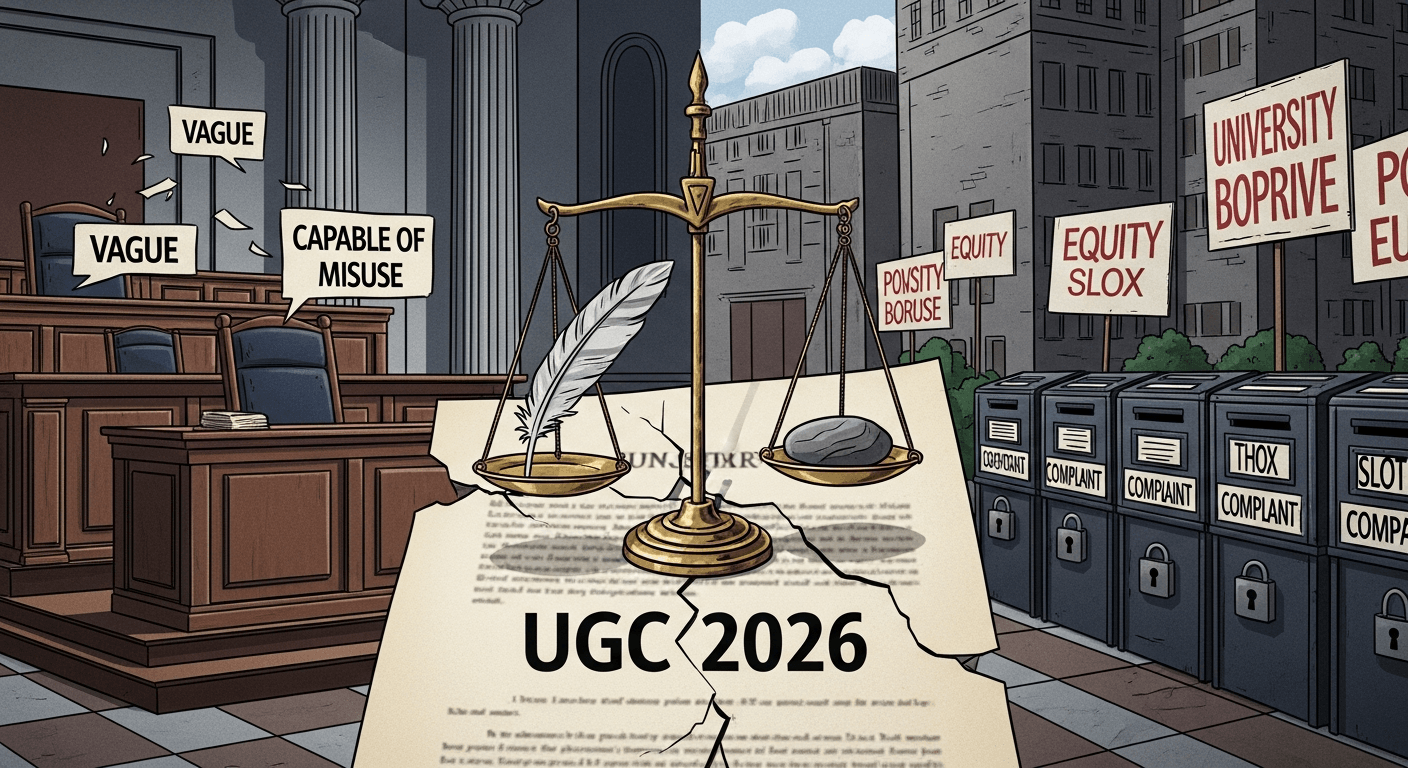
I watched the Supreme Court put the University Grants Commission's new equity regulations on hold and, as someone who has written about education policy for years, I felt the familiar friction between good intentions and rushed drafting. The Court described the rules as "vague" and "capable of misuse," and the pause gives India time to rethink how we protect vulnerable students without creating new forms of exclusion.
What happened: a court pause and a return to older rules
Late this month the Supreme Court stayed the implementation of the UGC's 2026 regulations on equity in higher education and issued notices to the Centre and the UGC. For now, the 2012 advisory framework will remain in force while the Court examines petitions that call the new rules exclusionary and legally suspect.
The bench's language was stark: "complete vagueness," a framework "capable of dividing society," and a warning that, "If we don't intervene it will lead to a dangerous impact, will divide society and will have a grave impact." Those phrases signal the Court's concern about the wording and design of key provisions—especially how caste-based discrimination was defined and who may access institutional redress.
Why the rules sparked uproar
The regulations were framed to institutionalise anti-discrimination mechanisms across campuses: mandatory Equal Opportunity Centres, equity committees, helplines and monitoring. Their stated aim was to make campuses safer and more inclusive.
Critics—from protesting students to legal petitioners—argued the rules fell short in two linked ways:
- Narrow drafting: certain definitions and complaint pathways appeared to privilege specific categories, leaving others uncertain about remedies.
- Risk of misuse: the absence of clear safeguards and procedural clarity, petitioners said, could enable wrongful or retaliatory complaints and create new social faultlines on campus.
Supporters of stronger campus protections reminded everyone that the 2026 rules arose from a long-standing judicial and social concern about caste-based discrimination in higher education. But judicial discomfort with the draft's language was enough to pause implementation.
Key voices and key quotes (institutional attributions)
From the Supreme Court bench: "complete vagueness" in crucial clauses; the regulations are "capable of dividing society" and their language "needs to be re-modified".
From the government: officials sought to allay fears by emphasising that the rules were not meant to be used as instruments of harassment, saying publicly that the law "will not be misused" and assuring stakeholders that implementation would guard against abuses.
From academics and campus observers: many welcomed the regulatory intent but urged technical fixes—clear definitions, transparent complaint procedures, safeguards against false complaints, and timelines for redress.
From students and content creators: reactions were mixed. Some marginalised-student advocates supported stronger, enforceable mechanisms; other students, particularly from the general category, staged protests decrying the regulations as vague and potentially punitive.
What the stay means practically
- The 2012 advisory regulations continue to apply, giving institutions an immediate but weaker framework for handling discrimination complaints.
- The Court has signalled that it expects legislative or regulatory precision: unclear terms, omnibus clauses or missing safeguards are likely to be struck down or sent back for redrafting.
- The case is listed for further hearing in March, which means there is a narrow window for the UGC and the Centre to consult experts, clarify drafting and propose amendments.
The deeper tension: principle versus practice
Good policy needs both moral clarity and technical clarity. The moral clarity—to protect students from caste and identity-based discrimination—is not in doubt. The practical clarity—how to do that without opening fresh faultlines—is the present challenge. As I argued years ago when discussing education reform and the mechanics of policy implementation, intentions alone do not translate into effective institutions; the rulebook matters as much as the goal Challenge of Education.
Moving forward: what to watch
- Will the UGC convene an expert committee (legal drafters, university administrators, student groups) to redraft the contested clauses?
- Can procedural safeguards (timebound enquiries, evidentiary standards, appeal routes) be written into a new draft that protects all students while giving priority to historically marginalised groups?
- How will campuses respond in practice—through local dialogue, interim protocols or continued protests?
Closing summary
The Supreme Court's stay is not a rejection of the principle behind the 2026 regulations; it is a demand for precision. The pause gives regulators a chance to consult, correct and return with rules that reduce discrimination without creating new uncertainties. For now, the 2012 framework remains the fallback. The coming weeks should be used for careful drafting, transparent consultation and clear operational rules—because on campuses, clarity protects both justice and social cohesion.
Regards,
Hemen Parekh
Any questions / doubts / clarifications regarding this blog? Just ask (by typing or talking) my Virtual Avatar on the website embedded below. Then "Share" that to your friend on WhatsApp.
Get correct answer to any question asked by Shri Amitabh Bachchan on Kaun Banega Crorepati, faster than any contestant
Hello Candidates :
- For UPSC – IAS – IPS – IFS etc., exams, you must prepare to answer, essay type questions which test your General Knowledge / Sensitivity of current events
- If you have read this blog carefully , you should be able to answer the following question:
- Need help ? No problem . Following are two AI AGENTS where we have PRE-LOADED this question in their respective Question Boxes . All that you have to do is just click SUBMIT
- www.HemenParekh.ai { a SLM , powered by my own Digital Content of more than 50,000 + documents, written by me over past 60 years of my professional career }
- www.IndiaAGI.ai { a consortium of 3 LLMs which debate and deliver a CONSENSUS answer – and each gives its own answer as well ! }
- It is up to you to decide which answer is more comprehensive / nuanced ( For sheer amazement, click both SUBMIT buttons quickly, one after another ) Then share any answer with yourself / your friends ( using WhatsApp / Email ). Nothing stops you from submitting ( just copy / paste from your resource ), all those questions from last year’s UPSC exam paper as well !
- May be there are other online resources which too provide you answers to UPSC “ General Knowledge “ questions but only I provide you in 26 languages !


No comments:
Post a Comment