
Introduction
I love small, reproducible hacks that make work feel a little magical. Recently I listened to a podcast episode where a young fashion‑tech founder described a tidy ChatGPT workflow she and her co‑founder use to make short videos that actually perform on social feeds. It’s simple, repeatable, and — crucially — teachable. That combination is my kind of productivity.
In this post I walk through what they do, why it works, the technical nuts and bolts, some ethical corners to watch, and quick ways you can try the same technique today. I’ll also point to a few sources where the idea was discussed publicly so you can hear it in their own words Business Insider.
Why reverse-engineering works
There’s a myth that viral content is mystical. It’s not. Viral formats are patterns — hooks, pacing, emotional beats, and visual cues that reliably trigger attention and sharing. The founders I heard describe cataloguing high‑performing clips, breaking them into parts (hook / middle / ending), and treating those parts like modular design elements.
From a product design standpoint this is brilliant: instead of inventing the frame, you study frames that already grab attention and adapt them to your story. It’s design thinking applied to social creative work.
The practical ChatGPT workflow
Here’s the core flow, distilled into practical steps I’d replicate tomorrow:
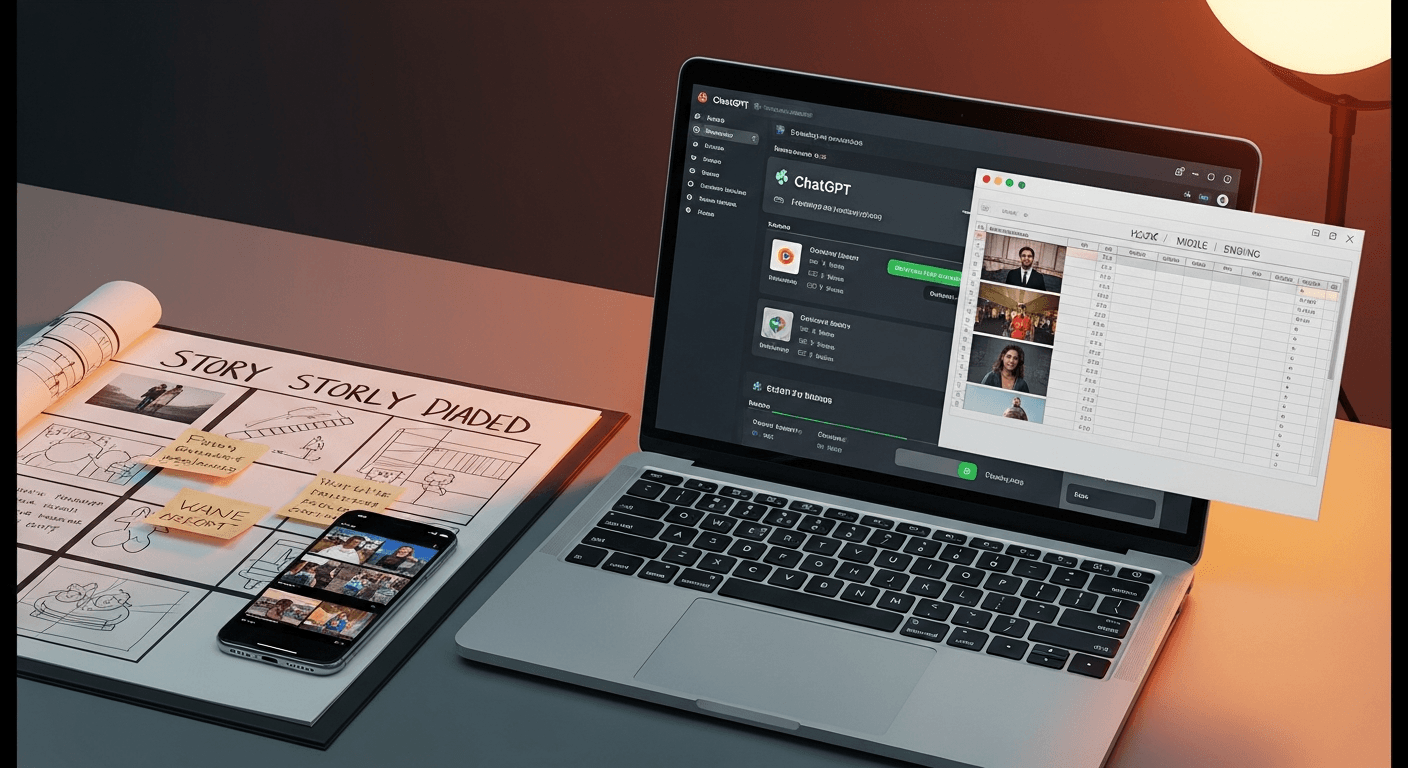
- Collect 8–12 strong videos in your niche. Note the platform and why each one worked. Create a simple spreadsheet and mark the hook, the central idea, and the payoff.
- Transcribe the videos (many people use ChatGPT or a transcription tool for this). Ask ChatGPT to analyze the transcripts: what’s the hook, what phrases are repeated, what emotional beats appear?
- Feed ChatGPT a plain description of your product or message and ask it to generate scripts that match the successful patterns you identified. Iterate until the tone and pacing fit.
This is clever because ChatGPT becomes the pattern‑translator between viral structure and your brand voice.
Tools and prompts that scale this approach
You don’t need a stack of fancy tools. At minimum I recommend:
- A transcription utility (or ChatGPT’s transcription where available)
- A spreadsheet for cataloging
- ChatGPT (or similar LLM) with a few well‑crafted prompts
Sample prompt (starter):
"Here are transcriptions of three viral clips. Identify the hook, the pacing, and repeatable rhetorical moves. Then, using this product description [paste], write three 20–30 second scripts that follow the same structure but adapt the language to our brand voice. Keep the hook in the first 3 seconds."
A small experiment I like: ask the model to produce a version with explicit timing notes (0–3s hook, 4–10s build, 11–20s payoff). That makes editing and shooting far more efficient.
Ethics, originality, and credit
Reverse engineering doesn’t mean plagiarizing. You’re borrowing structure, not copying content. Still, there are ethical and legal lines: don’t lift unique creative sequences, copyrighted music, or the exact script of identifiable creators.
Be transparent when required. If a format is associated with a particular creator or culture, adapt the style but contribute your own voice. Claiming inspiration and adding value keeps the practice sustainable and respectable.
When the method breaks (and how to fix it)
This approach is not a silver bullet. If you only mimic structure and ignore authenticity, your content will feel hollow. Two common failure modes:
- Overfitting: You follow the structure too mechanically and lose your brand personality. Fix: force a draft process where you ask the model to inject an authentic anecdote or brand insight.
- Platform drift: A format that worked last month may not work today. Fix: refresh your dataset of viral clips regularly and test small A/Bs before doubling down.
I also warn against treating ChatGPT as a creative autopilot; it’s a co‑pilot. The human in the loop (editor, creative lead) decides what’s worthy.
How to try this today (a 30‑minute sprint)
If you want to test this in an afternoon, try this micro‑experiment:
- Pick a niche and find 5 viral clips. Put them in a sheet with notes on hook/middle/end.
- Transcribe each clip (or paste captions). Ask ChatGPT to extract the three structural beats from each transcript.
- Paste a one‑paragraph product description and ask ChatGPT to produce 3 short scripts matching those beats.
- Pick one script, shoot a quick vertical clip, and test it as a low‑budget ad or organic post. Measure completion and click‑through.
Short quote I heard on the episode: “I use AI almost every single day, and it supercharges me.”
Conclusion
This is a useful, practical way to make content creation less random and more engineering‑led — a design + data approach powered by ChatGPT. The point isn’t to replace creativity; it’s to make the creative loop faster and more informed. If you treat formats as reusable patterns, you can iterate toward clearer, sharper, and more effective short video content.
Actionable takeaways
- Start with structure: catalog hook / middle / ending for top videos in your niche.
- Use ChatGPT as a pattern translator: transcribe, analyze, then generate scripts that map to those structures.
- Add timing notes in your prompts to make editing simpler.
- Keep authenticity: force at least one personal or brand‑specific line into each script.
- Test fast and often: small A/Bs show what actually works on a platform.
References & further listening
- A recent writeup of this approach appeared in Business Insider describing how a young founder used ChatGPT to reverse‑engineer viral videos: https://www.businessinsider.com/bill-gates-daughter-phoebe-phia-chatgpt-marketing-hacks-sophia-kianni-2025-6
- I’ve written about ChatGPT’s role in changing search and productivity workflows previously: http://myblogepage.blogspot.com/2024/11/searching-no-more.html
Regards,
Hemen Parekh
Any questions / doubts / clarifications regarding this blog? Just ask (by typing or talking) my Virtual Avatar on the website embedded below. Then "Share" that to your friend on WhatsApp.
Get correct answer to any question asked by Shri Amitabh Bachchan on Kaun Banega Crorepati, faster than any contestant
Hello Candidates :
- For UPSC – IAS – IPS – IFS etc., exams, you must prepare to answer, essay type questions which test your General Knowledge / Sensitivity of current events
- If you have read this blog carefully , you should be able to answer the following question:
- Need help ? No problem . Following are two AI AGENTS where we have PRE-LOADED this question in their respective Question Boxes . All that you have to do is just click SUBMIT
- www.HemenParekh.ai { a SLM , powered by my own Digital Content of more than 50,000 + documents, written by me over past 60 years of my professional career }
- www.IndiaAGI.ai { a consortium of 3 LLMs which debate and deliver a CONSENSUS answer – and each gives its own answer as well ! }
- It is up to you to decide which answer is more comprehensive / nuanced ( For sheer amazement, click both SUBMIT buttons quickly, one after another ) Then share any answer with yourself / your friends ( using WhatsApp / Email ). Nothing stops you from submitting ( just copy / paste from your resource ), all those questions from last year’s UPSC exam paper as well !
- May be there are other online resources which too provide you answers to UPSC “ General Knowledge “ questions but only I provide you in 26 languages !




No comments:
Post a Comment