
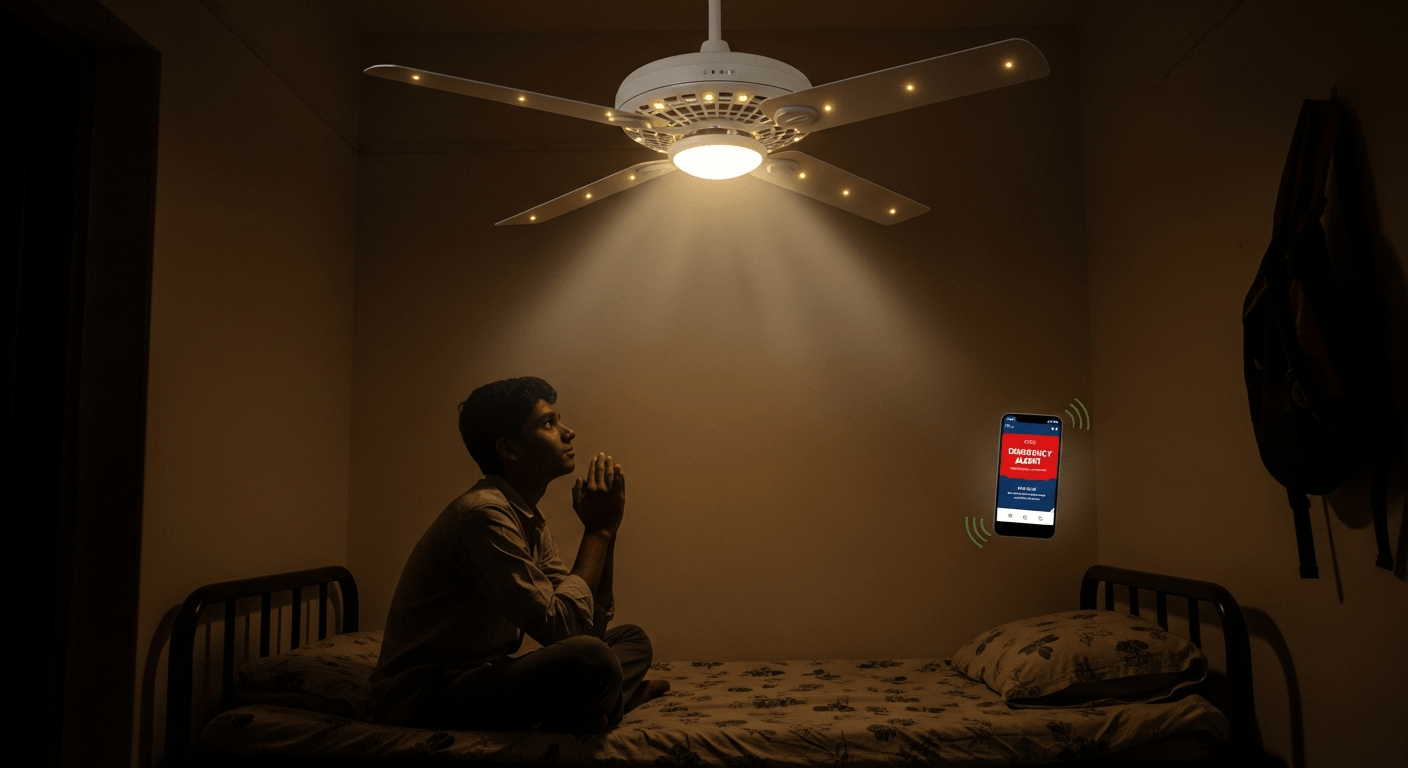
When a Fan Saves Lives
I read a recent Times of India piece about a 15�year�old student from Thane who engineered what she calls a "Suicide Saviour Fan" ��a ceiling fan retrofitted with sensors, an alarm logic and an automated alerting module designed to interrupt impulsive attempts and summon help immediately Times of India.
I want to say three things plainly: I admire the ingenuity, I worry about the context that made such an invention necessary, and I believe we must pair low�cost safety hardware with systemic mental�health solutions.
The idea ����simple, humane, scalable
From the article I learned the device behaves like an ordinary fan most of the time but detects an unusual load, trips a limit switch, triggers an alarm circuit and uses a microcontroller plus GSM module to message and call pre�authorized numbers without alerting others in the room. The intent is to convert a tragic instrument of impulse into a quiet sensor that buys time ���and time is often what saves lives.
Why this matters:
- It targets a frequent, repeatable risk location: hostels and PG rooms where ceiling fans are ubiquitous.
- It is designed to be discreet and non�destructive ��the surviving occupant isn't publicly exposed or shamed.
- It relies on inexpensive, widely available components, which means early pilots and mass adoption are plausible.
The larger frame: a student mental�health emergency
This invention is a creative patch for a far deeper wound. Across India we continue to see student suicides driven by academic pressure, isolation, stigma around mental health and failures of supervision in residential settings. I have written before about how parents, institutions and governments must respond ��including practical, scalable digital tools and helplines that reach distressed students before crisis points (Dear Parent: Save Your Child from Suicide).
A device that prevents one method of self�harm is valuable. But preventing self�harm in the aggregate requires layered action:
- Immediate safety engineering (anti�suicide hardware in dorms and PGs �fans, balconies, rafters).
- 24/7 accessible listening services and low�barrier counselling (hotlines, chatbots, human escalation).
- Active supervision and clear accountability in residential institutions and coaching centres.
- Family education so parents learn to listen and respond without shame or punishment.
- Policy measures: mandated safety audits for hostels and clear mental�health minimums for coaching centres.
Where technology helps ����and where it cannot do it alone
The fan is a great example of using modest tech to save lives. Equally promising are AI�assisted listening systems, anonymous check�in bots, and mobile escalation flows that I have argued for before. Yet technology alone cannot replace human empathy, responsible institutional cultures, or public policy.
We should:
- Pilot anti�suicide retrofits in high�risk hostels and PG clusters and measure outcomes.
- Create low�cost certification standards so repair shops and electricians can install approved kits without complicating maintenance.
- Pair hardware solutions with mandatory, staffed mental�health contact points and rapid�response escalation protocols.
A plea and a plan
To education leaders and policymakers: treat inventions like this as an invitation, not a final answer. Fund field trials, create procurement pathways for low�cost safety kits, and legislate mental�health minimums for residential education settings.
To school and hostel managers: install physical safety checks (including anti�ligature features) and daily human�check routines. Technology can alert, but human presence prevents despair from becoming final.
To parents and mentors: the most important intervention remains simple human words: I am with you. We will find a way. I have written directly to parents about this before because those words ����repeated, steady, unconditional �reach a child long before an alarm ever needs to be raised.
Closing thoughts
When a young student looks at newspaper headlines about peers dying and asks, "Can I do something?" and then builds a practical device that could save lives, we must both celebrate and act. Celebrate the compassion and curiosity; act so her invention is not the only barrier between despair and death.
We must make every living space for students safer, and every student’s access to help easier.
Regards,
Hemen Parekh
Any questions / doubts / clarifications regarding this blog? Just ask (by typing or talking) my Virtual Avatar on the website embedded below. Then "Share" that to your friend on WhatsApp.
Get correct answer to any question asked by Shri Amitabh Bachchan on Kaun Banega Crorepati, faster than any contestant
Hello Candidates :
- For UPSC – IAS – IPS – IFS etc., exams, you must prepare to answer, essay type questions which test your General Knowledge / Sensitivity of current events
- If you have read this blog carefully , you should be able to answer the following question:
- Need help ? No problem . Following are two AI AGENTS where we have PRE-LOADED this question in their respective Question Boxes . All that you have to do is just click SUBMIT
- www.HemenParekh.ai { a SLM , powered by my own Digital Content of more than 50,000 + documents, written by me over past 60 years of my professional career }
- www.IndiaAGI.ai { a consortium of 3 LLMs which debate and deliver a CONSENSUS answer – and each gives its own answer as well ! }
- It is up to you to decide which answer is more comprehensive / nuanced ( For sheer amazement, click both SUBMIT buttons quickly, one after another ) Then share any answer with yourself / your friends ( using WhatsApp / Email ). Nothing stops you from submitting ( just copy / paste from your resource ), all those questions from last year’s UPSC exam paper as well !
- May be there are other online resources which too provide you answers to UPSC “ General Knowledge “ questions but only I provide you in 26 languages !





No comments:
Post a Comment