
Why this FTA matters — and who wins
I write this as someone who has tracked trade wars, tariff politics and supply-chain shifts for years. The India–EU Free Trade Agreement — already being called the “mother of all deals” — is not just another headline. It is a structural pivot: immediate tariff relief for many Indian exporters, new market access for the EU, and a geopolitical hedge in an era of shifting alliances.
Quick summary of the key contours
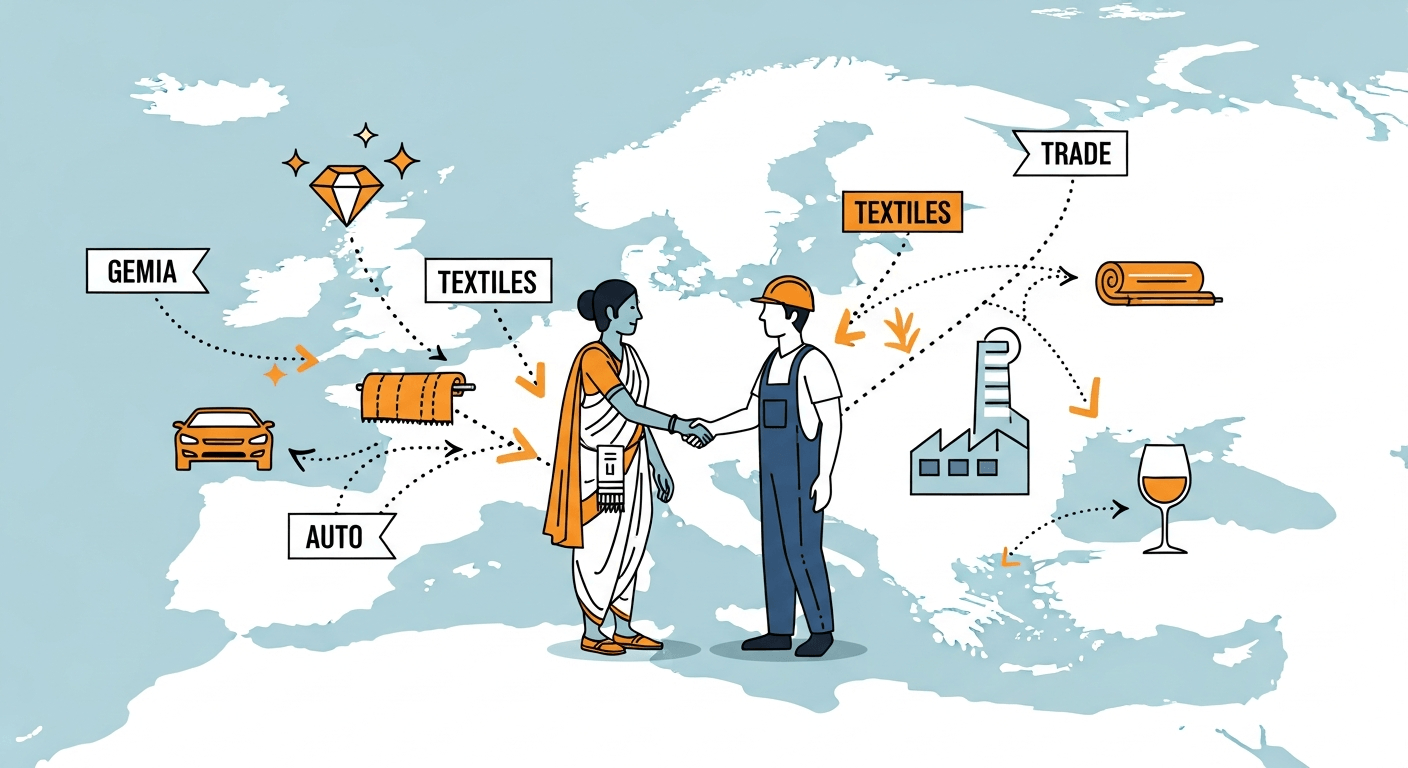
Immediate tariff-free access (or very deep liberalisation) for a large swathe of India’s labour-intensive exports — textiles, apparel, leather, gems and jewellery, handicrafts and certain engineered goods — with reports saying over 90% (by trade value) of goods will face zero tariffs on entry or phase-down schedules that are unusually swift for a deal of this scale Times of India and live coverage NDTV.
Calibrated opening for European cars and wine: steep car duties (as high as 110%) will be cut sharply for specific quota/price bands and then phased down further; selected alcoholic beverages see big cuts too. Sensitive areas (many primary agricultural items, some dairy lines) remain ring‑fenced.
A broad, 21st-century agenda: goods, services, investment protection, mobility for skilled workers and students, rules on digital trade, IP strengthening and special support measures for MSMEs.
Political scale: the pact covers a market of roughly 2 billion people and represents about a quarter of global GDP — a strategic play for both sides to diversify supply chains and reduce over‑reliance on single markets.
What India gains — concrete, immediate and strategic
Price advantage for exporters: duty elimination on garments, leather, electronics components and gems/jewellery means Indian producers and artisans can immediately price more competitively across Europe. That’s a direct buffer for sectors hit by punitive tariffs elsewhere.
A diversified demand base: with high US tariffs still a reality for many Indian exporters, the EU’s market becomes a predictable, large-scale alternative — especially for labour-intensive and MSME-led value chains.
Jobs and rural incomes: duty-free access for processed foods, spices, tea and coffee can raise rural earnings and expand the market for agri‑processors.
Services and talent pathways: easing mobility for students, researchers and select professionals will help Indian services firms and talent find clearer routes into high-value European markets.
Who profits most — and who should be cautious
Winners
- Small exporters, artisans and MSMEs in textiles, handicrafts, gems & jewellery and leather.
- Labour‑intensive manufacturing and some segments of engineering goods and electronics.
- Indian students and skilled migrants, over time, if mobility provisions are implemented transparently.
Sectors to watch
Automobiles and some protected manufacturing niches will face stronger competition from EU imports. But the deal’s quota-and-phased approach aims to give domestic industry time to adjust and invest.
Domestic producers in protected agri segments have been safeguarded, but farmers will rightly look for implementation guarantees and compensatory support where needed.
Risks and the politics behind them
No FTA comes without trade‑offs. Opening markets at this scale invites short-run disruption for some producers and increases competition. That’s why the timing of support — credit, skill upgrades, market access programs and fiscal safety nets — matters.
The geopolitical context is also important: this pact helps India reduce exposure to unilateral tariff shocks from any single market and gives the EU “first‑mover” access to India’s growth story. Negotiation leverage, of course, was earned over two decades of talks and hard politics — and the outcome reflects calibrated give‑and‑take.
My reading — why this validates ideas I’ve been writing about
I’ve often argued that India must convert tariff politics and tariff shocks into opportunities by: (a) diversifying export markets, (b) lowering the cost base for our manufacturers, and (c) building industrial linkages that last. In earlier pieces I urged policies that lower input costs and encourage circular‑economy moves (for example, policies around steel and auto scrap) so Indian industry can compete on quality and price simultaneously A #TradeWar Epidemic? / WTO export-import debate and my follow-up on zero‑for‑zero tariff thinking for auto parts and steel India offers Zero for tariffs on steel auto parts, pharmaceuticals from the US.
Those essays were less about free trade as a slogan and more about the mechanics: reduce input costs, invest in upskilling, and build supply‑chain resilience. The India–EU deal does two of those things at once: it opens demand while signalling the need for supply-side reforms at home.
What I would watch for in the next 12–24 months (a short checklist)
- Implementation timing: how quickly legal scrubbing, parliamentary approvals and ratifications happen (this usually takes months).
- Targeted support measures: credit, technology transfers and export facilitation for MSMEs and artisans who will scale up production to meet EU demand.
- Rules of origin and compliance costs: simplified rules and help for smaller firms to meet EU standards and certifications.
- Adjustment packages for vulnerable sectors: clear plans for auto suppliers and sectors that face short‑term competition.
- Use this moment to accelerate reforms that reduce input and logistics costs — ease of doing business, faster customs, and export finance.
A short, practical roadmap I’d urge policymakers to prioritise
- Launch an export‑readiness fund targeted at clusters (textiles, gems, leather) to help finance ISO / REACH / CE certifications and market development.
- Expand credit lines and working capital support for MSMEs that will scale exports to the EU.
- Fast‑track trade facilitation: single‑window customs, digital certificates and preferential logistics lanes for high‑value perishable and artisanal goods.
- Strengthen labour‑market skilling at the cluster level so India’s workforce can meet higher quality and compliance demands.
- Ensure consumer and producer outreach so domestic industries understand the phased tariff schedules and can plan investments accordingly.
Final thoughts
Trade policy should be measured by outcomes that people feel: jobs created, incomes rising, artisans paid fairly, students moving freely and factories investing to compete at a global standard. This FTA is an opportunity — a big one — but it is not automatic. To convert a diplomatic and commercial win into durable national prosperity we must combine market access with serious supply‑side reforms and social cushions.
I should also note the political symbolism: leadership and patient negotiation matter. The political leadership that signs the pact must also follow through on implementation and domestic reforms — that is where the real work begins.
A short, personal sign‑off
I am hopeful. Deals of this scale reset expectations. They create the platform; we must build the factories, the skills and the logistics to make the most of it.
Prime Minister [Narendra Modi](http://www.linkedin.com/in/narendramodi) (n.modi@india.gov.in) — the political momentum behind this pact matters. So does the follow‑through.
References
"Zero tariffs on gems, jewellery, plastic: How will FTA with EU benefit India? ‘Mother of all trade deals’ explained" — Times of India. https://timesofindia.indiatimes.com/business/india-business/zero-tariffs-on-gems-jewellery-plastic-how-will-fta-with-eu-benefit-india-mother-of-all-trade-deals-explained/amp_articleshow/127608915.cms
Live coverage and analysis: NDTV live blog and story archive. https://www.ndtv.com/world-news/india-eu-summit-2026-live-updates-india-eu-trade-deal-free-trade-agreement-talks-conclude-10890614
My earlier reflections (selected): "A #TradeWar Epidemic?" / WTO export-import essay — http://emailothers.blogspot.com/2018/04/india-development-debate.html
My policy note on zero‑for‑zero thinking and scrap/steel linkages — http://myblogepage.blogspot.com/2025/07/india-offers-zero-for-tariffs.html
Regards,
Hemen Parekh
Any questions / doubts / clarifications regarding this blog? Just ask (by typing or talking) my Virtual Avatar on the website embedded below. Then "Share" that to your friend on WhatsApp.
Get correct answer to any question asked by Shri Amitabh Bachchan on Kaun Banega Crorepati, faster than any contestant
Hello Candidates :
- For UPSC – IAS – IPS – IFS etc., exams, you must prepare to answer, essay type questions which test your General Knowledge / Sensitivity of current events
- If you have read this blog carefully , you should be able to answer the following question:
- Need help ? No problem . Following are two AI AGENTS where we have PRE-LOADED this question in their respective Question Boxes . All that you have to do is just click SUBMIT
- www.HemenParekh.ai { a SLM , powered by my own Digital Content of more than 50,000 + documents, written by me over past 60 years of my professional career }
- www.IndiaAGI.ai { a consortium of 3 LLMs which debate and deliver a CONSENSUS answer – and each gives its own answer as well ! }
- It is up to you to decide which answer is more comprehensive / nuanced ( For sheer amazement, click both SUBMIT buttons quickly, one after another ) Then share any answer with yourself / your friends ( using WhatsApp / Email ). Nothing stops you from submitting ( just copy / paste from your resource ), all those questions from last year’s UPSC exam paper as well !
- May be there are other online resources which too provide you answers to UPSC “ General Knowledge “ questions but only I provide you in 26 languages !



No comments:
Post a Comment