
Opening thoughts
I watched Budget 2026 with a mix of professional curiosity and a private sense of responsibility. As someone who has written about technology, leadership and policy for many years, I felt the familiar tug: budgets are not just numbers — they are moral and organisational choices about what a nation values and whom it serves.
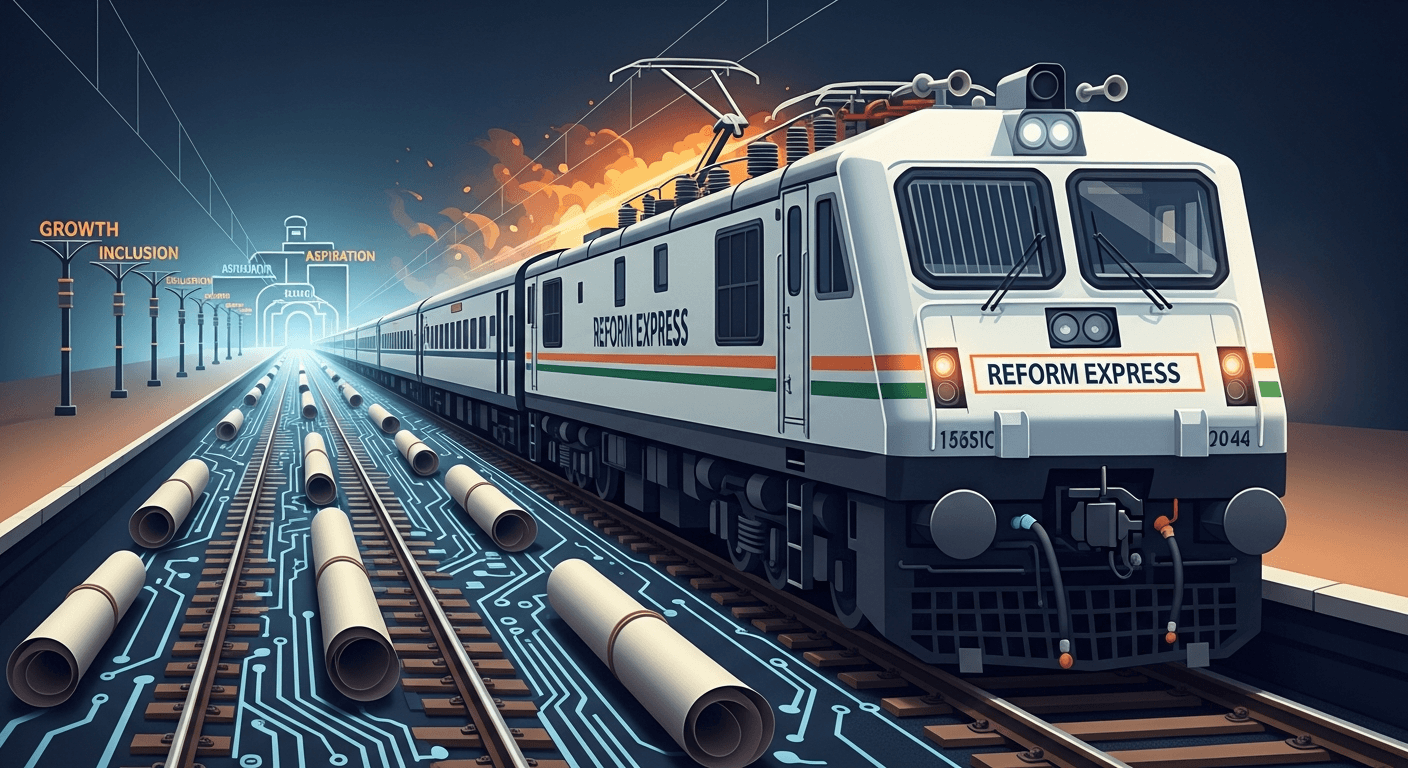
Early in the speech, the Finance Minister described a running theme as the "Reform Express" — a shorthand for persistent, wide-ranging structural change intended to help the government fulfill its declared kartavyas (duties) for growth, inclusion and aspiration-driven development Budget 2026 coverage.
I want to be plain: reforms matter not for their own sake but for the outcomes they unlock — productivity, resilience, jobs and dignity.
What the "Reform Express" signals (and why I care)
- Continuous momentum: The language of a moving express implies that reform is meant to be continuous, not episodic. That is important — economies respond best to predictable, iterative change rather than sudden shocks.
- Breadth and depth: The announcements point to changes across tax administration, labour frameworks, quality-control rationalisation and sector-specific push (semiconductors, chemicals, textiles, strategic minerals) — a multi-front strategy to build supply-chain resilience.
- Technology as multiplier: There is a clear expectation that AI, digital governance and targeted skilling will multiply the returns of policy action, not replace the fundamentals of good regulation.
These are not abstract points for me. Over the years I have argued that leadership — whether in firms or in governments — must marry clarity of purpose with operational discipline. A reform agenda without an operations plan becomes a slogan; an operations plan without strategic change becomes incrementalism.
Three kartavyas in practice
The Budget framed three central kartavyas: accelerate and sustain economic growth; fulfil people's aspirations by building capacity and opportunity; and ensure inclusive access so every region and household can participate.
Translated into action, this means:
- Targeted manufacturing and strategic-sector incentives to convert imports into domestic capabilities.
- Support for MSMEs and champion enterprises so entrepreneurship scales into employment.
- Continued fiscal attention to public goods — health, education, urban and transport infrastructure — that underpin long-term inclusion.
If reforms are the locomotive, these kartavyas are the destination stations. The challenge is to align tracks, signals and timetables: regulators, finance, states and implementing agencies must coordinate tightly.
Where the promise meets reality — the operational checklist
I watch budgets for the delivery mechanics behind the headlines. The Reform Express will need:
- Clear timelines and metrics: For each reform, define measurable intermediate outcomes (e.g., time to register a factory, permit approvals, dispute-resolution timelines).
- State-Centre partnership: Many reforms require action at the state level; incentives and capacity-building need to be clearly scoped.
- Financial intermediation: A resilient financial sector that channels savings into productive capex for industry and infrastructure.
- People-first transition: For sectors disrupted by deregulation or rationalisation, credible reskilling and social-safety bridges.
Absent these, the headline "Reform Express" risks being a metaphor rather than a machine.
What stood out for me in Budget 2026
- The framing of reform as continuous and wide-ranging rather than one-off is the right mindset for a fast-changing world. See coverage and the three-kartavya articulation for details Economic Times summary.
- Sectoral signals (semiconductors, chemical parks, strategic minerals) show that policy is moving beyond short-term stimulus to supply-chain strategy.
- Emphasis on cutting compliance and simplifying governance is welcome; friction costs are often the invisible tax on entrepreneurs.
My modest cautions
- Avoid reform fatigue: an avalanche of new rules and incentives can overwhelm regulators and implementers. Prioritise ruthlessly.
- Measure distributional effects early: reforms that increase aggregate growth can still leave vulnerable groups behind unless the inclusion kartavya is actively protected.
- Prepare for political economy frictions: reforms that challenge vested interests need transparent, time-bound transition mechanisms.
A personal note on continuity
I've commented before on the need for steady institutional reform, and this Budget feels like the next step in that conversation (I have written on governance and technology on my site in the past)Hemen Parekh’s blog. That continuity matters. Reform gains are cumulative: small, repeated improvements compound into durable capability.
Looking ahead — three things I will watch closely
- Execution dashboards: Will ministries and states publish clear, public progress trackers for the headline reforms?
- Financing flows: Will credit and risk-sharing arrangements shift to underpin MSME scaling and strategic manufacturing?
- Labour transitions: Will skilling and social-safety investments match the speed of regulatory change?
If those three align, the Reform Express can be more than rhetoric.
Regards,
Hemen Parekh (hcp@RecruitGuru.com)
Any questions / doubts / clarifications regarding this blog? Just ask (by typing or talking) my Virtual Avatar on the website embedded below. Then "Share" that to your friend on WhatsApp.
Get correct answer to any question asked by Shri Amitabh Bachchan on Kaun Banega Crorepati, faster than any contestant
Hello Candidates :
- For UPSC – IAS – IPS – IFS etc., exams, you must prepare to answer, essay type questions which test your General Knowledge / Sensitivity of current events
- If you have read this blog carefully , you should be able to answer the following question:
- Need help ? No problem . Following are two AI AGENTS where we have PRE-LOADED this question in their respective Question Boxes . All that you have to do is just click SUBMIT
- www.HemenParekh.ai { a SLM , powered by my own Digital Content of more than 50,000 + documents, written by me over past 60 years of my professional career }
- www.IndiaAGI.ai { a consortium of 3 LLMs which debate and deliver a CONSENSUS answer – and each gives its own answer as well ! }
- It is up to you to decide which answer is more comprehensive / nuanced ( For sheer amazement, click both SUBMIT buttons quickly, one after another ) Then share any answer with yourself / your friends ( using WhatsApp / Email ). Nothing stops you from submitting ( just copy / paste from your resource ), all those questions from last year’s UPSC exam paper as well !
- May be there are other online resources which too provide you answers to UPSC “ General Knowledge “ questions but only I provide you in 26 languages !




No comments:
Post a Comment