
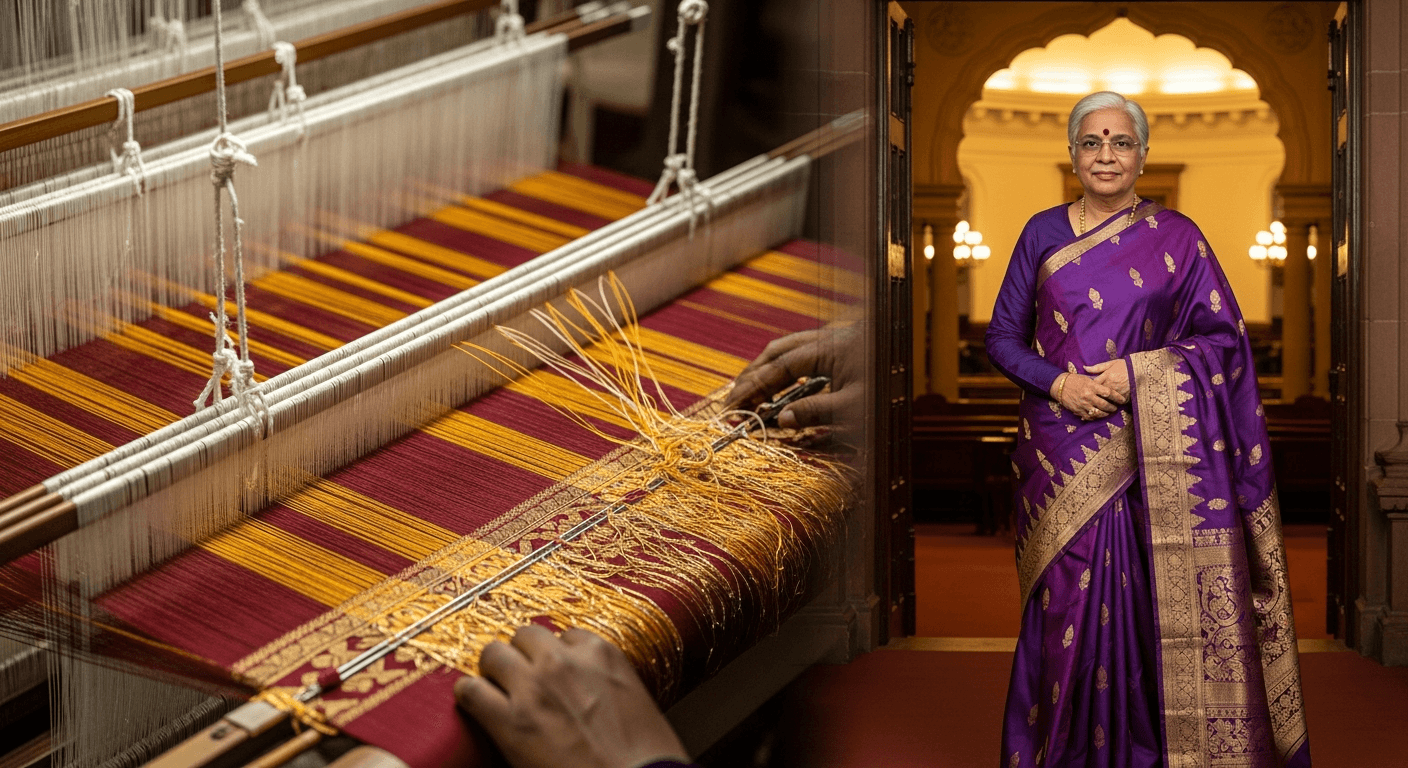
On a Kanjeevaram for Budget Day
I took note, as many did, of the Finance Minister's choice of a Kanjeevaram (Kanchipuram) saree on Budget Day — a deliberate nod to a centuries-old weaving tradition from Tamil Nadu and a reminder that clothes can carry cultural and civic messages as the nation listens to numbers and policy details. News reports from multiple outlets captured images and described the drape and colours chosen on the day News report on the Budget-day Kanjeevaram choice and how the selection fits a longer pattern of highlighting regional handloom crafts Coverage of the Budget-day saree choices over several years.
Why a Kanjeevaram matters
Origins and craft: Kanjeevaram (also spelled Kanchipuram) sarees come from Kanchipuram in Tamil Nadu. They are traditionally handwoven in mulberry silk with heavy, durable fabric and distinctive zari (metal thread) work — often showing temple-inspired motifs, peacocks, florals and geometric borders. The weave traces its continuity across centuries and local temple cultures.
Cultural resonance: In south India and across the country, a Kanjeevaram is associated with ritual, ceremony and longevity. Wearing one on a national occasion signals respect for artisanal lineages and for regional textile histories.
Visible support for weavers: Beyond symbolism, wearing handloom textiles on a national platform is routinely read as an act of recognition for rural craft economies and small-scale weavers.
(For short background reading on the Kanjeevaram tradition and its place in India’s handloom heritage, see the reporting linked above.)
A brief, neutral background on the Finance Minister’s public sartorial pattern
Over recent years the Finance Minister has become known for presenting budgets while wearing handloom sarees that spotlight different regional weaving traditions. That pattern — repeated across multiple Budget Days — has been widely covered and interpreted as a way to draw attention to local artisans and to the country’s textile diversity Compendium of Budget-day handloom choices.
I have written previously about how visible leadership and personal example can reinforce public policies on fiscal prudence and cost-conscious governance; choosing handloom and regionally sourced textiles is one kind of visible gesture that aligns, symbolically, with those themes (Time to lead from front).
Symbolism of attire on Budget Day
Attire on a day when the nation watches the fiscal statement is inevitably read for subtext. Neutral ways to think about that symbolism:
- Cultural representation: Choosing a regional weave draws attention to a state or a craft community and can be framed as a tribute to that region’s artisans.
- Continuity and ritual: Repeating the handloom choice across years communicates a pattern — recognition for craft rather than a one-off token.
- Soft messaging: Clothing can be a way to acknowledge cultural diversity without words; on high-visibility days that soft messaging is picked up by media and public conversation.
Public and media reaction
Media coverage focused on craft, colour and origin — noting that the saree was a Kanjeevaram from Tamil Nadu and placing that choice in the context of prior Budget Day sarees that highlighted different states and weaving traditions Detailed coverage and context. Social media responses varied from appreciation for the craft and the spotlight on weavers to neutral commentary that pointed out the political calendar around state elections; most mainstream reporting treated the choice as cultural signalling rather than a policy statement.
The cost-conscious angle: what “on-budget” can mean here
Price range and accessibility: Kanjeevaram sarees vary widely in price depending on silk quality, amount and type of zari, and intricacy of motifs. Reports commonly note a spectrum from relatively affordable handloom variants to very high-end pure-silk examples. That range allows public figures — and ordinary buyers — to choose pieces that both honour the craft and remain mindful of cost.
Symbol vs. expenditure: The symbolic value of wearing a handloom saree does not necessarily depend on an extravagant purchase. Selecting a modestly priced, authentically handwoven piece or showcasing a weaver’s work (sometimes gifted or sourced through artisan cooperatives) can foreground the craft without extravagant spending.
Messaging for fiscal culture: When those who speak on budgets visibly favour locally made, artisanal textiles, it can be read as aligning personal behaviour with principles of supporting domestic livelihoods and being mindful of public perception — a point I have argued before about leadership by example (Time to lead from front).
Craftsmanship and origin: a brief note on Kanchipuram weavers
- Technique: Kanchipuram weavers typically use mulberry silk and a special interlocking technique that joins the body and border threads so the border has a distinct weight and sheen.
- Motifs and sources: Designs are often inspired by temple architecture, local flora and fauna, and traditional patterns passed down across generations.
- Local economy: Kanchipuram’s weaving clusters are small-scale, family-run operations where the work is labour-intensive; highlighting these weaves matters to sustaining artisan incomes and passing skills to new generations.
Closing reflection: cultural representation in public life
Public life mixes the ceremonial and the substantive. On Budget Day — when economics, policy and numbers are front and centre — sartorial choices offer a parallel, visual conversation about identity, craft and what we value. Choosing a Kanjeevaram on such a day is not only a fashion choice; it is a public, cultural gesture that can draw attention to weavers, regional traditions and the broader handloom economy.
As I watch these patterns repeat over years, I see value in an approach that combines respect for craft, modesty in expenditure, and consistent public recognition for small-scale artisans. Those combined signals — subtle but visible — can complement the larger, technical work of fiscal policy by reminding us that economies are lived through people and their skills.
Regards,
Hemen Parekh
Any questions / doubts / clarifications regarding this blog? Just ask (by typing or talking) my Virtual Avatar on the website embedded below. Then "Share" that to your friend on WhatsApp.
Get correct answer to any question asked by Shri Amitabh Bachchan on Kaun Banega Crorepati, faster than any contestant
Hello Candidates :
- For UPSC – IAS – IPS – IFS etc., exams, you must prepare to answer, essay type questions which test your General Knowledge / Sensitivity of current events
- If you have read this blog carefully , you should be able to answer the following question:
- Need help ? No problem . Following are two AI AGENTS where we have PRE-LOADED this question in their respective Question Boxes . All that you have to do is just click SUBMIT
- www.HemenParekh.ai { a SLM , powered by my own Digital Content of more than 50,000 + documents, written by me over past 60 years of my professional career }
- www.IndiaAGI.ai { a consortium of 3 LLMs which debate and deliver a CONSENSUS answer – and each gives its own answer as well ! }
- It is up to you to decide which answer is more comprehensive / nuanced ( For sheer amazement, click both SUBMIT buttons quickly, one after another ) Then share any answer with yourself / your friends ( using WhatsApp / Email ). Nothing stops you from submitting ( just copy / paste from your resource ), all those questions from last year’s UPSC exam paper as well !
- May be there are other online resources which too provide you answers to UPSC “ General Knowledge “ questions but only I provide you in 26 languages !



No comments:
Post a Comment