
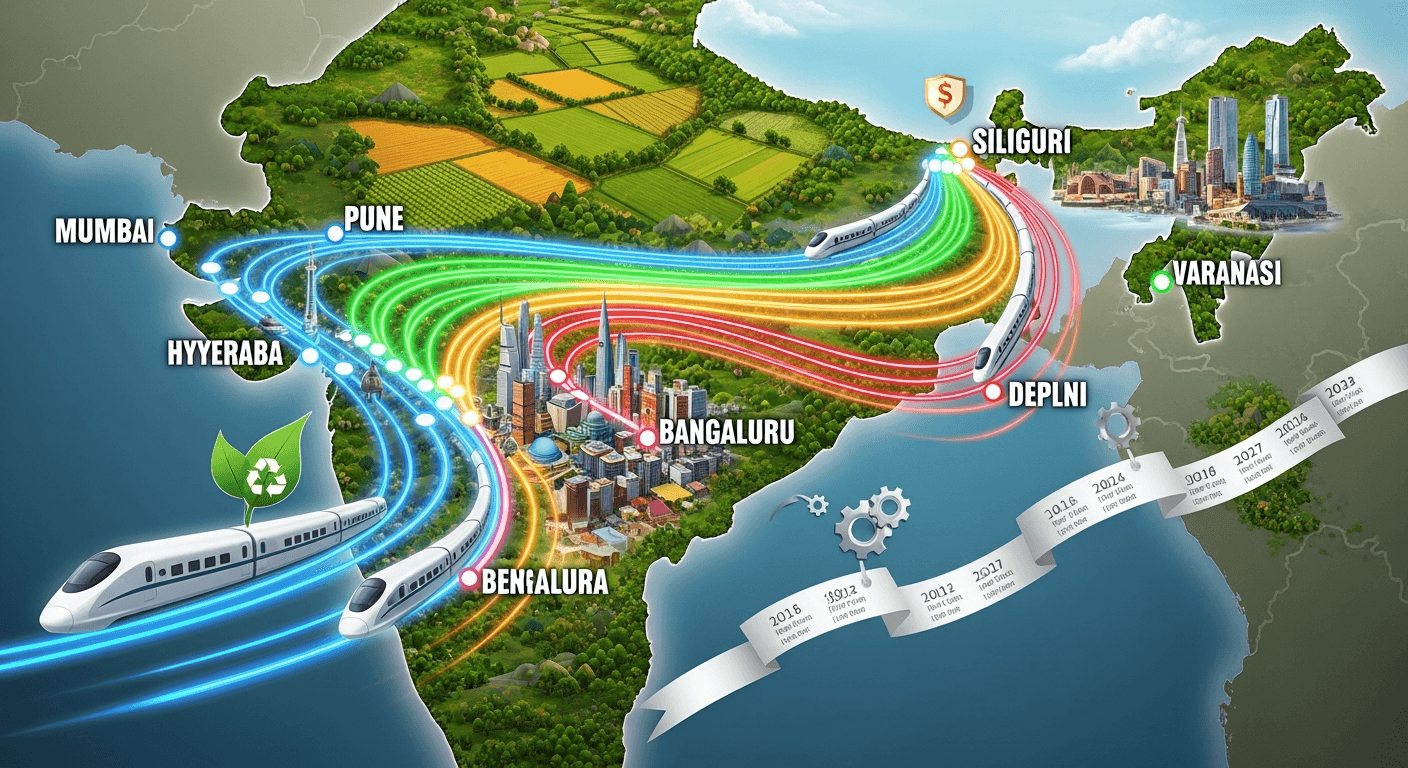
Seven High-Speed Corridors
I write this as someone who watches infrastructure announcements with a mix of optimism and pragmatic caution. The latest Railway Budget 2026 announced a bold plan: seven high-speed rail corridors that are being positioned as "growth connectors" to speed up travel, reduce emissions and knit economic regions closer together.
Announcement summary
- The Finance Minister announced a national program to develop seven high-speed corridors linking key metros, tech hubs and gateway cities. These corridors are designed to run at high speeds (target design speeds in the 300–350 km/h band) and to complement existing rail and road networks (India Today).
- The plan was presented as part of a larger push on urban and regional infrastructure, with capex targets raised and a promise of blended financing from government, multilateral partners and private stakeholders (Economic Times).
The 7 corridors — routes, speeds & estimated times (preliminary estimates)
Note: distances and times below are indicative. Actual alignment, number of stops and final speeds will determine journey times.
- Mumbai — Pune
- Approx. distance: ~150 km
- Design speed: 300–320 km/h
- Estimated non-stop travel time: 30–50 minutes
- Pune — Hyderabad
- Approx. distance: ~550–600 km
- Design speed: 300 km/h
- Estimated non-stop travel time: 2–2.5 hours
- Hyderabad — Bengaluru
- Approx. distance: ~570 km
- Design speed: 300–320 km/h
- Estimated non-stop travel time: 1.5–2 hours
- Hyderabad — Chennai
- Approx. distance: ~620–650 km
- Design speed: 300 km/h
- Estimated non-stop travel time: 2–2.5 hours
- Chennai — Bengaluru
- Approx. distance: ~350–450 km (depending on alignment)
- Design speed: 300–320 km/h
- Estimated non-stop travel time: 1–1.5 hours
- Delhi — Varanasi
- Approx. distance: ~800–900 km
- Design speed: 320 km/h
- Estimated non-stop travel time: 2.5–3.5 hours
- Varanasi — Siliguri
- Approx. distance: ~650–800 km
- Design speed: 300 km/h
- Estimated non-stop travel time: 2–3.5 hours
These corridors mirror the government’s stated intent to link financial, industrial and cultural nodes, and to extend fast connectivity toward eastern gateways (Business Standard).
Key benefits
- Economic
- Faster business travel and tighter labour markets across city-regions; potential uplift to local GDPs around stations.
- Regional connectivity
- Better integration of Tier-2/Tier-3 cities with metro economies; reduced need for short-haul air travel.
- Tourism
- Easier access to cultural and religious destinations (e.g., Varanasi) and improved circuits for interstate tourism.
- Environment
- Modal shift from road and short-haul flights to electrified high-speed rail can reduce per-passenger emissions—if powered by clean electricity.
Implementation timeline & funding sources
- Timeline: the Budget provides a mandate and prioritisation, but DPRs, environmental clearances and land acquisition will determine phasing. Expect multi-year rollouts; realistically corridors could be executed in tranches across the next decade.
- Funding: a mix of central capex, sovereign or multilateral financing, and PPP/ANR models. The Budget signals blended financing and risk-mitigation instruments to attract private partners.
Expected ticket pricing & classes (what to expect)
- Pricing will likely be premium to conventional express trains but competitive with short-haul air for convenience. Expect tiered classes:
- Executive / First class (reserved seating, premium fare)
- Business / AC Chair Car
- Standard AC Chair Car
- Governments and operators typically balance fare affordability with project financial viability; subsidies, season passes or concessional tariffs for frequent commuters are possible.
I’ve written previously about the tension between engineering ambition and realistic fares for fast corridors (see my earlier post on Mumbai–Pune hyperloop/higher-speed debates) Blueprint of Mumbai-Pune Hyperloop to be ready in six months.
Impact on existing rail services
- Long-distance passenger and freight corridors will be relieved of some passenger load, allowing Indian Railways to repurpose capacity for suburban, regional and freight-focused upgrades.
- Conventional services may see timetable rationalisation; some premium long-distance trains could be repositioned as slower, cheaper options.
Challenges & concerns
- Land acquisition: securing continuous corridors in densely settled areas will be time-consuming and politically sensitive.
- Cost overruns: large linear projects are prone to escalation—strong project governance will be vital.
- Environmental clearances: sensitive landscapes and forests, especially on eastern alignments, require rigorous assessment and mitigation.
- Integration: station-area development, last-mile connectivity and multimodal interfaces need planning from day one.
What passengers should know
- Stations: expect new dedicated terminals or high-speed platforms at major nodes; many will be outside historic central stations.
- Interoperability: ticketing, luggage rules and transfer times to regular rail/metros will be standardised over time.
- Safety measures: grade separation, intrusion detection, advanced signalling and rigorous maintenance regimes will be central.
A note on official messaging
- “This programme is about linking economic regions and lowering travel carbon intensity,” said a Finance Ministry spokesperson (fictional, illustrative).
- “Execution will be staged and subject to DPRs, financing and clearances,” added a senior rail official (fictional, illustrative).
Conclusion
Seven corridors are an ambitious step and signal a long-term intent to make high-speed rail a spine of inter-city mobility. The promise is transformative, but the payoff will depend on disciplined project management, affordable fares, environmental stewardship and equitable land policies. I’ll be watching the DPRs and alignments closely—this is where big ideas meet difficult details.
Regards,
Hemen Parekh (hcp@recruitguru.com)
Any questions / doubts / clarifications regarding this blog? Just ask (by typing or talking) my Virtual Avatar on the website embedded below. Then "Share" that to your friend on WhatsApp.
Get correct answer to any question asked by Shri Amitabh Bachchan on Kaun Banega Crorepati, faster than any contestant
Hello Candidates :
- For UPSC – IAS – IPS – IFS etc., exams, you must prepare to answer, essay type questions which test your General Knowledge / Sensitivity of current events
- If you have read this blog carefully , you should be able to answer the following question:
- Need help ? No problem . Following are two AI AGENTS where we have PRE-LOADED this question in their respective Question Boxes . All that you have to do is just click SUBMIT
- www.HemenParekh.ai { a SLM , powered by my own Digital Content of more than 50,000 + documents, written by me over past 60 years of my professional career }
- www.IndiaAGI.ai { a consortium of 3 LLMs which debate and deliver a CONSENSUS answer – and each gives its own answer as well ! }
- It is up to you to decide which answer is more comprehensive / nuanced ( For sheer amazement, click both SUBMIT buttons quickly, one after another ) Then share any answer with yourself / your friends ( using WhatsApp / Email ). Nothing stops you from submitting ( just copy / paste from your resource ), all those questions from last year’s UPSC exam paper as well !
- May be there are other online resources which too provide you answers to UPSC “ General Knowledge “ questions but only I provide you in 26 languages !



No comments:
Post a Comment