
Lead
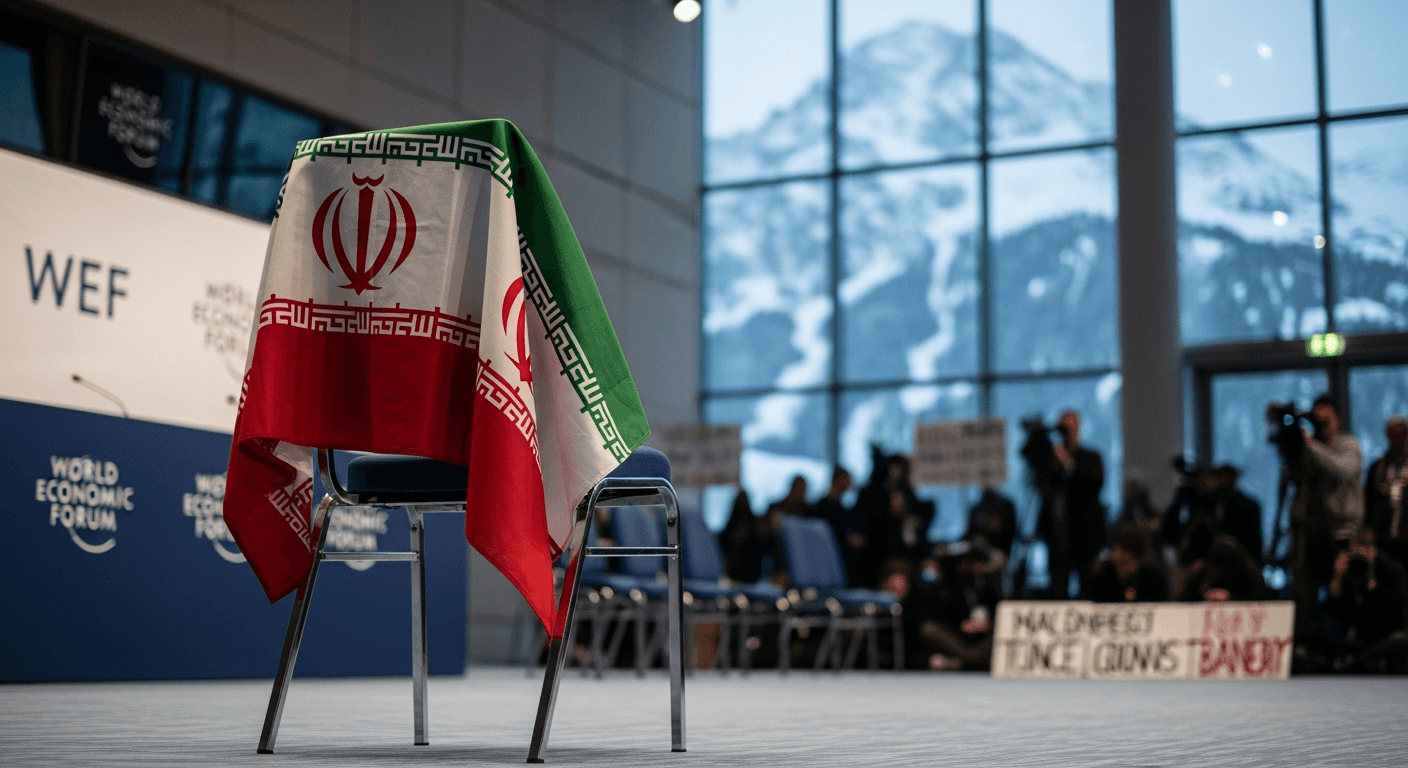
I write this from the perspective of someone who watches how global gatherings reflect — and sometimes shape — geopolitics. This week the World Economic Forum (WEF) announced that Iran’s foreign minister, who had been listed as a speaker, will not attend the Davos annual meeting because “the tragic loss of lives of civilians in Iran over the past few weeks means that it is not right for the Iranian government to be represented at Davos this year” (Times of India). The decision, articulated in a WEF post on X, closes off a public-facing diplomatic channel at one of the year’s highest-profile multilateral fora.
Background
The invitation had been circulated months earlier; the foreign minister was scheduled to appear on a panel addressing cooperation in a contested world. In the intervening period Iran experienced a wave of nationwide unrest and a harsh security response. Rights groups and several monitoring organisations have published high casualty figures — numbers that remain contested and difficult to independently verify from outside Iran — and many activists publicly urged Davos organisers to rescind the invitation (India Today).
My previous writing has often argued that global forums must balance openness with responsibility; this episode illustrates that tension in real time (A Twin Tragedy). The WEF framed its choice as one of propriety towards victims and protesters; critics of the invitation argued platforming a government representative amid allegations of severe rights violations would be politically and morally fraught.
Reactions
Organisations that track and campaign on Iran’s human-rights record and advocacy groups pressed the case for the disinvitation. At the same time, some diplomats and intermediaries cautioned that formal exclusion from public panels does not equate to the end of behind-the-scenes communication channels; Swiss authorities routinely note their mediation role between Washington and Tehran during high-level gatherings (India Today).
Among observers, Hillel Neuer (hcneuer@unwatch.org) — whose organisation has in the past called for accountability in international fora — publicly welcomed steps that would, in his view, prevent perceived impunity for alleged abuses (see reporting on advocacy responses in outlets covering the decision). I note his reaction here because it illustrates how rights watchdogs see forum-platforming as part of a broader accountability ecosystem; his perspective was one of several voices that influenced public debate on the invitation ([Newsmax / other coverage referenced above]).
Iran’s foreign ministry reacted strongly on social media, describing the move as politically motivated and accusing external actors of pressuring Davos organisers; those posts were later modified or deleted in the public record, according to reporting on the ministry’s statements (The National). Advocacy groups such as United Against Nuclear Iran (UANI) had directly lobbied the WEF to withdraw the invitation, arguing that giving a global stage to Tehran’s representatives would undermine protesters and victims.
Implications
There are three practical consequences worth noting.
Diplomatic optics and leverage: Public exclusions change what the global “stage” looks like, and send signals about reputational cost. They can shape bilateral and multilateral calculus without replacing discreet diplomacy.
Forum legitimacy and precedent: Davos and similar events balance inclusive dialogue with political pressures. Choosing not to host a government representative in a given year sets a precedent that may be invoked in future crises — prompting both praise from rights advocates and criticism from those who warn against politicising multilateral platforms.
Information and accountability: Removing a scheduled public appearance narrows the space for direct questioning in a live, multilateral setting. That can limit public scrutiny while leaving other channels — backchannel diplomacy, private meetings, or legal actions — as alternatives for accountability.
For analysts, the decision is also a reminder of how global civil society, domestic protests, and media attention can converge to influence elite decision-making. The WEF’s statement explicitly tied its choice to recent civilian deaths; the organisation placed reputational norms above the earlier scheduling of a speaker.
Conclusion
I view the WEF’s action as emblematic of a broader shift: international forums increasingly face calls to weigh platform access against human-rights considerations. That balance will not please everyone. Advocates will argue the move defends victims; diplomats will caution about closing doors that could serve de-escalatory functions. As someone who has chronicled how institutions respond to crises, I see this as one more instance where visibility — or its withdrawal — becomes a diplomatic instrument.
If nothing else, the episode underlines that Davos is not just a venue for business and ideas but has, in moments like this, become a stage where global norms and political judgments are publicly tested.
Regards,
Hemen Parekh
Any questions / doubts / clarifications regarding this blog? Just ask (by typing or talking) my Virtual Avatar on the website embedded below. Then "Share" that to your friend on WhatsApp.
Get correct answer to any question asked by Shri Amitabh Bachchan on Kaun Banega Crorepati, faster than any contestant
Hello Candidates :
- For UPSC – IAS – IPS – IFS etc., exams, you must prepare to answer, essay type questions which test your General Knowledge / Sensitivity of current events
- If you have read this blog carefully , you should be able to answer the following question:
- Need help ? No problem . Following are two AI AGENTS where we have PRE-LOADED this question in their respective Question Boxes . All that you have to do is just click SUBMIT
- www.HemenParekh.ai { a SLM , powered by my own Digital Content of more than 50,000 + documents, written by me over past 60 years of my professional career }
- www.IndiaAGI.ai { a consortium of 3 LLMs which debate and deliver a CONSENSUS answer – and each gives its own answer as well ! }
- It is up to you to decide which answer is more comprehensive / nuanced ( For sheer amazement, click both SUBMIT buttons quickly, one after another ) Then share any answer with yourself / your friends ( using WhatsApp / Email ). Nothing stops you from submitting ( just copy / paste from your resource ), all those questions from last year’s UPSC exam paper as well !
- May be there are other online resources which too provide you answers to UPSC “ General Knowledge “ questions but only I provide you in 26 languages !




No comments:
Post a Comment