
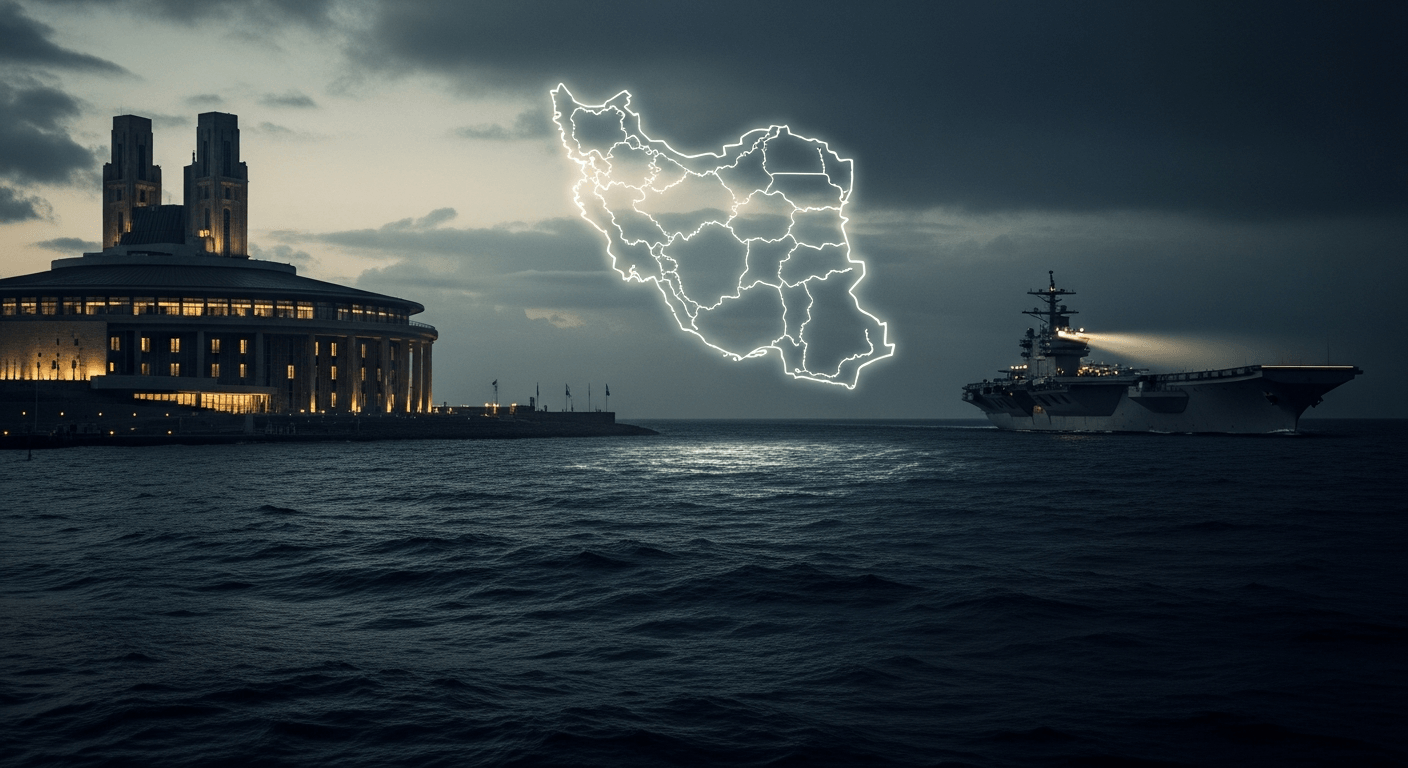
Force Not Yet Known
I spend a lot of time watching how words, deployments and legal frameworks interact at moments when the world seems to be balancing on a hairline. The last week’s rhetoric out of Jerusalem — a public warning that "if it makes a mistake and attacks us, we will act with a force it has not yet known" — is one of those moments. That sentence, delivered by Israel’s prime minister in parliament, is short, stark and meant to do three things at once: deter, reassure a worried public, and signal to allies and adversaries what might follow if deterrence fails Times of Israel.
In this piece I want to unpack that sentence and the surrounding signals: what Israel said publicly, how Washington has reacted, what international law says about the options on the table, and the realistic scenarios and consequences that follow. I aim to be clear-eyed and balanced — the stakes are high, and clarity matters.
What was said, and why it matters
The public warning I quoted was part of a broader set of statements in which Israel framed Iran’s missile and nuclear activity as an existential threat and vowed strong retaliation to any direct Iranian attack. Israeli officials have repeatedly emphasised both a right to prevent a nuclear-capable Iran and a determination to punish any direct attack on Israeli territory Times of India.
Two practical effects follow from such language. Domestically, it reassures voters that the government will not appear weak. Internationally, it signals red lines: a public declaration of consequences is meant to raise the political cost for Tehran of escalation — while also telegraphing to partners, especially the United States, that Israel expects tangible support or at least alignment.
The U.S. role: calibrator, backstop, or co-combatant?
U.S. reactions in recent weeks have been cautious but consequential. Washington has taken visible steps — for example, moving carrier strike assets and, in earlier escalations, conducting strikes on Iranian nuclear-related sites — that function as both a deterrent and a message of collective concern about proliferation risks Times of India; Security Council analyses.
At the same time, public disagreements have appeared over tactics — for example, Israel’s public push for certain post-war governance arrangements in Gaza drew an explicit line of disagreement with Washington about which regional actors should participate in an advisory board [Times of India]. Those quarrels matter because they reveal the limits of political consensus: military support or tacit acquiescence from the U.S. can be decisive, but it is not unconditional.
International law: self-defence, imminence and proportionality
Any use of force by a state against another state is governed by the UN Charter. Article 51 recognises the inherent right of individual or collective self-defence if an armed attack occurs, and it remains the legal lodestar for these debates. The tough questions arise where states claim anticipatory or preventive self-defence, or rely on doctrines like "unwilling or unable" to justify strikes against non-state actors on another state’s soil UN Article 51 summary; Security Council Report analysis.
Two legal principles matter most:
- Necessity/imminence: is an attack imminent in the sense recognised by the Caroline test ("instant, overwhelming, leaving no choice of means, and no moment for deliberation")? If not, preventive strikes are legally and politically risky.
- Proportionality: any response must be proportionate to the threat and confined to what is necessary to repel it.
These legal constraints do not make outcomes predictable, but they do constrain the range of justifiable state behaviour and shape international reactions and legitimacy.
Plausible scenarios and their implications
- Low-level exchanges and calibrated deterrence
- What: Missile salvos or drone strikes limited in scope; tit-for-tat strikes on proxy sites.
- Implications: Localised damage, heightened risk for civilians and commerce; global markets jitter but strategic escalation halted by diplomatic channels and back-channel assurances.
- Major Iranian strike; Israeli decisive retaliation
- What: A significant Iranian direct strike on Israeli territory or assets triggers the type of large-scale response Israel has publicly warned about.
- Implications: Rapid military escalation; potential involvement of U.S. forces in defensive operations or to secure regional lines of communication; high civilian casualties; regional spillover (Lebanon, Iraq, Persian Gulf).
- U.S.-led intervention or direct U.S. strikes in support of Israel
- What: Washington moves from deterrence to active strikes, citing collective self-defence or imminent threat.
- Implications: Broader war risk, possible fragmentation of international support, intense UN and diplomatic activity, and legal debate over Article 51’s scope.
- De-escalation and diplomacy
- What: Back-channel diplomacy, third-party mediation, and clear, verifiable commitments on nuclear restraint.
- Implications: Lower immediate risk; requires credible verification and meaningful incentives for Iran — a politically difficult path for all sides but the least destructive.
Expert analysis and the political calculus
Regional analysts emphasise a perennial problem: military strikes can set back programs temporarily but rarely eliminate underlying political drivers. Others note that Israel’s public warnings — while militarily credible — are designed to bind domestic politics to a narrative of existential urgency, making quick diplomatic compromise harder. Independent legal scholars highlight how frequent invocations of expansive self-defence doctrines can erode the international legal order if not transparently reported to the Security Council (as Article 51 requires) [Security Council Report analysis].
What I watch next
- Concrete steps by Washington: formal statements, force posture changes, or legal justifications sent to the UN.
- Tehran’s public posture versus covert preparations: rhetoric can be bluster or credible signalling; both must be monitored.
- Diplomatic traffic — regional and multilateral — that could provide pressure-release valves.
Words like "force not yet known" are designed to do strategic work. They can deter — or they can corner leaders into actions that spiral. My hope is that deterrence holds and that states lean into diplomacy and clear legal framing rather than open-ended escalation.
Regards,
Hemen Parekh
Any questions / doubts / clarifications regarding this blog? Just ask (by typing or talking) my Virtual Avatar on the website embedded below. Then "Share" that to your friend on WhatsApp.
Sources and further reading
- Israeli parliamentary and press statements summarised in Times of Israel coverage: "Netanyahu: If Iran attacks Israel, ‘we will act with strength that Iran hasn't yet known'" Times of Israel.
- Regional reporting and contemporaneous coverage: Times of India summary of statements and U.S. force movements Times of India.
- Analysis of geopolitical and legal implications, including the use of Article 51 and reporting obligations: Security Council Report "In Hindsight: The Increasing Use of Article 51" Security Council Report.
- Context on legal standards for self-defence and proportionality: UN Office of Legal Affairs summary of Article 51 UN legal materials.
- Regional expert discussion and interviews (analysis of political calculations and risks): Al Jazeera coverage and interviews (various pieces on Israel–Iran tensions and regional implications).
Get correct answer to any question asked by Shri Amitabh Bachchan on Kaun Banega Crorepati, faster than any contestant
Hello Candidates :
- For UPSC – IAS – IPS – IFS etc., exams, you must prepare to answer, essay type questions which test your General Knowledge / Sensitivity of current events
- If you have read this blog carefully , you should be able to answer the following question:
- Need help ? No problem . Following are two AI AGENTS where we have PRE-LOADED this question in their respective Question Boxes . All that you have to do is just click SUBMIT
- www.HemenParekh.ai { a SLM , powered by my own Digital Content of more than 50,000 + documents, written by me over past 60 years of my professional career }
- www.IndiaAGI.ai { a consortium of 3 LLMs which debate and deliver a CONSENSUS answer – and each gives its own answer as well ! }
- It is up to you to decide which answer is more comprehensive / nuanced ( For sheer amazement, click both SUBMIT buttons quickly, one after another ) Then share any answer with yourself / your friends ( using WhatsApp / Email ). Nothing stops you from submitting ( just copy / paste from your resource ), all those questions from last year’s UPSC exam paper as well !
- May be there are other online resources which too provide you answers to UPSC “ General Knowledge “ questions but only I provide you in 26 languages !



No comments:
Post a Comment