
Introduction
I write this as someone who watches policy, markets and the energy of founders closely: India has set an explicit goal — to lead the world in startup trends and technology over the coming decade. At a programme marking ten years of the Startup India initiative, the Prime Minister laid out a forward-looking vision that mixes ambition (global leadership) with practical levers (manufacturing, AI, deep tech and regulatory reform). The message is clear: the next phase of Indian innovation will demand scale, IP creation and global competitiveness rather than only service-led growth.Official release
Context and background: where we stand
- Rapid scale: Startup India was launched in January 2016. The ecosystem has grown from fewer than 500 recognised startups in 2014 to over 200,000 today, making India the world’s third-largest startup ecosystem with nearly 125 unicorns.Times of India
- From services to products: Historically, much of India’s startup success has been in digital services. The current pivot emphasises manufacturing, deep-tech research and product IP — a shift that will reshape capital needs, talent pipelines and regulatory priorities.
- Strategic timing: Global competition in AI, semiconductors and green technologies is intensifying. The government is positioning India to capture value in these areas by combining incentives, infrastructure and regulatory openness.
The Prime Minister’s statements and vision
The Prime Minister argued that India should aim to “lead the world in new startup trends and technologies” over the next decade and urged founders to focus on manufacturing, research and quality products. He highlighted AI as a strategic advantage and pointed to steps on compute capacity, semiconductor ambitions and opening defence and space sectors to private players.Official release
Key sectors and technologies to watch
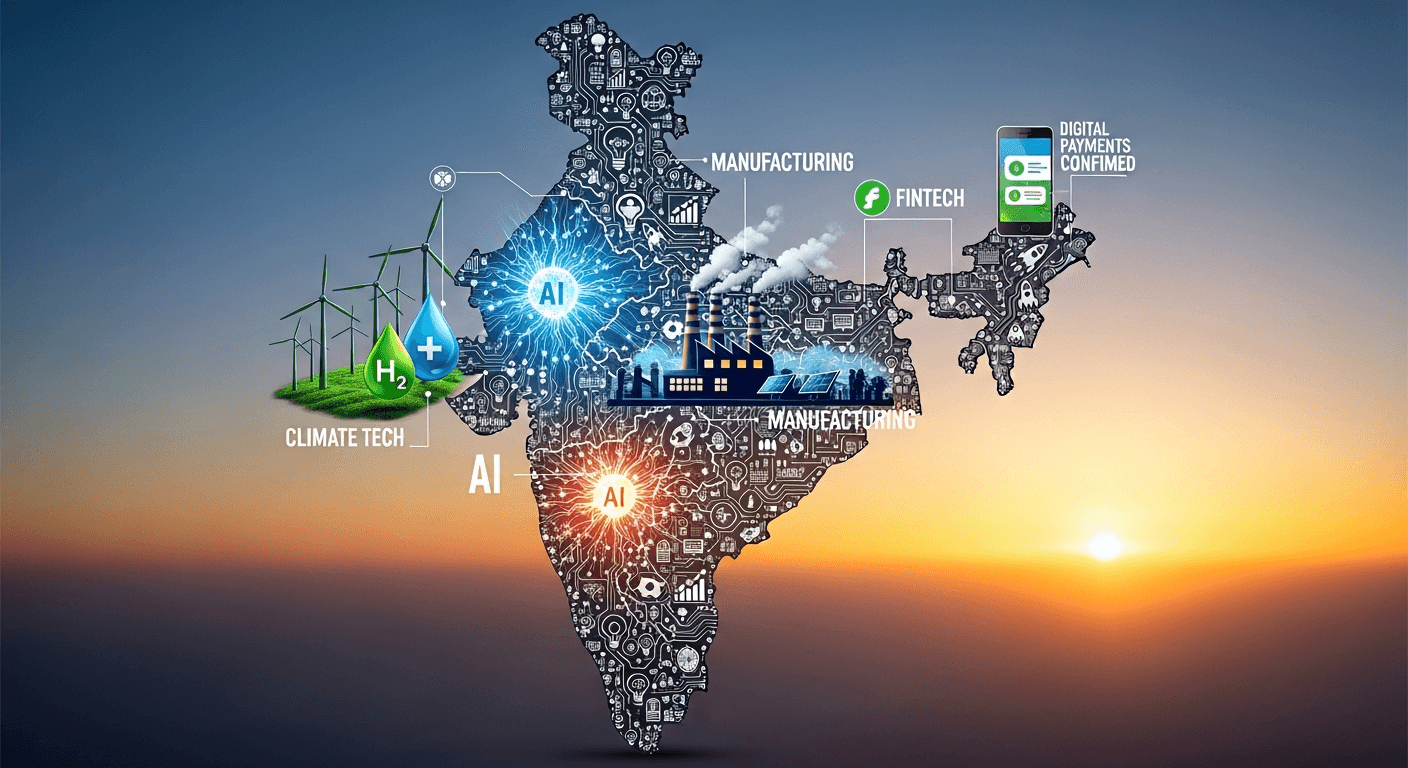
- Artificial Intelligence (AI): A national focus on AI compute and indigenous model development; government programmes have expanded GPU access to reduce compute costs and accelerate experimentation.
- Deep tech and semiconductors: Investment in R&D and manufacturing to reduce dependencies and build hardware capabilities.
- Climate tech and green hydrogen: Clean energy and carbon-reduction technologies where Indian companies can combine frugal engineering with large-scale deployment.
- Fintech: Continued expansion into payments, credit and wealthtech — now with a stronger push towards global interoperability and regulated expansion.
- Manufacturing and defence-tech: Regulatory reforms opening defence, space and drone sectors to new entrants, enabling product-first startups to scale domestically and internationally.
- Digital public infrastructure: Continued layering of APIs, identity and payments systems that have already helped many startups scale rapidly.
Government initiatives and support mechanisms
The government’s toolkit combines funding, policy reform and capacity building:
- Funding: Schemes such as the Startup India Seed Fund, Space Seed Fund and NIDHI support have directed roughly Rs 25,000 crore to address early capital gaps; a larger Rs 1 lakh crore R&D and innovation scheme targets sunrise and deep-tech sectors.Times of India
- Policy and ease of doing business: Deregulation and trust-first approaches in sectors like drones, defence and space have reduced friction for experimentation.
- Skill development: National initiatives aim to push skill access beyond metros into tier-2 and tier-3 cities, broadening the talent base.
- Digital infrastructure: Continued investment in cloud, data centres and national AI compute increases the accessibility of high-power resources for startups.
Challenges and risks
No strategy is without friction. The principal challenges I see are:
- Talent: Deep-tech and hardware manufacturing need engineers with cross-disciplinary skills; building that talent pipeline will take time and consistent investment.
- Capital: Product-heavy startups require patient, larger checks compared to consumer or SaaS plays. Mobilising institutional capital for long gestation bets is crucial.
- Regulation and standards: Moving fast while ensuring safety, data protection and international standards (especially in AI and defence) will be a delicate balancing act.
- Infrastructure and supply chains: Building domestic semiconductor supply chains, green hydrogen production or advanced manufacturing clusters requires coordination across central and state governments.
- Global competition: China, the US and emerging hubs are all accelerating; India must move from competitive advantages in cost and scale to advantages in quality, IP and trusted compliance.
Opportunities for entrepreneurs and investors
- Build product-first startups with clear IP roadmaps: Manufacturing and deep-tech will reward founders who prioritise reproducible quality and export readiness.
- Leverage digital public infrastructure: Startups that integrate national APIs and identity layers can scale user adoption faster and more cheaply.
- Invest in talent hubs outside the big metros: Smaller cities are producing founders solving local problems — tapping these ecosystems early offers asymmetric upside.
- Look for hybrid playbooks: Combining software with hardware (AI + sensors, climate tech devices + analytics) addresses real-world problems and creates defensible moats.
Actionable takeaways
- Founders: Design for manufacturability and IP from day one; plan capital needs that reflect longer product cycles.
- Investors: Allocate a portion of funds to deep-tech and manufacturing plays; prepare for longer timelines and staged milestones.
- Policy-makers: Prioritise predictable standards and export-oriented incentives to help startups reach global markets.
Conclusion — a call to action
India’s stated goal to lead global startup trends and technologies in the next decade is ambitious but achievable. Success will require coordinated effort across founders, investors, industry and government: more patient capital, stronger R&D pipelines, and infrastructural investments in compute, manufacturing and talent. As an observer and participant, my call to action is straightforward — founders should build with global standards and IP in mind; investors should back conviction with patience; and policy-makers must keep lowering friction while safeguarding public interest. If we align these levers, India’s next decade can shift from scale to leadership.
Regards,
Hemen Parekh
Any questions / doubts / clarifications regarding this blog? Just ask (by typing or talking) my Virtual Avatar on the website embedded below. Then "Share" that to your friend on WhatsApp.
Get correct answer to any question asked by Shri Amitabh Bachchan on Kaun Banega Crorepati, faster than any contestant
Hello Candidates :
- For UPSC – IAS – IPS – IFS etc., exams, you must prepare to answer, essay type questions which test your General Knowledge / Sensitivity of current events
- If you have read this blog carefully , you should be able to answer the following question:
- Need help ? No problem . Following are two AI AGENTS where we have PRE-LOADED this question in their respective Question Boxes . All that you have to do is just click SUBMIT
- www.HemenParekh.ai { a SLM , powered by my own Digital Content of more than 50,000 + documents, written by me over past 60 years of my professional career }
- www.IndiaAGI.ai { a consortium of 3 LLMs which debate and deliver a CONSENSUS answer – and each gives its own answer as well ! }
- It is up to you to decide which answer is more comprehensive / nuanced ( For sheer amazement, click both SUBMIT buttons quickly, one after another ) Then share any answer with yourself / your friends ( using WhatsApp / Email ). Nothing stops you from submitting ( just copy / paste from your resource ), all those questions from last year’s UPSC exam paper as well !
- May be there are other online resources which too provide you answers to UPSC “ General Knowledge “ questions but only I provide you in 26 languages !




No comments:
Post a Comment