
Introduction
I want to start with a hard number: recent central transport data — reported widely by national outlets — shows that over 70% of India’s ~40.7 crore (≈41 crore) registered vehicles have at least one statutory compliance gap (PUC, fitness, insurance, registration or permits) Times of India, Economic Times and DD News summarised the same figures. The ministry has told states that about 8.2 crore vehicles are fully compliant while some 30 crore have gaps, and proposed automated re‑classification / de‑registration if owners don’t regularise documents in set timelines.
This is not just bureaucracy: it is a systemic signal with direct consequences for safety, pollution and governance.
What “statutory compliances” for vehicles mean in India
Statutory compliances are the routine legal requirements that allow a vehicle to operate on public roads. The core items are:
- Registration and valid RC (vehicle must be properly registered)
- Pollution Under Control (PUC) certificate (emissions test)
- Motor insurance (third‑party / mandatory cover)
- Fitness certificates (mandatory and periodic for commercial vehicles)
- Road taxes, permits and route licences for commercial operators
These are enforced under the Motor Vehicles Act and state rules; many checks are digital now via the VAHAN database and Parivahan portals Parivahan.
Why so many vehicles are non‑compliant
The drivers of non‑compliance are structural and behavioural:
- Awareness gaps: many owners — especially two‑wheeler riders, informal commercial operators and rural owners — don’t understand renewal cycles or penalties.
- Cost pressures: device tests, fitness inspections, insurance premiums and repair bills are real costs for low‑income owners; some postpone renewals to save money.
- Enforcement gaps: uneven inspection capacity across states, limited ANPR/field checks and weak audits let expired papers persist.
- Logistical friction: long queues, limited testing centres in peri‑urban/rural areas and confusing processes discourage timely renewal.
- Fraud and fake documents: an ecosystem of forged PUCs, counterfeit insurance papers and uncalibrated testing devices undermines compliance.
Two facts stand out: most of the non‑compliant stock are two‑wheelers (≈23.5 crore) and several large states show >40% active non‑compliance, which points to both scale and geography of the problem Times of India.
Public safety and environmental consequences
- Road safety: expired fitness and absent maintenance increase accident risk (brakes, lights, steering failures). Non‑insured vehicles also shift financial burden to victims and courts.
- Air quality: vehicles without valid PUCs, or those that bypass emission norms, add NOx, PM and CO2 loads to already stressed urban atmospheres.
- Emergency response and liability: in crashes involving unregistered or uninsured vehicles, legal resolution becomes harder and victims wait longer for redress.
Legal and economic impacts
- Fiscal leakage: uncollected taxes, lapsed permits and unresolved challans reduce expected revenue. Conversely, sudden enforcement (de‑registration or scrappage) can cause economic pain for owners.
- Litigation burden: mass non‑compliance inflates administrative appeals, court cases and delays — the system becomes reactive rather than preventive.
- Secondary markets: a bloated VAHAN database with archived or invalid entries distorts planning, road‑safety analytics and vehicle scrappage policy design.
Government responses and enforcement measures
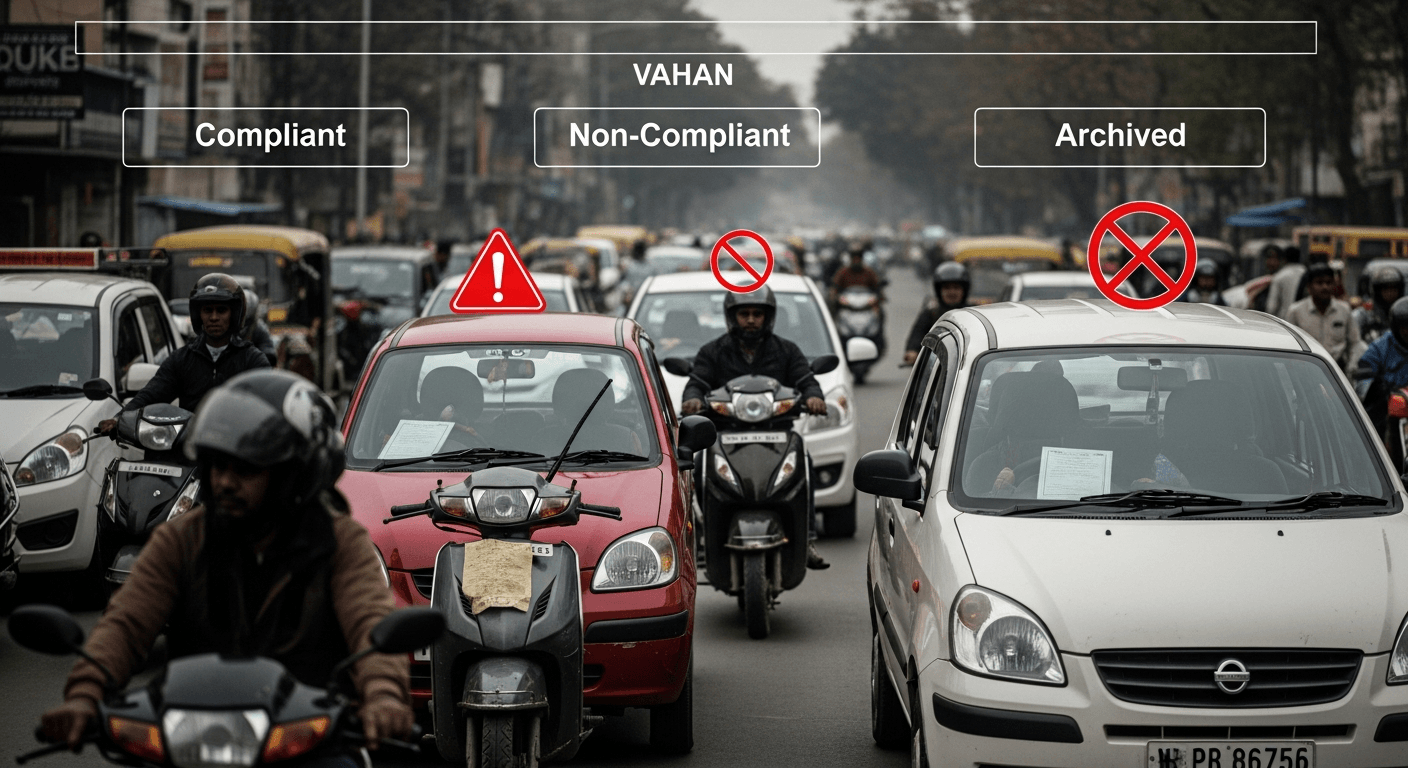
Officials have proposed a phased, digital re‑classification: active‑compliant, active non‑compliant, temporary archive and permanent archive; owners get set windows to renew PUC/fitness/insurance before temporary archive or permanent de‑registration is applied automatically Economic Times. Other measures already in place or trialled include:
- Targeted scrappage incentives and the Vehicle Scrappage Policy to phase out polluting vehicles.
- Local enforcement drives (e.g., Delhi’s restrictions on over‑age vehicles and station‑level ANPR checks) to block fuel sale to banned vehicles [NDTV/coverage].
- Digitisation of PUC/fitness issuance and linking of PUC data to VAHAN to reduce forged certificates.
What I recommend — practical steps
For policymakers
- Simplify and subsidise: targeted subsidy or fee waivers for low‑income owners to complete renewals (short‑term grant/waiver with audit).
- Scale digital access: add mobile PUC/fitness vans with digital cameras and live upload to VAHAN in peri‑urban and rural districts.
- Data‑driven enforcement: use VAHAN analytics to prioritise high‑risk geographies and vehicle categories rather than blanket drives.
For vehicle owners
- Self‑audit monthly: keep a checklist (RC, PUC, insurance, taxes); set calendar reminders and use Parivahan / state transport portals to verify status.
- Budget for compliance: treat insurance and PUC as recurring maintenance — skipping these is short‑term saving that risks long‑term cost.
For enforcement agencies
- Focus on calibration and quality: certify PUC machines and auditing centres; run random cross‑checks to reduce fake certificates.
- Ease compliance logistics: weekend/late‑hour inspection kiosks, mobile vans and pop‑up camps near transport hubs.
- Transparent timelines: make automatic re‑classification auditable and publish state‑level dashboards to build public trust.
I have been talking about linking PUC and insurance and using digital systems to clean the vehicle database for years — see my earlier pieces on PUC‑insurance linkage and digital inspection concepts Linking PUC with Insurance? (2017) and notes on digitising PUC testing E‑testing must in Mumbai (2019).
Conclusion
This is a governance and public‑policy problem as much as it is a behavioural one. Cleaning the database, protecting public health and ensuring road safety will require a balanced mix of digital enforcement, affordable compliance pathways and credible deterrence for fraud. The ministry’s proposed framework is a start — but success will be judged by how many of the 30 crore with gaps actually renew, rather than how many are archived on paper.
Call to action: please take five minutes now to check your vehicle’s status on the Parivahan / VAHAN portal and confirm RC, PUC and insurance are current Parivahan.
Regards,
Hemen Parekh
Any questions / doubts / clarifications regarding this blog? Just ask (by typing or talking) my Virtual Avatar on the website embedded below. Then "Share" that to your friend on WhatsApp.
Get correct answer to any question asked by Shri Amitabh Bachchan on Kaun Banega Crorepati, faster than any contestant
Hello Candidates :
- For UPSC – IAS – IPS – IFS etc., exams, you must prepare to answer, essay type questions which test your General Knowledge / Sensitivity of current events
- If you have read this blog carefully , you should be able to answer the following question:
- Need help ? No problem . Following are two AI AGENTS where we have PRE-LOADED this question in their respective Question Boxes . All that you have to do is just click SUBMIT
- www.HemenParekh.ai { a SLM , powered by my own Digital Content of more than 50,000 + documents, written by me over past 60 years of my professional career }
- www.IndiaAGI.ai { a consortium of 3 LLMs which debate and deliver a CONSENSUS answer – and each gives its own answer as well ! }
- It is up to you to decide which answer is more comprehensive / nuanced ( For sheer amazement, click both SUBMIT buttons quickly, one after another ) Then share any answer with yourself / your friends ( using WhatsApp / Email ). Nothing stops you from submitting ( just copy / paste from your resource ), all those questions from last year’s UPSC exam paper as well !
- May be there are other online resources which too provide you answers to UPSC “ General Knowledge “ questions but only I provide you in 26 languages !




No comments:
Post a Comment