
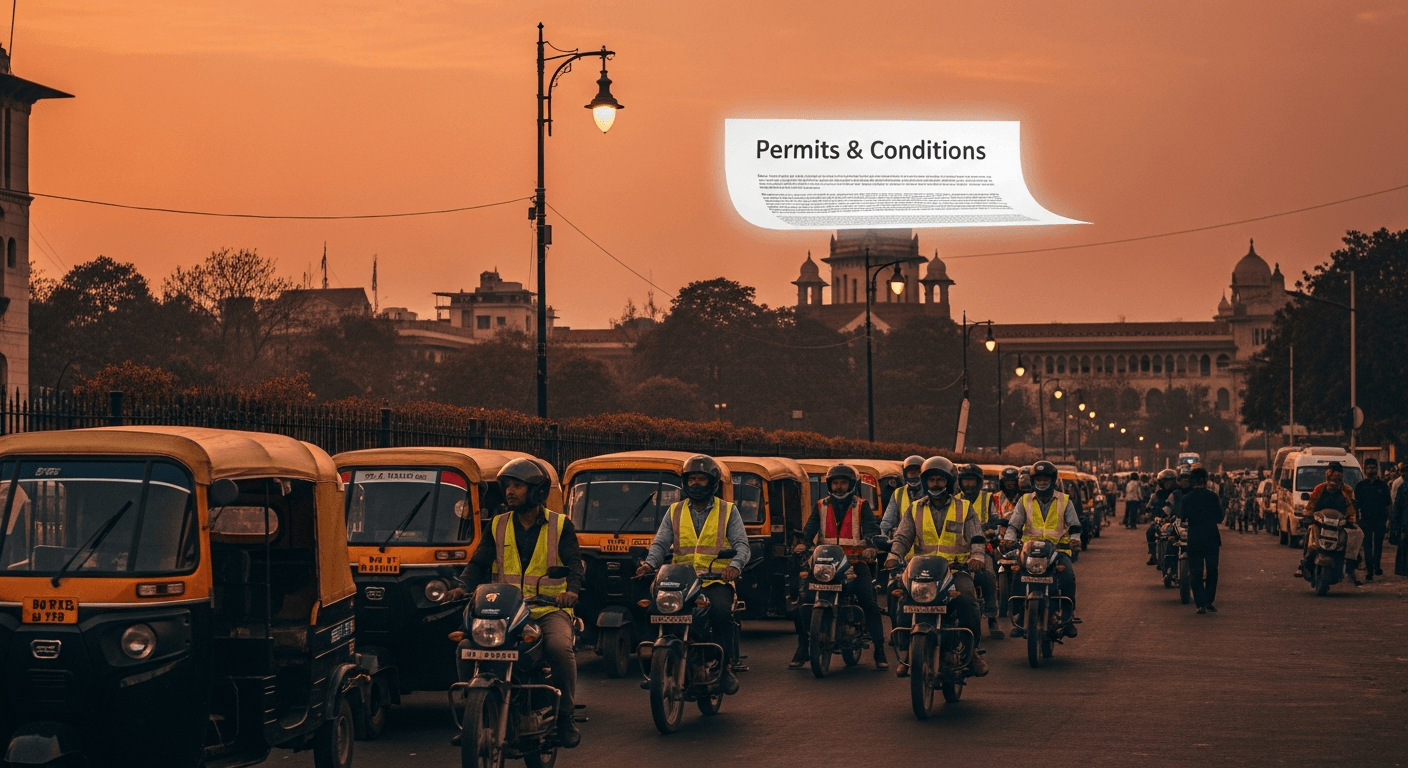
I woke up the morning the Karnataka High Court cleared the way for bike taxis feeling the same small thrill I get when a city finds a new way to move people. For many commuters the order felt like relief — a familiar, fast and affordable option returning to the streets. For regulators, operators and citizens it opened a familiar question: how do we balance convenience, livelihoods and safety?
What happened — a short background
A division bench of the Karnataka High Court set aside the earlier direction that effectively halted bike-taxi operations across the state. The bench asked the state to consider pending applications to register motorcycles as transport vehicles and to grant permits where appropriate, while explicitly empowering regional transport authorities to attach conditions to those permits Times of India. The earlier ban had been driven by concerns that the state should first notify rules under Section 93 of the Motor Vehicles Act before allowing bike taxis.
I’ve written about the promise of two-wheeler mobility before — how bike taxis can be a fast, low-cost last-mile bridge and a source of livelihood in congested cities My earlier post on bike taxis and urban mobility. That perspective helps me read this judgment as more than legal news: it’s a nudge to get regulation right, not to block an entire service.
Why the High Court intervened (in plain language)
- The court pushed back against a blanket prohibition: if a trade is not expressly prohibited, the state should not effectively ban it without reason. Instead, the court said authorities may regulate — but not simply prevent — a legitimate business.
- It directed that applications for registration and permits be considered on their merits and allowed regional transport authorities to lay down conditions where necessary.
In other words: the judiciary asked the state to regulate rather than shut down.
What reasonable conditions the state should consider
If I were advising the transport department, these are the practical conditions I’d expect to see attached to permits:
- Mandatory registration of vehicles as transport vehicles and issuing of formal permits.
- Background checks and police verification for riders.
- Compulsory third-party and passenger insurance; clear compensation rules.
- Standardised helmet quality for both rider and passenger; reflective clothing for night shifts.
- Minimum training and onboarding standards for riders (first aid, safe driving, passenger handling).
- Night-time restrictions or geo-fencing in high-risk corridors; limits on carrying multiple passengers.
- Fitness and pollution compliance checks — with incentives for electric two-wheelers.
- Aggregator obligations: fare transparency, digital receipts, real-time trip tracking, and a fast grievance redressal mechanism.
- Data-sharing with authorities for incident analysis (with privacy safeguards).
These measures create a practical, enforceable framework that protects commuters while preserving livelihoods.
Reactions on the ground
- Commuters: Many regular users — students, shift workers and women who rely on quick, affordable rides — told me the return of bike taxis matters for daily life. For short trips in dense corridors they are often faster and cheaper than taxis or autos.
- Operators and drivers: Aggregators and riders (whose incomes depend on daily trips) have been vocal about livelihood losses during the suspension and are relieved. Their central ask: clear, time-bound rules so they can plan investment and training.
- State and regulators: Officials have signalled caution; they want guardrails that address safety and congestion. The court’s nudge means the state now has to translate caution into a concrete policy — and do it quickly.
Legal and policy implications
This episode underscores a recurring legal tension: the state’s power to regulate transport under the Motor Vehicles Act versus constitutional protections for trade and livelihood. Courts have signalled that while regulation is necessary, a de facto ban without considered policy can be arbitrary. Practically, Karnataka must now formulate rules under Section 93 or take reasoned decisions on permit applications.
Safety, enforcement and operational realities
Good rules are only as good as enforcement. I’d watch for:
- Capacity at regional transport offices to process permits quickly.
- Police and municipal coordination to address unlawful competition and turf conflicts with other modes.
- Technology-enabled compliance: digital permits, app-based ID checks, and emergency buttons.
Encouraging electric bike taxis with subsidies or fast-track permits lowers emissions and noise while making compliance easier.
Economic impact — a quick read
Permit-based operations would stabilise incomes for thousands of riders and restore last-mile connectivity that benefits jobs and businesses. There may be short-term competitive pressure on autorickshaw drivers and some displacement; a fair policy would include transition support and a stakeholder dialogue to reduce conflict.
Practical tips
For commuters:
- Verify rider details in the app and share trip status with a trusted contact.
- Wear a good helmet (not just any lightweight cap) and insist on a second helmet if needed.
- Prefer cashless payments and keep a screenshot of the fare and route.
For operators and riders:
- Prioritise documented onboarding: background checks, training certificates and insurance paperwork.
- Follow safety protocols — visible helmets, responsible riding, no phone use while driving.
- Cooperate with regulators on data and grievance processes; transparency builds trust.
In closing
This judgment is an opportunity: not merely to win a legal battle, but to craft sensible rules that make bike taxis safe, accountable and sustainable. If we get the policy right — tying safety, enforcement and incentives together — cities gain a fast, affordable mobility layer and thousands regain livelihoods. That’s worth the careful work ahead.
Regards,
Hemen Parekh
Any questions / doubts / clarifications regarding this blog? Just ask (by typing or talking) my Virtual Avatar on the website embedded below. Then "Share" that to your friend on WhatsApp.
Get correct answer to any question asked by Shri Amitabh Bachchan on Kaun Banega Crorepati, faster than any contestant
Hello Candidates :
- For UPSC – IAS – IPS – IFS etc., exams, you must prepare to answer, essay type questions which test your General Knowledge / Sensitivity of current events
- If you have read this blog carefully , you should be able to answer the following question:
- Need help ? No problem . Following are two AI AGENTS where we have PRE-LOADED this question in their respective Question Boxes . All that you have to do is just click SUBMIT
- www.HemenParekh.ai { a SLM , powered by my own Digital Content of more than 50,000 + documents, written by me over past 60 years of my professional career }
- www.IndiaAGI.ai { a consortium of 3 LLMs which debate and deliver a CONSENSUS answer – and each gives its own answer as well ! }
- It is up to you to decide which answer is more comprehensive / nuanced ( For sheer amazement, click both SUBMIT buttons quickly, one after another ) Then share any answer with yourself / your friends ( using WhatsApp / Email ). Nothing stops you from submitting ( just copy / paste from your resource ), all those questions from last year’s UPSC exam paper as well !
- May be there are other online resources which too provide you answers to UPSC “ General Knowledge “ questions but only I provide you in 26 languages !



No comments:
Post a Comment