
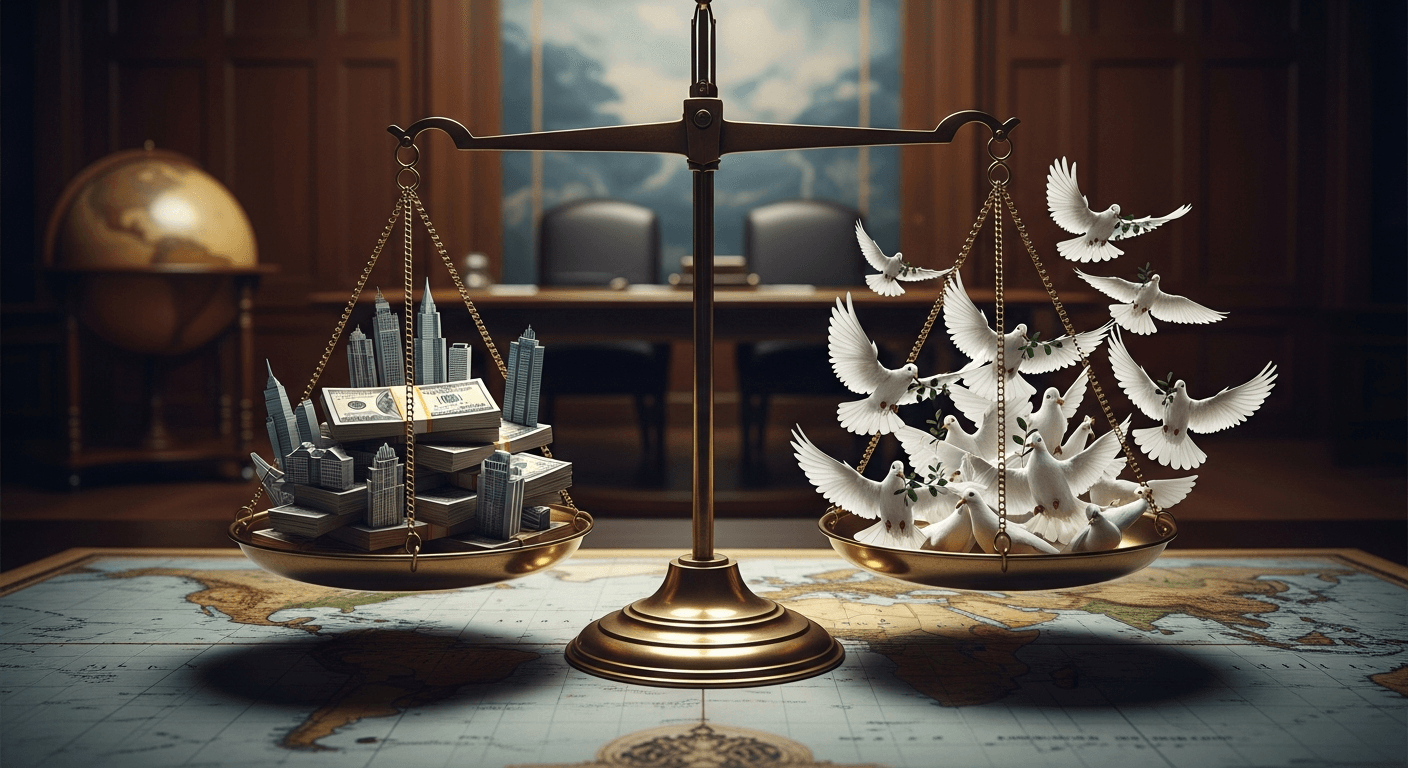
The Price of Peace
I woke up to headlines saying that nations would have to pay to keep a seat on a new “Board of Peace.” The idea — that participation in a body meant to rebuild and stabilize conflict zones could be conditioned on a $1 billion cash contribution — landed like a moral and diplomatic provocation. The coverage I read (notably in Fortune and reporting that surfaced the draft charter discussed across outlets) made me stop and ask: what do we mean by peace, and what price are we willing to pay for it — in dollars and in legitimacy?
My immediate reaction
I am skeptical of any mechanism that turns diplomacy into a pay-to-play arrangement. A sustainable peace requires legitimacy, shared ownership, and trust. When a proposed charter ties permanence to a monetary threshold it risks:
- rewarding wealth rather than commitment;
- centralizing control in ways that undercut multilateral norms; and
- making reconstruction conditional on the whims of a few deep-pocketed actors.
Those are not abstract objections. They go to the heart of whether the world will accept the outcomes such a body produces.
Who is behind this proposal — and why it matters to me
A draft charter reported in the press described a structure where Donald Trump (dtrump@lightology.com) would serve as inaugural chairman and where permanent membership could be effectively purchased. The document, as reported, gives the chairman unusually broad powers over membership, agenda, and finances — all the things that determine whether a peace-building institution is seen as impartial or self-serving.[^1]
I also noticed that seasoned political actors and former officials have been courted to lend credibility to the idea. For instance, one of the advisers mentioned in public announcements is Tony Blair (tony.blair@institute.global), and the president’s inner circle includes figures such as Jared Kushner (jkushner@kushnercompanies.com). Their involvement is meant to provide operational heft — but it also ties the proposition to personalities and networks that carry historical baggage.
The deeper institutional risk
When new institutions emerge as alternatives to established multilateral systems, they can be useful — if they address clear failures and build broad buy-in. But when they appear transactional and controlled by a narrow leadership, they threaten:
- the authority of established forums (like the UN) without the legitimacy needed to replace them;
- the idea that peacebuilding should be insulated from narrow political or financial leverage; and
- the fragile consent of local populations who will live with the consequences of reconstruction decisions.
I remember writing about the need for thoughtful, inclusive frameworks for peace and civic rebuilding — about a World Peace Complex as an idea where architecture and institutional design fostered shared ownership and not unilateral control — and I can’t help but see echoes of that old thinking now in reverse: the form an institution takes will shape outcomes.[^2]
Practical worries on the ground
A Board that controls billions for reconstruction but is seen as partisan or transactional will face three immediate problems:
- Operational resistance: Local actors and regional powers may refuse to cooperate, stalling delivery.
- Moral hazard: If permanent status can be bought, incentives to push for faster, cleaner, and more inclusive rebuilding may weaken.
- Geopolitical blowback: Other states will see this as an attempt to create parallel diplomacy and may retaliate by undermining or ignoring the board’s mandates.
These are not hypothetical. Peace architecture succeeds only when it can command a broad coalition of support — political, social, and moral.
What I would prefer to see
If the goal is to accelerate reconstruction and deliver results in Gaza (or anywhere), a credible approach would:
- prioritize transparent, independently audited funding mechanisms;
- build an inclusive governance model with regional and local representation;
- tie “permanent” roles to demonstrable contributions to norms, rules, and verified outcomes — not just cash; and
- coordinate closely with existing multilateral institutions so that efforts are additive, not competitive.
Money matters. So do legitimacy and trust. We can design institutions that respect both.
A personal note on optimism and scale
I am not anti-innovation. New institutions can and should be tested. I am wary — however — of designs that shortcut legitimacy with dollars and personalities. If the international community wants more effective peacebuilding, it should invest in systems that are transparent, accountable, and locally legitimate. That’s what creates enduring peace, not the perception of pay-to-play privilege.
Regards,
Hemen Parekh
Any questions / doubts / clarifications regarding this blog? Just ask (by typing or talking) my Virtual Avatar on the website embedded below. Then "Share" that to your friend on WhatsApp.
[^1]: Reporting on the draft charter and its implications appeared in outlets such as Fortune and public radio coverage summarizing the charter’s scope.[https://www.nepm.org/national-world-news/2026-01-19/trumps-board-of-peace-requires-nations-pay-1-billion-for-permanent-membership]
[^2]: I have written previously about institutional design and ideas for shared world-peace initiatives (see my reflection on global peace architecture from earlier writing: The Road to World Peace Starts From Ayodhya).
Get correct answer to any question asked by Shri Amitabh Bachchan on Kaun Banega Crorepati, faster than any contestant
Hello Candidates :
- For UPSC – IAS – IPS – IFS etc., exams, you must prepare to answer, essay type questions which test your General Knowledge / Sensitivity of current events
- If you have read this blog carefully , you should be able to answer the following question:
- Need help ? No problem . Following are two AI AGENTS where we have PRE-LOADED this question in their respective Question Boxes . All that you have to do is just click SUBMIT
- www.HemenParekh.ai { a SLM , powered by my own Digital Content of more than 50,000 + documents, written by me over past 60 years of my professional career }
- www.IndiaAGI.ai { a consortium of 3 LLMs which debate and deliver a CONSENSUS answer – and each gives its own answer as well ! }
- It is up to you to decide which answer is more comprehensive / nuanced ( For sheer amazement, click both SUBMIT buttons quickly, one after another ) Then share any answer with yourself / your friends ( using WhatsApp / Email ). Nothing stops you from submitting ( just copy / paste from your resource ), all those questions from last year’s UPSC exam paper as well !
- May be there are other online resources which too provide you answers to UPSC “ General Knowledge “ questions but only I provide you in 26 languages !




No comments:
Post a Comment